
How Many Passports Can You Have? The Rules for a Canadian Citizen
As many as you have citizenships: Canada sets no limit. Which passport to show at each border, the second Canadian passport and triple citizenship.
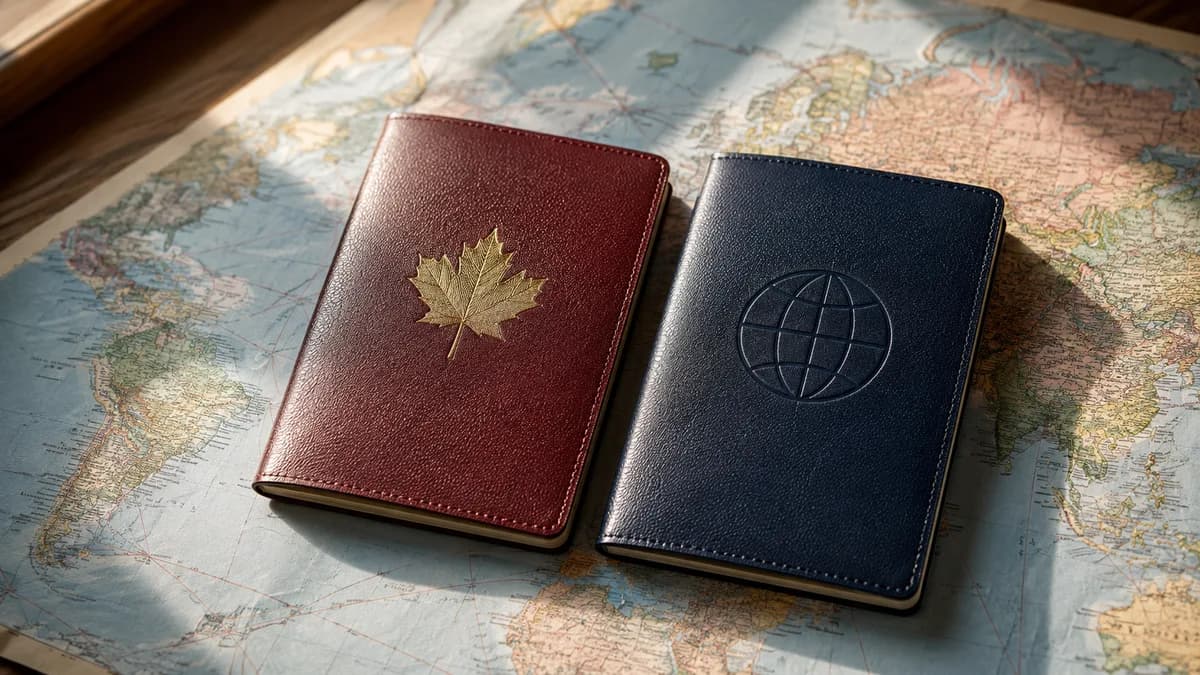
A Canadian citizen can have as many passports as citizenships: Canada limits neither the number of nationalities its citizens hold nor the number of foreign passports they carry. Two, three or more passports are therefore legal on the Canadian side, provided each other country also accepts multiple nationalities. The real question is not "how many" but "which one to show at which border", because the wrong answer can leave you grounded at the gate. Here are the rules, the special case of a second Canadian passport, and a few figures on passports in Canada.
No limit on the Canadian side
Since 1977, the Citizenship Act has let a Canadian acquire or keep other nationalities without losing their own. It does not count them: two, three or four citizenships are treated the same way, and no one will ask you to choose. A child born in Toronto to a French mother and a Moroccan father can thus hold three passports from birth, and a new citizen who takes the oath keeps every passport they had the day before. Our article on dual citizenship in Canada explains what that position involves.
The limit always comes from the other country. Some states forbid dual nationality or withdraw it automatically from anyone who acquires another: India, China, Singapore, Malaysia, Saudi Arabia, and Japan, which asks you to choose as an adult. Others have allowed it recently, such as Germany in 2024. Before counting your passports, check the rule of each country that issued you one, because that country decides whether yours is still valid after your Canadian ceremony.
The golden rule: each country wants to see its own passport
Holding several passports creates one simple obligation: you enter and leave a country on that country's passport when you are its citizen. Canada requires it to board a flight bound for Canada, with a single exception, Canadian-Americans, who may present their U.S. passport. The United States requires its citizens to enter and leave on a U.S. passport. Many other countries apply the same rule to their nationals, sometimes with exit permits. A Canadian who shows up at the Air Canada counter in Paris with only their French passport will be denied boarding, unless they have obtained an emergency special authorization from IRCC.
In practice, travel with all your valid passports, and use them consistently: the passport you leave a country on should be the one you entered it on, so that entry and exit records close cleanly. Between two third countries, pick the one that spares you a visa. The Canadian passport gives visa-free or electronic-authorization access to around 180 countries and territories, which often makes it the best choice, except for countries that waive visas for your other nationalities. Our article on U.S. visas for Canadians covers the most frequent case.
Two Canadian passports at once: possible, but restricted
Canada issues, in principle, one passport per person. A second Canadian passport, with limited validity, can be granted in specific situations: your passport is tied up at an embassy for a visa application while you need to travel, or you are going to countries whose entry requirements clash, for example a stamp from one that blocks entry to the other. The application goes through Passport Canada with a letter explaining the need, and the second document stays valid for the time required. It is not a convenience option: most travellers will never need one.
Triple citizenship: same answer
Canada allows triple citizenship, and more, exactly as it allows dual: no provision sets a ceiling. What changes with three passports is complexity. Each country may claim taxes, military service, consular registration or the use of its passport at its borders, and Canadian consular help can be limited in a country that regards you as its citizen only. Do your homework before each trip to a country whose nationality you hold, and keep every passport current: one expired document in a family of three is a classic cause of trouble at the airport.
Giving up one of your nationalities remains possible, but rarely useful: the procedure is done with the country concerned, often for a fee, and it is hard to reverse. Most Canadians who hold several passports keep them all, and simply learn which one to take out at each counter. The only case where the question truly arises is a country that forces a choice, such as Japan, or that demands military service from its nationals.
How many Canadians have a passport, and what yours contains
About 67% of Canadians hold a valid passport, more than 27 million passports in circulation according to Passport Program data for 2025-2026, one of the highest rates in the world, driven by the proximity of the United States. The Canadian passport contains no printed address: moving house requires no action, unless an application is being processed, in which case you must notify Passport Canada. It is renewed online or by mail for most adults, with a validity of five or ten years.
If you have just obtained citizenship, this is the time to apply for your first Canadian passport: the required documents, the guarantor, the photos and the timelines are detailed in our guide on the Canadian passport after citizenship. Keep your citizenship certificate safe, as it remains the only accepted proof for every new application.
Key takeaways
- On the Canadian side, no limit: as many passports as citizenships, including three or more.
- The limit comes from other countries: check that each one accepts multiple nationalities.
- To fly to Canada, the Canadian passport is mandatory (except a U.S. passport for Canadian-Americans).
- A second Canadian passport exists only for specific needs, with reduced validity.
The Canadian passport is one of the most concrete benefits of citizenship. If you are not there yet, our guide on how to become a Canadian citizen and our practice exams take you all the way to the ceremony.