
How to Apply for a Canadian Passport After Your Citizenship Ceremony
New citizen? You can apply for a passport as soon as you have your certificate: form PPTC 153, guarantor, photos, 2026 fees and timelines.
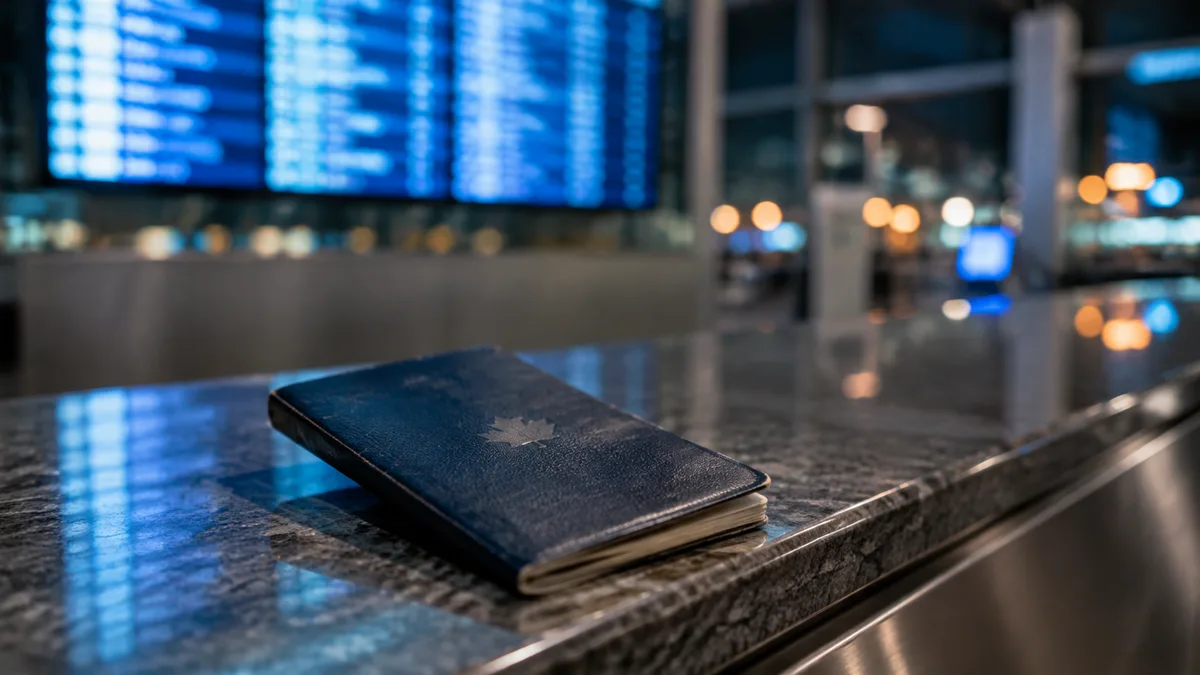
You can file your Canadian passport application as soon as your citizenship certificate is in your hands, sometimes the same day as the ceremony. The Passport Program imposes no waiting period after the oath. What slows most new citizens down is not an administrative rule: it is the photos, the guarantor and the form, three things that take about a week once you know the right order.
The passport is usually the first line on the list of tasks that follow the oath. For the full picture, our complete checklist of what to do after the ceremony also covers your health card, driver's licence, social insurance number and voter registration. This article stays on one file, the first Canadian passport, and on what actually causes applications to fail.
One detail surprises many new citizens: since the electronic travel authorization rules took effect in 2016, a Canadian with dual citizenship can no longer board a flight to Canada on their other passport, unless that passport is American. If travel is in your plans, the Canadian passport is not a nice-to-have document, it is your way home.
When can you apply after the ceremony?
As soon as the citizenship certificate is in your hands, with no minimum delay. There is no cooling-off period, no extra residency requirement and no letter from IRCC to wait for. The one triggering event is receiving the certificate, because that is the document proving you are a citizen.
The format of your ceremony shapes the calendar. At an in-person ceremony, the paper certificate is handed to you at the end, after the oath and the anthem, and you surrender your permanent resident card on the way out. At a virtual ceremony, the electronic certificate arrives by email, usually within a few days. Our article on the citizenship ceremony and the oath walks through both formats.
One piece of common sense before you book anything: do not pay for a non-refundable ticket until the passport is in your mailbox. Published timelines are service standards, not guarantees, and an incomplete application goes back to the end of the queue. The same caution applies to weddings, funerals and work commitments abroad.
Your citizenship certificate is the only accepted proof of citizenship
The citizenship certificate is the document the Passport Program requires as proof of citizenship, and nothing substitutes for it. Your confirmation of permanent residence, the IRCC decision letter and the commemorative certificate handed out as a keepsake at the ceremony are all refused. Plenty of files come back for that single confusion.
You must submit the original, not a photocopy. The office processes it and returns it to you by mail, separately from the passport, which is why the two documents do not arrive on the same day. If you received an electronic certificate as a PDF, print it exactly as instructed on canada.ca and store the original file somewhere safe, because you will need it again at every renewal.
Check every character of your name, your date of birth and your place of birth as soon as you receive it. The passport will be issued in exactly the name printed on the certificate, with no interpretation. A transcription error is corrected by IRCC, not at the passport counter, and that correction takes weeks. We cover the process, including lost and stolen certificates, in our guide to the Canadian citizenship certificate.
Which form: PPTC 153 for adults, PPTC 155 for children
A new citizen aged 16 or over fills in form PPTC 153, the adult general passport application; for a child under 16, the form is PPTC 155. Both versions apply to applications filed in Canada or in the United States.
In either case this is a first application, never a renewal, even if you already hold a passport from another country. Simplified renewal is reserved for people who already have a Canadian passport that is valid or recently expired. That is also why the online service, which exists for renewals, is not open to you for this first document.
Download the current version from the passport section of canada.ca rather than from a third-party site, because forms change and an outdated version can be refused. Fill it on screen to avoid legibility problems, print it on white letter-size paper, single sided, then sign in ink inside the box provided. A signature that spills outside the box is a common reason for return.
The documents to gather before you start
A first adult application in Canada needs six things: the signed form, the original citizenship certificate, valid identification, two compliant photos, contact details for two references and the payment. Gathering everything before you reach the counter avoids the second trip, which is the most common waste of time.
- Form PPTC 153, completed and signed, with the guarantor section filled in by the guarantor and not by you.
- The original citizenship certificate, or a printout of the electronic certificate produced according to the instructions on canada.ca.
- Valid government-issued identification showing your photo and signature: a provincial driver's licence, a provincial photo card or an equivalent document. Remember that you hand in your permanent resident card at the ceremony, so it can no longer serve as ID.
- Two identical photos taken within the last six months by a commercial photographer, one of them signed on the back by your guarantor.
- Full contact details for two references, with address and phone number, so the office can reach them during processing.
- Payment of the fee, calculated from the validity period you choose and any optional services.
Photograph or copy the whole package before sending it. If something goes missing in transit, you will know exactly what you declared, and the certificate number will be useful for any later dealings with IRCC.
What passport documents do I need? The five-line list
- Proof of citizenship: your citizenship certificate (or, for someone born in Canada, a provincial birth certificate).
- A valid piece of ID with photo and signature: driver's licence, an accepted health card, a still-valid permanent resident card.
- Two identical passport photos taken by a professional photographer, one signed on the back by the guarantor.
- A guarantor who has known you for at least two years and two references who can be reached.
- Form PPTC 153, completed and signed, and payment of the fee.
One question comes up often after a move: how do you change the address in your passport? The answer is that there is nothing to change. The Canadian passport contains no printed address; only an application in progress requires you to notify Passport Canada. And if you already hold a foreign passport, note that Canada does not limit the number of passports a citizen holds: our article on how many passports you can have explains which one to show at each border.
Guarantor and two references, in plain language
A guarantor is someone who holds a Canadian passport, has known you for at least two years and certifies that you are the person in the photo. This is not a financial sponsor: no money is involved and the guarantor takes on no responsibility for your travel. They confirm your identity, nothing more. To qualify, they must:
- be 18 years of age or older at the time of signing;
- hold a Canadian passport issued for 5 or 10 years that is valid or expired less than a year ago;
- have known you personally for at least two years;
- not be a member of your family, and not be one of your two references;
- be reachable by phone while the application is processed.
The guarantor completes their own section of the form, enters their passport number and dates, then signs the back of one of the two photos with the required wording. This is the part of the file people rush most often, and a single blank box in that section is enough to send the whole application back to you.
No one in your circle meets those conditions? That is common for newcomers whose Canadian network is still young, and it is not a dead end. A statutory declaration in lieu of guarantor, form PPTC 132, can be signed in front of a commissioner for oaths, a notary public or a justice of the peace. Plan for an appointment and a modest fee.
The two references are separate people from the guarantor. They must be 18 or older, have known you for at least two years, not be family members and give a current address and phone number. Tell them you have listed them: an unanswered call from the passport office slows the file down for everyone.
Photos: the number one reason files come back
Photos must measure 50 mm by 70 mm, be less than six months old and come from a commercial photographer who writes their name, address and the date on the back. Booth photos and pictures taken on a phone are refused. The remaining requirements are just as precise:
- two identical prints, unretouched, on matte or glossy photo paper;
- face square to the camera, neutral expression, mouth closed, eyes open and clearly visible;
- face height between 31 mm and 36 mm, measured from chin to crown;
- plain, light-coloured background with no shadows or patterns;
- glasses removed, even non-prescription ones; head coverings allowed only for religious or medical reasons, with the face fully visible;
- on the back of one print only, the certification wording signed by your guarantor.
Tell the photographer it is for a Canadian passport, not a visa and not a US document. The formats differ, and a studio that hands you 2 inch by 2 inch prints costs you three weeks. Check the size, the date and the studio stamp on the back before you leave the shop, while fixing it is still free.
2026 fees: five years or ten years
In Canada, an adult passport costs $120 for five years and $160 for ten years, and a passport for a child under 16 costs $57. These are the amounts posted on canada.ca in August 2026. Fees are reviewed periodically, so confirm them on the official Canadian passport page before you prepare payment.
- Adult 16 and over, 5-year validity: $120.
- Adult 16 and over, 10-year validity: $160.
- Child aged 0 to 15, maximum 5-year validity: $57.
- Express service, 2 to 9 business days: $50 extra.
- Urgent service, pickup the next business day: $110 extra.
- Pickup at a passport office: $20 extra.
The arithmetic is simple for an adult: ten years at $160 works out to $16 a year, against $24 a year for the five-year option. The shorter version makes sense in two situations, when this month's budget is tight and when your appearance or your name may change, for instance after a marriage. Otherwise the ten-year passport is the cheaper choice.
Fees are not refundable once the application has been processed, including if it is refused. Budget for the extras too: roughly thirty dollars of photos, the statutory declaration before a notary if you need one, and tracked postage. Keep in mind that some countries require a passport valid for at least six months beyond your return date.
Processing times and the urgent passport route
Allow 10 business days for an application submitted in person at a passport office and 20 business days for one filed at a Service Canada Centre or by mail, counted from the day the file is received. These are published service standards, not individual promises.
They do not include mailing time in either direction, statutory holidays or the extra days needed if part of your file has to be verified. Translated into calendar weeks, a mailed application often takes five to six weeks between the moment you drop the envelope and the day the passport lands in your mailbox.
Three faster routes exist, all limited to in-person submission at a passport office and all conditional on proof of travel: urgent service with pickup the next business day, express service in two to nine business days, and simple pickup at the office. The proof has to be concrete, such as a ticket, a confirmed itinerary or an official summons. Travel plans without a booking do not qualify.
Always check the current timelines and the services offered by the specific office before you travel to it, since both shift with the season and March through July remains the busiest stretch of the year. Some service points take urgent applications by appointment only.
In person or by mail?
In person if you are travelling within three months or if your file has any wrinkle at all; by mail if you are in no rush and no service point is near you. The decision is about error risk as much as speed.
The counter offers more than a shorter timeline. An agent checks your photos, your signature and the guarantor section in front of you, and you leave with a receipt and a file number you can use to follow progress. Most of the errors that send an application back are solved in thirty seconds at the counter, while the same errors cost weeks by mail.
By mail, send the complete package to the Passport Program address printed on the form, using a tracked service. You are trusting your original citizenship certificate to the postal system, which easily justifies the few extra dollars for tracking. Note that no first passport application can be filed online in Canada: the online service exists, but it is limited to renewals.
Filing at a Service Canada Centre is a reasonable middle ground. There are many of them, including in smaller communities, and an agent reviews your documents before they are forwarded. The standard is still 20 business days, though, and not every office offers the faster services.
Passports for a child who became a citizen
A child under 16 needs their own passport, their own citizenship certificate and form PPTC 155: they cannot be added to a parent's passport. That practice ended in Canada long ago, at every age.
The application is signed by a parent or guardian, who must prove the relationship, usually with the child's birth certificate or citizenship certificate. Both parents have to be listed on the form, and any custody, guardianship or access order must be attached if one exists. Maximum validity is five years regardless of age, and a child's passport cannot be extended: when it expires, a complete new application is required.
The child's photo follows the same size rules, with some tolerance on expression for the youngest. An infant may have their mouth open, but they must be alone in the frame, with no adult hands visible, against a light background. Expect that a passport taken at age two will not look much like the same child at seven, which occasionally prompts a question at the border: that is normal and worth anticipating.
If your child became a citizen alongside you, they received their own certificate at the ceremony. Store it with yours rather than in a school folder, because it will be needed for school registration, for health coverage and for every passport renewal until they turn 16.
Mistakes that get an application sent back
The vast majority of returned files fail on form, not on substance: a non-compliant photo, a misplaced signature, an incomplete guarantor section. None of these errors puts your citizenship in doubt, but each one costs weeks and sometimes a trip.
- Sending a photocopy of the citizenship certificate instead of the original, or an electronic certificate printout that ignores the official instructions.
- Photos that are too old or the wrong size, especially the square format used in the United States.
- A signature that spills outside the box, is written in pencil, or looks nothing like the one on your ID.
- An ineligible guarantor: a family member, a passport expired more than a year ago, or someone who has known you for less than two years.
- References who cannot be reached, whose details are incomplete, or who are the same person as the guarantor.
- A name that does not match across the certificate, the ID and the form, a frequent issue after a marriage or a legal name change.
- Crossed-out text or correction fluid: in that case the form has to be redone cleanly.
- The wrong fee amount, for instance the five-year price paid for a ten-year application.
Reading the form out loud takes ten minutes and can save you three weeks. If any box still leaves you unsure, go to the counter instead of mailing it: the question gets settled on the spot, with the people who will handle your file.
Your timeline, from ceremony to passport in hand
A well-prepared file takes about a week of legwork; everything after that is processing time. Here is the sequence that works for most new citizens, adjusted to your guarantor's availability.
- Ceremony day: you receive the certificate, hand in the permanent resident card, and immediately check the spelling of your name and your date of birth.
- Days 1 and 2: photos at a commercial studio, form PPTC 153 completed on screen, decision between five and ten years of validity.
- Days 3 to 5: meet your guarantor for the declaration and the signature on the back of the photo, and call both references to warn them.
- Days 5 to 7: submit in person or mail with tracking, pay the fee, and keep the receipt and file number.
- Weeks 2 to 6: processing, then the passport arrives and, separately, the citizenship certificate comes back by mail.
If travel is already booked, reverse the order: start by securing an appointment at a passport office that offers urgent service, then organize your documents around that date. Bring the proof of travel on the day, because without it the faster processing is refused no matter what you paid.
The passport is only one box on the list. Once the application is filed, move on to the other steps in our guide to what comes after the citizenship ceremony: updating your records with provincial services, your social insurance number, and above all getting on the voters list, which does not happen automatically after the oath.
And if someone around you is still at the test stage, send them something to practise with: timed mock exams, chapter quizzes and spaced review that brings missed questions back until they stick. It is exactly the road you have just finished.