
How to Vote for the First Time as a New Canadian Citizen
New Canadian citizen? Here is how to register with Elections Canada, what ID to bring, and how federal, provincial and municipal voting differ.
To vote in a Canadian federal election you must be a Canadian citizen, be at least 18 years old on election day, and be able to prove your identity and your address. Your ceremony took care of the first condition the moment you took the oath: all that is left is confirming your registration and showing up in the right place.
The right to vote starts immediately. There is no waiting period, no probation, no form to get approved. Someone sworn in at ten in the morning can vote that same afternoon if an election happens to fall on that day. What actually stops new electors is almost never eligibility: it is registration and identification. For the bigger picture of what to sort out in the weeks after the oath, our full post-ceremony checklist walks through each item.
This article follows the real order of operations: check whether you are already on the National Register of Electors, understand the card that arrives in the mail, get your ID ready, choose how you want to vote, then know what waits for you behind the voting screen. The federal rules described here come from Elections Canada, the independent, non-partisan agency that runs federal elections. Exact dates change with every election, so confirm them on elections.ca as soon as a vote is called.
Who can vote in a federal election
Any Canadian citizen who will be 18 or older on election day can vote, no matter how recently they became a citizen. The Discover Canada guide sums the rule up in three conditions, and the citizenship test asks about them regularly.
- Be a Canadian citizen. Citizenship by naturalization takes effect the moment you take the oath, not when the certificate reaches your mailbox.
- Be 18 on election day. The election date is what counts, not the date you registered. If you turn 18 by election day, you may vote at an advance poll a few days earlier.
- Be on the voters list, or add yourself to it, including right at the polling place on the day itself.
- Be able to prove your identity and address with documents Elections Canada accepts.
One detail surprises many new electors: you do not vote for a prime minister. You vote for a candidate in your riding, one of the 343 electoral districts the country has used since the redistribution first applied at the April 2025 election. The party that holds the confidence of the House of Commons forms the government, and its leader becomes prime minister. That mechanism is unpacked in our guide to how federal elections actually work.
Your vote is secret and the law protects it. Nobody may look at your ballot or demand to know how you voted: not an employer, not a neighbour, not a family member.
Conversely, as long as you were a permanent resident you could not vote at any level, and international students or foreign workers cannot either. The full list of who is excluded, and of who votes despite common belief, such as prisoners and Canadians abroad, is in our article on who cannot vote in Canada.
Are you already registered? Check the National Register of Electors
Check your registration online at elections.ca: the voter registration service tells you within minutes whether you are on the National Register of Electors and at which address. It is the only reliable confirmation, before or after a ceremony.
The National Register of Electors is a permanent database of Canadians who are qualified to vote. Elections Canada estimates it covers roughly 96% of eligible electors, though address accuracy runs lower, for the simple reason that people move faster than databases update. Every voters list used in every polling place is drawn from this register.
Registration is not mandatory in Canada and is not a condition of eligibility. An unregistered elector can still vote, but has to complete the paperwork on the spot, which lengthens the wait both for them and for the line behind them. Registering ahead of time simply makes your day easier.
- Online, at elections.ca, using a scanned piece of ID that proves your address.
- By mail, returning the registration form filled out and signed.
- At an Elections Canada office, which opens in every riding during a campaign.
- At the polling place, on election day or during advance voting.
Two habits pay off. First, tick the box on your income tax return that authorizes the Canada Revenue Agency to pass your name, address, date of birth and citizenship to Elections Canada: it is the easiest way to stay current year after year. Second, update your address after every move, or your voter card will go politely to whoever lives in your old place.
The registration offer at your citizenship ceremony
Many new citizens land on the Register through a consent box on their citizenship application, or through a form handed out on ceremony day. Neither one is automatic, and neither one is required.
The citizenship application form contains an explicit consent: you authorize Immigration, Refugees and Citizenship Canada to share your name, address, date of birth and citizenship date with Elections Canada once you become a citizen. If you ticked that box, your file moves along without any further action from you.
At the ceremony itself, new citizens often receive a package: the certificate, information materials and, depending on the venue and the timing, a voter registration form. Filling it in takes about a minute. Declining it has no effect whatsoever on your citizenship or your rights, since registration stays voluntary.
Either way, allow several weeks for processing. That is exactly why the online check still matters: ticked box or not, consent does not replace confirming your status on elections.ca before a vote.
What the voter information card is really for
The voter information card is mailed to registered electors after an election is called. It confirms your registration and tells you where and when to vote, but it does not replace a piece of ID.
- Your name and the address you are registered at.
- The address of your election day polling place, with its opening hours.
- The address and dates of your advance polling place, which is often somewhere else entirely.
- Elections Canada contact details and accessibility information for the venue.
Bring it: it speeds up finding your name on the list and saves you hunting for the right table. Bring your identification too, because the card alone will not carry you through the verification step.
If the card does not arrive within days of the election being called, or if your name is misspelled on it, use the online service or call Elections Canada. A card addressed to a previous occupant must never be used to vote: report it to Elections Canada instead, so the register can be corrected.
What ID to bring to the polling place
Elections Canada accepts three combinations: one government-issued piece with your photo, name and current address; two documents with your name, at least one showing your current address; or a written declaration backed by a voucher.
- Option 1, one piece. A driver's licence, or any card issued by a federal, provincial, territorial or municipal government that carries your photo, your name and your current address.
- Option 2, two documents. Both must show your name and at least one must show your current address. Common examples: Canadian passport, citizenship certificate or card, provincial health card, utility bill, bank statement, lease, notice of assessment, government benefit statement, student card, library card.
- Option 3, declaration and voucher. With no proof of address, you may sign a written declaration and ask an elector registered at the same polling station to vouch for you. That person must show their own ID and can vouch for one person only.
Two details matter especially for new citizens. Your citizenship certificate proves your name but never your address, so pair it with a recent bill or statement. And your PR card no longer proves anything about your status once you have taken the oath, a point covered in what happens to your PR card.
Some electronic documents shown on a phone, such as a paperless bill or statement, are accepted. The full list is authorized by the Chief Electoral Officer and can change from one election to the next, so review the official list of accepted ID before you head out.
The four ways to cast your ballot
You can vote on election day, during advance polls, at any Elections Canada office in the country, or by mail. All four routes end the same way: a counted ballot.
- On election day. Polls stay open twelve hours, staggered by time zone so results land at roughly the same moment across the country. You vote at the location printed on your card, and nowhere else.
- At advance polls. Four consecutive days, from the tenth to the seventh day before election day, usually 9 a.m. to 9 p.m. This is the practical option if you work or travel on election day.
- At an Elections Canada office. There is one in every riding during the campaign. You vote there by special ballot, until 6 p.m. on the sixth day before election day, even if you are far from home.
- By mail. You apply for a special ballot voting kit online or in person, before that same deadline, and return the completed ballot early enough for it to arrive before polls close.
One rule is worth memorizing: once your special ballot application is approved, you cannot vote any other way, even if the kit reaches you late. Only ask for a mail-in ballot if you are genuinely sure you cannot get to a polling place.
Dedicated services also exist for residents of long-term care homes, hospital patients, people in correctional institutions and, depending on the election, students on selected campuses. If you need help marking your ballot, an election worker or a person of your choice may assist you, and tools such as the tactile voting template are available on request.
What actually happens in the voting booth
Voting in person takes about five minutes once your turn comes, and it unfolds the same way from coast to coast.
- You go to the table for your polling division and give your name and address.
- You show your ID. The worker finds your name on the list and strikes it off.
- You receive a folded ballot with the poll worker's initials on the back.
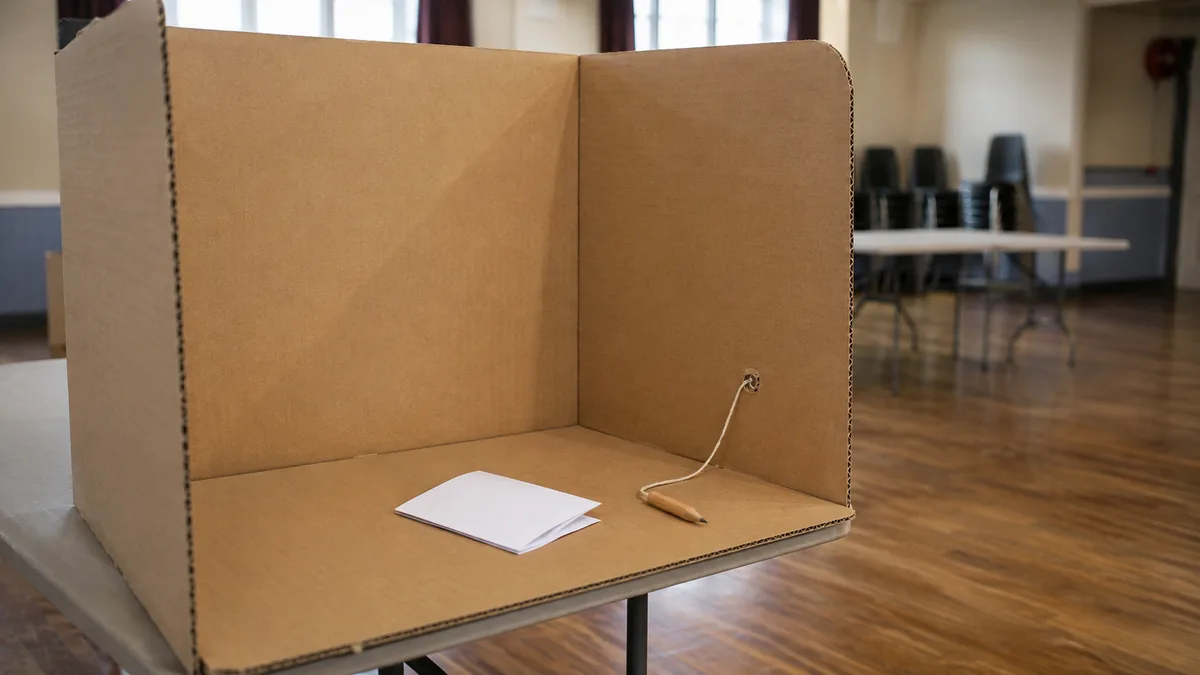
- You step behind a cardboard screen, alone and out of sight.
- You mark an X in the circle beside the name of one candidate, using the pencil provided or your own pen.
- You refold the ballot along its original creases and return to the table.
- The worker tears off the numbered counterfoil without unfolding the ballot, and you drop it into the box yourself.
If you make a mistake or damage your ballot, do not put it in the box: hand it back and ask for another one. The spoiled ballot is cancelled and replaced, and nobody will ask you why.
Ballot secrecy is protected by law. Do not photograph your marked ballot and do not show it to anyone, since both are prohibited. No one, at the polling place or anywhere else, may tell you how to vote, and election workers are held to strict neutrality.
Your employer must give you time to vote
The Canada Elections Act guarantees every employed elector three consecutive hours to vote while polls are open, with no deduction from pay.
The rule does not require your employer to hand you three hours off. It requires your schedule to leave three consecutive hours free while the polls are open. If it already does, there is nothing to request and nothing to grant.
Here is a concrete example. In the Eastern time zone, polls run from 9:30 a.m. to 9:30 p.m. If you work from 8 a.m. to 6 p.m., you still have three and a half hours after work, so your employer owes you nothing. If you work from 9 a.m. to 7:30 p.m., only two hours remain, and your employer must release you early enough or late enough to reach three consecutive hours.
The employer chooses when that time is granted, but cannot cut your pay or penalize you for it. A few categories of freight and passenger transport employees are exempt. Provincial, territorial and municipal elections apply their own time-off rules, often similar but rarely identical.
Federal, provincial, municipal: three separate registrations
Being registered with Elections Canada does not register you for your province's elections or your city's. Each level has its own agency, its own voters list and its own rules.
- Federal. Elections Canada. You elect the member of Parliament for your riding, who sits in the House of Commons.
- Provincial or territorial. Élections Québec, Elections Ontario, Elections BC and their counterparts. You elect the representative for your provincial riding, called an MPP, MLA, MNA or MHA depending on where you live.
- Municipal. The rules are set by provincial law and the vote is run by your city. You elect a mayor and councillors, and in some provinces school trustees.
Conditions vary between levels more than people expect. Being 18 and holding Canadian citizenship are required everywhere, but the definition of residency shifts, and provinces such as British Columbia and Nova Scotia let non-resident property owners vote in the municipality where they own property. Check with your provincial election agency rather than assuming the federal rule applies across the board.
The calendar differs too. Several provinces run on fixed dates: Quebec's next general election is set for October 5, 2026, and Ontario municipalities vote on October 26, 2026. Federally, the next fixed date falls in the autumn of 2029, but an early dissolution is always possible, which is why it pays to keep your registration current all the time rather than at announcement time.
This three-level split is exactly the one the citizenship test made you learn. You now meet it in your mailbox, as three different envelopes arriving years apart.
Voting from outside Canada
A Canadian citizen aged 18 or over who lives abroad can vote by special ballot, with no limit tied to length of absence since the 2018 legislative changes and the Supreme Court decision of 2019.
The route runs through the International Register of Electors. You apply for a special ballot online or by mail, with proof of identity and citizenship, listing your last residential address in Canada: that address decides which riding your vote is counted in.
A special ballot carries no printed list of names. You write in, by hand, the first and last name of the candidate in your riding, not the name of a party. Check the official list of confirmed candidates before you write anything down.
Deadlines are tight. Your application must arrive before 6 p.m. Eastern time on the sixth day before election day, and the completed ballot must reach Elections Canada in Ottawa before polls close on election day. Leave generous room for international mail, and reapply for each general election.
If you live abroad and your family grows there, note that passing on citizenship follows a separate set of rules, summarized in citizenship rules for a child born abroad.
If your name is not on the voters list
You can register on the spot at the polling place, on election day or at an advance poll. Do not walk away without voting.
This is the most common situation for new citizens. The registration sent after your ceremony has not been processed yet, or you moved recently, or your name sits on the register with a slightly different spelling than the one on your ID. None of those situations takes away your right to vote.
- Your ID, matching one of the three accepted options.
- A few minutes to complete a short registration form, no more than that.
- Failing proof of address, a voucher registered at the same polling station who signs a declaration with you.
If something goes wrong, ask for the site supervisor before you leave. You can also reach Elections Canada at 1-800-463-6868 during an election period, in both official languages, to have your file checked.
From the Discover Canada guide to the ballot box
Discover Canada presents voting both as a right protected by the Charter and as a responsibility of citizenship, and the citizenship test asks about both sides.
The official guide lists six responsibilities: obeying the law, taking responsibility for yourself and your family, serving on a jury, voting in elections, helping others in the community, and protecting our heritage and environment. Voting is the only one with fixed dates, exercised a handful of times per decade, and it is also the one the largest number of citizens skips: turnout at the April 2025 federal election came in around 69% according to Elections Canada.
The exam questions on this topic become obvious once you have voted once: who may vote, at what age, who you vote for in a federal election, what the responsibilities of citizenship are, what the three levels of government are. If you are still preparing for the test, work through those chapters one at a time, then let spaced review bring back whatever slips and take a timed mock exam to confirm it holds.
One historical marker the test often asks about rounds out the picture: most Canadian women aged 21 and over gained the federal vote in 1918, and the franchise only became genuinely universal over the course of the twentieth century. The very ordinary act you will perform behind a cardboard screen took a long time to reach everyone.
Your first vote, in practice
The first vote is the only one that takes preparation. Once your registration is confirmed and your two pieces of ID are identified, later elections need nothing more than a reminder in your calendar. Do the check today, while no campaign is running: that is when the Elections Canada online service answers fastest.
And if other post-ceremony tasks are still waiting, a passport application, record updates, replacing old documents, go back to our after-ceremony guide, which puts them in order from the day after the oath through the months that follow.