
Nova Scotia on the Citizenship Test: Key Facts
Halifax is Nova Scotia's capital, an Atlantic province and 1867 founder. History, Bay of Fundy, practice questions and common traps on the citizenship test.
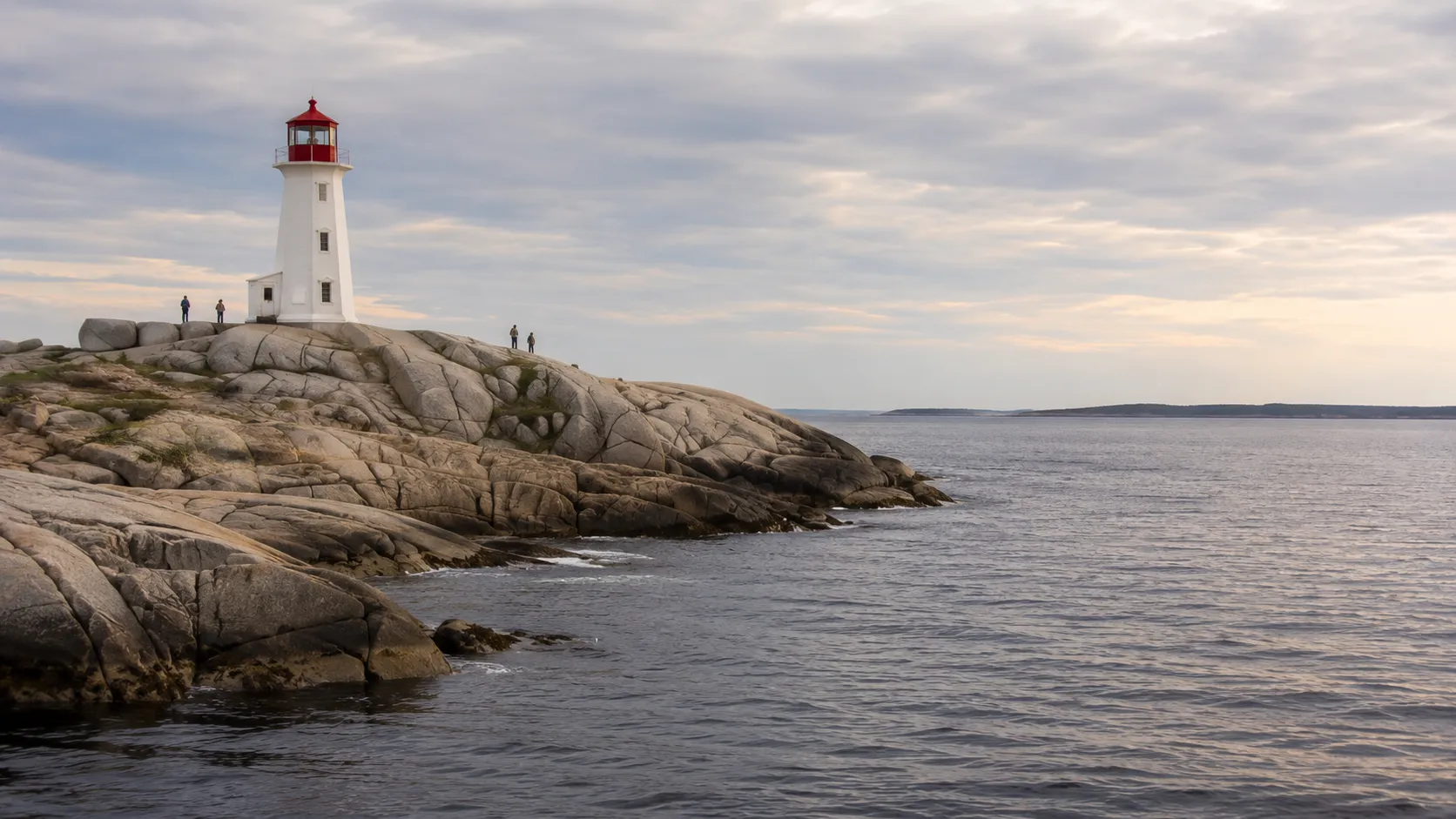
Nova Scotia's capital is Halifax, a province in the Atlantic Canada region that has been part of Confederation since 1867. The name Nova Scotia means New Scotland, a nod to its strong Scottish and Gaelic heritage. Halifax is a major Atlantic seaport and home to Canada's east-coast naval base. These facts come up regularly on the citizenship test, along with the Bay of Fundy tides, the Halifax Explosion of 1917 and the history of the Acadians and the Mi'kmaq. This guide gathers the essentials from the official Discover Canada guide, with a timeline, the people to know, practice questions and the traps to avoid.
Capital and Region of Nova Scotia
Halifax is the capital of Nova Scotia and the province's main urban centre. It is also one of the most important ports on Canada's Atlantic coast, open all year thanks to its ice-free waters. The city plays a key military role, as it is home to the country's east-coast naval base, just as Esquimalt in British Columbia hosts the west-coast base. The Halifax Regional Municipality also includes Dartmouth, across the harbour. Its neighbour Prince Edward Island also has its own page, with Charlottetown and the 1864 Conference.
Nova Scotia is part of the Atlantic Canada region, along with New Brunswick, Prince Edward Island and Newfoundland and Labrador. It is the most populous of the four. Almost entirely surrounded by the ocean, it is joined to New Brunswick by a narrow isthmus, and Cape Breton Island forms its northeastern part. This maritime position has shaped its history, economy and culture.
Timeline: From the Mi'kmaq to Modern Nova Scotia
The Mi'kmaq have lived in the region for thousands of years and still do. The first Europeans to settle permanently were the French: in 1604 and 1605, Pierre Dugua de Mons and Samuel de Champlain founded Port-Royal in Acadia, one of the first permanent European settlements north of Florida. The Acadian colony then grew around the Bay of Fundy, where Acadians built dykes to farm the land.
- 1605: the French found Port-Royal, the beginning of Acadia
- 1713: the Treaty of Utrecht hands Acadia to Great Britain
- 1749: the British found Halifax as a military stronghold
- 1755 to 1763: the deportation of the Acadians, known as the Great Upheaval
- 1758: Canada's first elected assembly meets in Halifax
- 1848: Nova Scotia becomes the first colony to win responsible government
- 1867: founding province of Confederation
- 1917: the Halifax Explosion
- 1928 to 1971: Pier 21 welcomes hundreds of thousands of immigrants
For the test, two dates stand out: 1867 for Confederation and 1917 for the Halifax Explosion. The 1755 deportation and the first elected assembly of 1758 are also facts the official guide highlights, because they mark the start of parliamentary democracy in Canada and one of the most painful episodes in its history.
History and Joining Confederation
Nova Scotia is one of the four founding provinces of Canada in 1867. Together with Ontario, Quebec and New Brunswick, it took part in the creation of the Dominion of Canada. The year 1867 is essential to remember for the exam. The colony had already led the way before that: Canada's first elected representative assembly met in Halifax in 1758, and Nova Scotia was the first colony to achieve responsible government, in 1848.
The province has a rich and at times tragic history. In 1917, the Halifax Explosion, caused by the collision of two ships, one loaded with munitions, devastated the city and remains one of the largest human-made explosions before the nuclear age. A few years earlier, in 1912, Halifax had received the bodies of many Titanic victims. The region also carries the history of the Mi'kmaq, of the Acadians deported in 1755, and of the Loyalists, including Black Loyalists, who arrived after the American Revolution.
People and Places from Nova Scotia in Discover Canada
The official guide links several names to the province. Joseph Howe, a Halifax journalist and politician, was the leading champion of responsible government in the 1840s. Alexander Graham Bell, inventor of the telephone, spent part of his life in Baddeck on Cape Breton Island, where a museum now bears his name. Viola Desmond, a Halifax businesswoman who refused to accept segregation in a movie theatre in 1946, appears on the ten-dollar bill.
As for places, Pier 21 in Halifax is now the Canadian Museum of Immigration: more than a million newcomers first set foot in Canada there between 1928 and 1971. The guide also mentions the schooner Bluenose, engraved on the dime and built in Lunenburg, and the Peggy's Cove lighthouse. These details help with questions that match a Canadian symbol to its home province.
Geography and the Bay of Fundy
The Bay of Fundy, between Nova Scotia and New Brunswick, has the highest tides in the world. This natural phenomenon draws visitors from around the globe and reflects the close bond between the province and the ocean. The Atlantic coast to the south is rocky and rugged, while the Annapolis Valley inland offers fertile farmland known for its orchards.
- The Bay of Fundy and its tides, the highest in the world
- The Peggy's Cove lighthouse, an iconic provincial landmark
- A long, rugged and rocky Atlantic coastline
- Cape Breton Island, its highlands and the Cabot Trail
- The Annapolis Valley and its orchards
- A maritime climate shaped by the ocean
The Peggy's Cove lighthouse is one of the most photographed scenes in Canada. This dramatic coastline is a reminder of how central the sea is to life in Nova Scotia. Remember that the Bay of Fundy is shared with New Brunswick: either province can be named in a question about it.
Population, Cultures and Heritage
The name Nova Scotia means New Scotland, and the province keeps a strong Scottish and Gaelic heritage, visible in its music, bagpipes, tartans and traditions, especially on Cape Breton Island where Gaelic is still spoken. It is also home to the history of the Mi'kmaq, the region's Indigenous people, and the French-speaking Acadians, whose communities survive in places such as Baie Sainte-Marie and Cape Breton.
Nova Scotia's Black community is one of the oldest in Canada, descended from Black Loyalists and refugees from the War of 1812. More recently, Pier 21 made Halifax a gateway for immigrants from Europe, which helps explain the province's diversity. To remember these facts, you can review them chapter by chapter in the learning section.
Economy and Cities
Fishing and shipbuilding are traditional industries in Nova Scotia, and Halifax shipyards still build vessels for the Royal Canadian Navy today. The Port of Halifax, active all year round, supports trade, defence and maritime transport. Forestry, farming in the Annapolis Valley, tourism and Halifax's universities round out an economy long oriented toward the sea.
Beyond the capital, the main cities are Sydney on Cape Breton, a former coal and steel town, Truro in the centre of the province, and Lunenburg, a port town listed as a World Heritage site. Yarmouth, at the southwestern tip, is a historic fishing port. The province's culture blends Scottish, Acadian and Indigenous influences, and its traditional music festivals draw audiences from far beyond the Atlantic region.
Practice Questions About Nova Scotia
Put yourself in test conditions with these questions modelled on the official format. Pick an answer, then check the explanation.
- What is the capital of Nova Scotia? a) Fredericton b) Halifax c) Charlottetown. Answer: b) Halifax. Fredericton is the capital of New Brunswick and Charlottetown of Prince Edward Island.
- In which region of Canada is Nova Scotia? a) Central Canada b) the Prairies c) Atlantic Canada. Answer: c) Atlantic Canada.
- True or false: the highest tides in the world are in the Bay of Fundy. Answer: true, between Nova Scotia and New Brunswick.
- In what year did the Halifax Explosion happen? a) 1867 b) 1912 c) 1917. Answer: c) 1917, during the First World War.
- What does the name Nova Scotia mean? a) New France b) New Scotland c) New Ireland. Answer: b) New Scotland, because of its Scottish heritage.
- True or false: the deportation of the Acadians began in 1755. Answer: true, and it continued until 1763.
At least five out of six right? You are ready on this province. If not, go back over the timeline and then practise with a free mock exam in 45 minutes, no signup required.
Common Mistakes: Halifax and the Other Atlantic Capitals
The most common trap is mixing up the four Atlantic capitals. Halifax goes with Nova Scotia, Fredericton with New Brunswick, Charlottetown with Prince Edward Island and St. John's with Newfoundland and Labrador. Here are the other mix-ups we see among candidates.
- Halifax versus Fredericton, Charlottetown and St. John's: four provinces, four different capitals.
- Charlottetown, 1864: the conference that paved the way for Confederation was held in Prince Edward Island, not Nova Scotia.
- Bay of Fundy: bordered by both Nova Scotia and New Brunswick, so either can be the answer depending on the question.
- Acadians versus Quebecois: Acadians are the French speakers of Atlantic Canada, deported in 1755; the Quebecois live in Quebec.
- Pier 21: in Halifax, not in Montreal or Quebec City.
- Peggy's Cove: a fishing village and a lighthouse, not a major city.
For the Atlantic capitals, a simple trick works well: learn them as a list of four pairs and recite them in the same order every time you review. On test day, the right answer will come to you on its own.
What the Test Asks About Nova Scotia
Questions about Nova Scotia often focus on its capital, its region and its role as a founding province. Remember that Halifax is the capital, that the province lies in Atlantic Canada, and that it joined Confederation in 1867. The Bay of Fundy, the 1917 explosion, Pier 21 and the Scottish, Acadian and Mi'kmaq heritage complete the list.
- Provincial capital: Halifax, seaport and east-coast naval base
- Region: Atlantic Canada, the most populous province in the region
- Joined Confederation: founding province, 1867
- Meaning of the name: New Scotland
- Peoples and cultures: Mi'kmaq, Acadians (deportation of 1755), Scottish and Gaelic heritage
- Notable facts: the Bay of Fundy tides, the 1917 Halifax Explosion, Pier 21, the Peggy's Cove lighthouse, fishing and shipbuilding
The test has 20 questions, with a pass mark of 15 out of 20 in 45 minutes, based on the official Discover Canada guide, available on the Government of Canada website. Once these facts are learned, reinforce them with smart review, which reschedules the questions you missed until they stick.