
Citizenship Test: New Brunswick Facts to Know
New Brunswick facts for the Canadian citizenship test: capital Fredericton, official bilingualism, Acadians, the Bay of Fundy, and Confederation in 1867.
New Brunswick's capital is Fredericton, it sits in Atlantic Canada, and it was one of the four founding provinces of Confederation in 1867. Those three facts, capital, region, and founding year, are exactly the kind of detail the Canadian citizenship test likes to check, and New Brunswick adds one more that comes up often: it is Canada's only officially bilingual province. This guide covers those anchor facts, then goes deeper into the history, geography, cities, and people you may meet in Discover Canada, and finishes with practice questions and the mix-ups that cost candidates points.
Capital and Region
Fredericton is the provincial capital, a relatively small riverside city on the Saint John River. It is not the largest city in the province, which sometimes trips people up. The two biggest urban centres are Moncton and Saint John, while Fredericton remains the seat of government and the legislature.
Fredericton earned that role in the Loyalist era, when the young colony wanted a seat of government inland, away from the exposed coast. Today it hosts the Legislative Assembly, the University of New Brunswick, and a large share of provincial public service jobs. If a question asks where the provincial legislature sits, the answer is Fredericton, whatever the population figures say.
New Brunswick belongs to Atlantic Canada, the group of four eastern provinces that also includes Nova Scotia, Prince Edward Island, and Newfoundland and Labrador. The first three are also called the Maritimes. Knowing that regional label matters, because the study guide often groups provinces by region rather than listing them one by one. Its neighbour Prince Edward Island also has its own page, with Charlottetown and the 1864 Conference.
A Short History of New Brunswick
New Brunswick's story runs from Indigenous nations through French Acadia, British rule, the Loyalist migration, and finally Confederation. The Mi'kmaq lived mainly along the eastern and northern coasts, and the Wolastoqiyik, also called the Maliseet, along the Saint John River valley, which they call the Wolastoq. Both nations fished, traded, and travelled the rivers long before any European ship arrived, and both remain present in the province today.
French settlement began in the early 1600s, when Samuel de Champlain and his companions spent the winter of 1604 on an island in the St. Croix River. The colony that grew from these beginnings was called Acadia, and the Acadians built farms along the Bay of Fundy by diking the salt marshes. Discover Canada highlights this early French presence, so it helps to link the word Acadia with the Maritime region in your mind.
In 1755, during the struggle between Britain and France for North America, British authorities began deporting the Acadians. Thousands were forced from their homes and scattered along the Atlantic coast and beyond, in a period Acadians call the Great Upheaval. Many later returned and resettled, especially in what became northern and eastern New Brunswick, which is why the Acadian population is concentrated there today.
The next turning point came after the American Revolution. In 1783 and 1784, thousands of United Empire Loyalists, colonists who had stayed faithful to the British Crown, arrived in the Saint John River valley. Their numbers were so large that Britain carved a separate colony out of Nova Scotia in 1784 and named it New Brunswick. Discover Canada describes the province as founded by the Loyalists, and that phrase is a good one to remember.
The 19th century brought shipbuilding, timber exports, and, in 1867, Confederation. In the 20th century the province formally recognized its two founding language communities: it adopted its own Official Languages Act in 1969, and its bilingual status was later written into the Canadian Charter of Rights and Freedoms in 1982. That is the legal basis for the only officially bilingual province fact the test loves.
How New Brunswick Joined Canada
New Brunswick was one of the original members of Confederation on July 1, 1867, alongside Ontario, Quebec, and Nova Scotia. It did not join later like most western provinces did. That founding status is a common test point, so it helps to remember the original four together.
One New Brunswick name appears directly in Discover Canada: Sir Samuel Leonard Tilley. A Father of Confederation from Saint John, Tilley suggested the term Dominion of Canada in 1864, inspired by a verse in Psalm 72 that speaks of dominion from sea to sea. If the test asks who proposed the word Dominion, Tilley is the answer, and the fact conveniently ties New Brunswick to the national story.
Confederation was not universally popular in the province. Many New Brunswickers worried about being outvoted by the larger central provinces, and the question dominated local politics in the mid 1860s. The promise of an intercolonial railway linking the Maritimes to Quebec and Ontario helped win support, a pattern you will see again when British Columbia joins in 1871.
Geography and Landscape
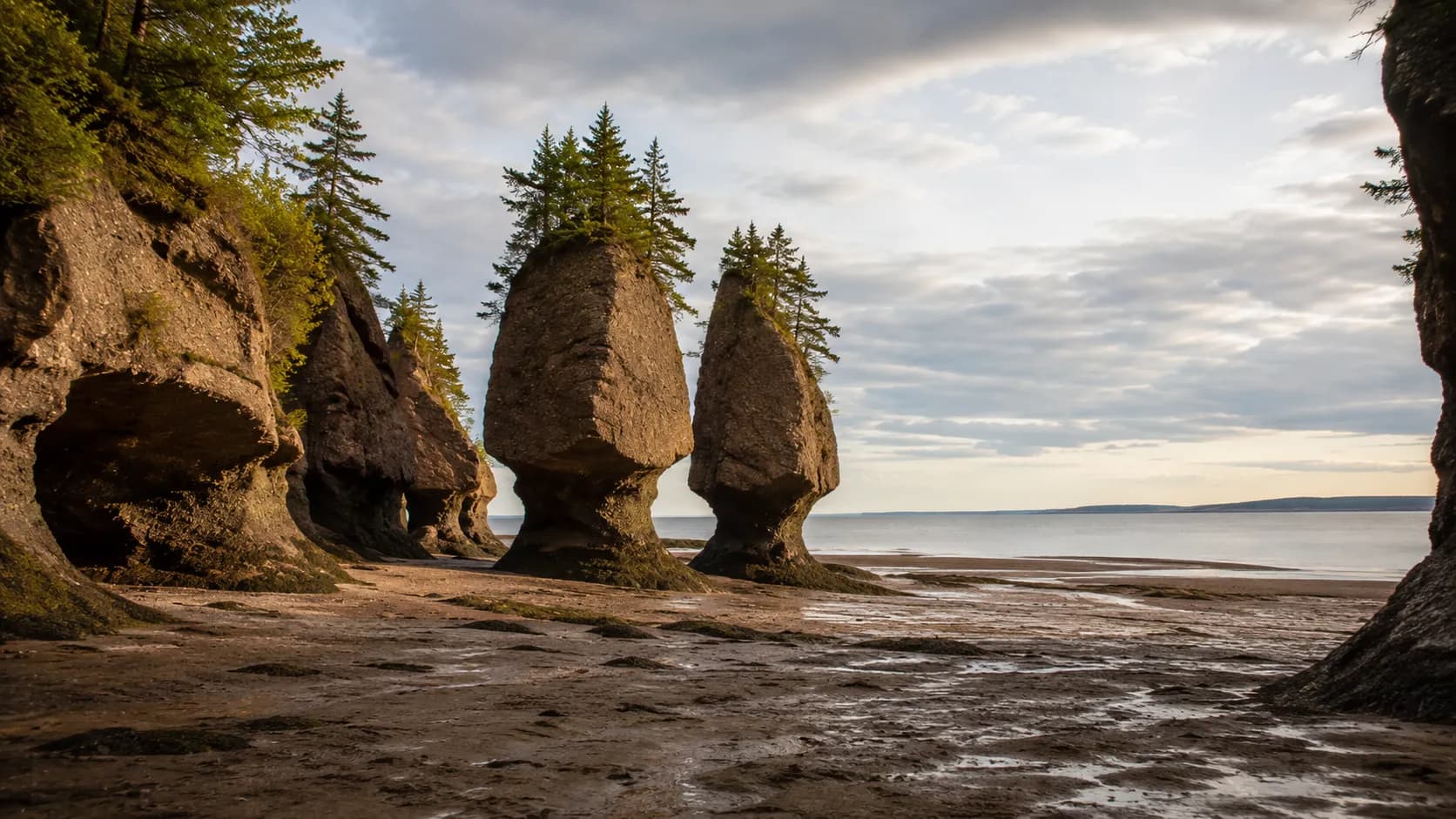
Forests cover most of New Brunswick, which is why forestry has long shaped its economy and identity. The province is also famous for the Bay of Fundy, home to the highest tides in the world. At low tide you can walk on the ocean floor at the Hopewell Rocks, the tall sandstone flowerpot formations carved by those tides.
The Bay of Fundy deserves a moment more, because it is New Brunswick's signature geographic fact. The bay lies between New Brunswick and Nova Scotia, and twice a day an enormous volume of seawater moves in and out, producing tides that can rise higher than a multi-storey building. Along the Fundy coast you find the Hopewell Rocks, Fundy National Park, and fishing villages built around the tidal rhythm. For the test, associate Fundy with the highest tides in the world and with New Brunswick.
The Saint John River runs through the province and gives its name to the port city at its mouth. Discover Canada notes that the province lies in the Appalachian range and that the Saint John River system is the second largest on North America's Atlantic coast. This mix of dense forest, river valleys, and a dramatic tidal coastline is the geographic picture worth carrying into the exam.
Cities Beyond the Capital
Saint John, at the mouth of the Saint John River on the Bay of Fundy, is the province's main port and industrial centre, and it holds the title of Canada's first incorporated city, dating from 1785. Its harbour handles shipping, its refinery and mills anchor manufacturing, and its Loyalist heritage is visible in the old uptown streets.
Moncton, in the southeast, is the principal Acadian and francophone centre and a fast-growing transportation and services hub for the Maritimes. Its position near the Nova Scotia border and the approach to Prince Edward Island makes it a natural crossroads. Discover Canada describes Moncton as the main Acadian centre, so pair Moncton with Acadian culture.
Smaller centres matter too. Bathurst and Campbellton in the north, Edmundston in the francophone northwest, and Miramichi on the river of the same name each anchor their regions, while Caraquet on the Acadian Peninsula hosts one of the largest Acadian festivals. You will not be tested on these towns, but they help you picture where the French-speaking population lives: mostly in the north and east.
Economy: Forests, Ports, and Fisheries
Forestry has been New Brunswick's economic backbone since the timber trade of the 1800s, and pulp, paper, and lumber mills still dot the province. Discover Canada lists forestry, agriculture, fisheries, mining, food processing, and tourism as the principal industries, which is a compact list worth remembering.
Fisheries thrive on both the Fundy and Gulf of St. Lawrence coasts, with lobster, crab, and salmon among the well-known catches. Agriculture is strongest in the upper Saint John River valley, where potatoes are a major crop. Add the Port of Saint John, the refinery, information technology and customer service jobs in Moncton and Fredericton, and tourism drawn by the Fundy tides, and you have a rounded view of how the province earns its living.
People, Language, and Culture
The single most testable fact about New Brunswick is language. It is the only officially bilingual province in Canada, meaning English and French have equal official status in provincial government and services. Roughly one third of the population is francophone, and most of them are Acadians, descendants of the early French settlers.
Official bilingualism in New Brunswick works differently from federal bilingualism, and the difference is worth understanding. At the federal level, English and French are the official languages of Parliament, federal courts, and federal services across the whole country. New Brunswick is the only province that also gives both languages equal status in its own provincial institutions. Quebec has French as its sole official language, and the other provinces operate mainly in English while offering some French services. That distinction is exactly what a well-written test question would probe.
Acadian culture is visible everywhere, from the tricolour flag with its gold star, adopted in 1884, to the national holiday on August 15 and the Tintamarre, a noisy street parade where communities make as much sound as possible to show they are still here. Chiac, a distinctive local blend of French and English, is heard around Moncton. This blend of English and French heritage makes the province a good example when the study guide discusses Canada's two official languages.
Indigenous culture is equally alive. Mi'kmaq and Wolastoqiyik communities maintain their languages, powwows, and treaty relationships with the Crown, and the Peace and Friendship Treaties of the 1700s remain a reference point today. Together with the English-speaking majority descended from Loyalists, Irish, and Scottish settlers, these groups make New Brunswick a compact portrait of the founding peoples described in Discover Canada.
What the Test Asks About New Brunswick
Expect straightforward recall questions rather than trick ones. Common angles include the capital (Fredericton), the fact that New Brunswick is officially bilingual, its status as a founding province in 1867, and its place in the Atlantic region. The Bay of Fundy tides, the Acadians, and the Loyalists can appear as geography or history details.
You will not be quizzed on every town, so focus on the big markers above. A quick way to lock them in is to practise with mixed provincial questions in a timed practice exam, then review anything you miss with smart review so the facts stick. The official study guide, Discover Canada, remains the source of every real question.
Practice Questions
Try these six questions before you check the answers. They follow the style of the real test: one correct answer, no tricks, and every fact drawn from the study guide.
- 1. What is the capital of New Brunswick? (a) Moncton (b) Saint John (c) Fredericton (d) Halifax. Answer: (c) Fredericton. Moncton and Saint John are larger, but Fredericton is the seat of government.
- 2. Which is the only officially bilingual province in Canada? (a) Quebec (b) New Brunswick (c) Ontario (d) Manitoba. Answer: (b) New Brunswick. Quebec is officially French, and Canada as a whole is bilingual at the federal level.
- 3. When did New Brunswick join Confederation? (a) 1867 (b) 1870 (c) 1871 (d) 1873. Answer: (a) 1867. It was one of the four founding provinces.
- 4. True or false: the Bay of Fundy has the highest tides in the world. Answer: true. The bay lies between New Brunswick and Nova Scotia.
- 5. Who suggested the term Dominion of Canada in 1864? (a) John A. Macdonald (b) George-Étienne Cartier (c) Sir Leonard Tilley (d) Louis Riel. Answer: (c) Sir Leonard Tilley, a Father of Confederation from New Brunswick.
- 6. Which group settled New Brunswick after the American Revolution? (a) Acadians (b) United Empire Loyalists (c) Vikings (d) Métis. Answer: (b) the Loyalists, whose arrival in 1783 and 1784 led to the creation of the colony.
If you scored five or six, you are in good shape on this province. If not, the explanations tell you which of the anchor facts to revisit before moving on.
Common Mix-Ups to Avoid
- Fredericton, Moncton, and Saint John: the capital is the smallest of the three. Do not pick the biggest city by reflex.
- Saint John and St. John's: Saint John (spelled out, no apostrophe) is in New Brunswick; St. John's is the capital of Newfoundland and Labrador.
- New Brunswick and Nova Scotia: both are Atlantic founding provinces of 1867. Halifax is Nova Scotia's capital, Fredericton is New Brunswick's, and the Bay of Fundy lies between them.
- Bilingual province versus bilingual country: Canada has two official languages federally; New Brunswick is the only province that is officially bilingual in its own right.
- Acadians and Québécois: both are French-speaking, but the Acadians descend from the settlers of Acadia in the Maritimes, not from New France along the St. Lawrence.
- Maliseet and Wolastoqiyik: two names for the same nation. The Mi'kmaq are a different nation.
Most wrong answers on provincial questions come from these swaps rather than from missing knowledge. Reading each option twice before you click is cheap insurance.
Key Facts Recap
- Capital: Fredericton (largest cities: Moncton and Saint John)
- Region: Atlantic Canada (also one of the three Maritime provinces)
- Joined Confederation: 1867, one of the four founding provinces
- Only officially bilingual province (English and French)
- About one third francophone, mostly Acadian; deportation of the Acadians began in 1755
- Founded by United Empire Loyalists after the American Revolution; separate colony in 1784
- Sir Leonard Tilley proposed the term Dominion of Canada
- Landmarks: Bay of Fundy and the Hopewell Rocks; forests cover most of the province
- First Nations: Mi'kmaq and Wolastoqiyik (Maliseet)
The real test is 20 questions with a pass mark of 15 out of 20, and you have 45 minutes when you write it online, so a handful of solid provincial facts can make the difference. When you are ready, run a full chapter quiz to check your recall under exam conditions.