
Citizenship Test in Prince Edward Island: PEI Guide
Study for the Canadian citizenship test in Prince Edward Island. Learn PEI's capital, Confederation history, geography, and the facts the test asks about.
Prince Edward Island's capital is Charlottetown, it sits in Atlantic Canada, and it joined Confederation in 1873. If you are preparing for the Canadian citizenship test from PEI, these three facts are the foundation. The exam draws every question from the official guide *Discover Canada*, so knowing your province well helps you recognize answers faster and feel confident on test day. This guide goes further than the three anchors: it covers the island's history, its towns, its economy, the people and events that appear in the study guide, practice questions, and the mix-ups that cost newcomers points.
Capital and region
Charlottetown is the capital of Prince Edward Island and its largest urban centre. The city is named after Queen Charlotte, and it anchors island life for government, business, and culture. Prince Edward Island belongs to the Atlantic region, grouped with Nova Scotia, New Brunswick, and Newfoundland and Labrador. The test often pairs a province with its region and capital, so practice saying "Charlottetown, Atlantic Canada" together until it feels automatic.
PEI is Canada's smallest province in both area and population. That small size is part of its identity and a common test detail. Despite its size, the island carries outsized historical weight in the story of how Canada came together.
Charlottetown itself is a compact harbour city. Province House, where the 1864 delegates met, still stands downtown, and the waterfront, Victoria Row, and the Confederation Centre of the Arts give the city a lively summer season. Because the province is small, most Islanders live within an hour's drive of the capital, which makes Charlottetown the natural centre of daily life as well as of government.
A short history of the island
The island's story begins long before Europeans arrived. The Mi'kmaq have lived here for thousands of years and call the island Epekwitk, often written Abegweit, a name usually translated as "cradled on the waves". They fished the coasts, travelled by canoe between the island and the mainland, and remain a living community today, notably in the Lennox Island and Abegweit First Nations.
French settlers knew the island as Île Saint-Jean, part of the wider colony of Acadia. After the Seven Years' War the island passed to Britain under the Treaty of Paris in 1763, and many Acadian families were deported or displaced. In 1799 the colony was renamed Prince Edward Island in honour of Prince Edward, Duke of Kent, the father of the future Queen Victoria.
The nineteenth century brought waves of Scottish, Irish, and English settlers, a long struggle against absentee landlords who owned much of the island from Britain, and finally the 1864 conference that made Charlottetown famous. Entry into Confederation in 1873 helped settle the land question and the railway debt at the same time. The twentieth century added *Anne of Green Gables* in 1908, the rise of tourism, and in 1997 the opening of the Confederation Bridge.
How PEI joined Canada
Prince Edward Island is celebrated as the Birthplace of Confederation. In 1864, Charlottetown hosted the Charlottetown Conference, the first meeting where colonial leaders discussed uniting the British North American colonies. Those talks led directly to the creation of Canada in 1867. It is one of the great ironies of Canadian history that the province where Confederation was born did not actually join until later.
PEI formally entered Confederation in 1873, six years after the country was founded. The island had held back at first, partly over railway debts and the terms of union. When Ottawa agreed to help with those costs, PEI joined as Canada's seventh province. Expect the test to test both dates: the 1864 conference and the 1873 entry.
The delegates who met in Charlottetown, and later in Quebec City and London, are remembered as the Fathers of Confederation. Among them was Sir John A. Macdonald, who became Canada's first prime minister in 1867. Discover Canada presents this sequence in its history chapter, so be ready to place the Charlottetown Conference at the very start of the road to Confederation.
Geography and landscape
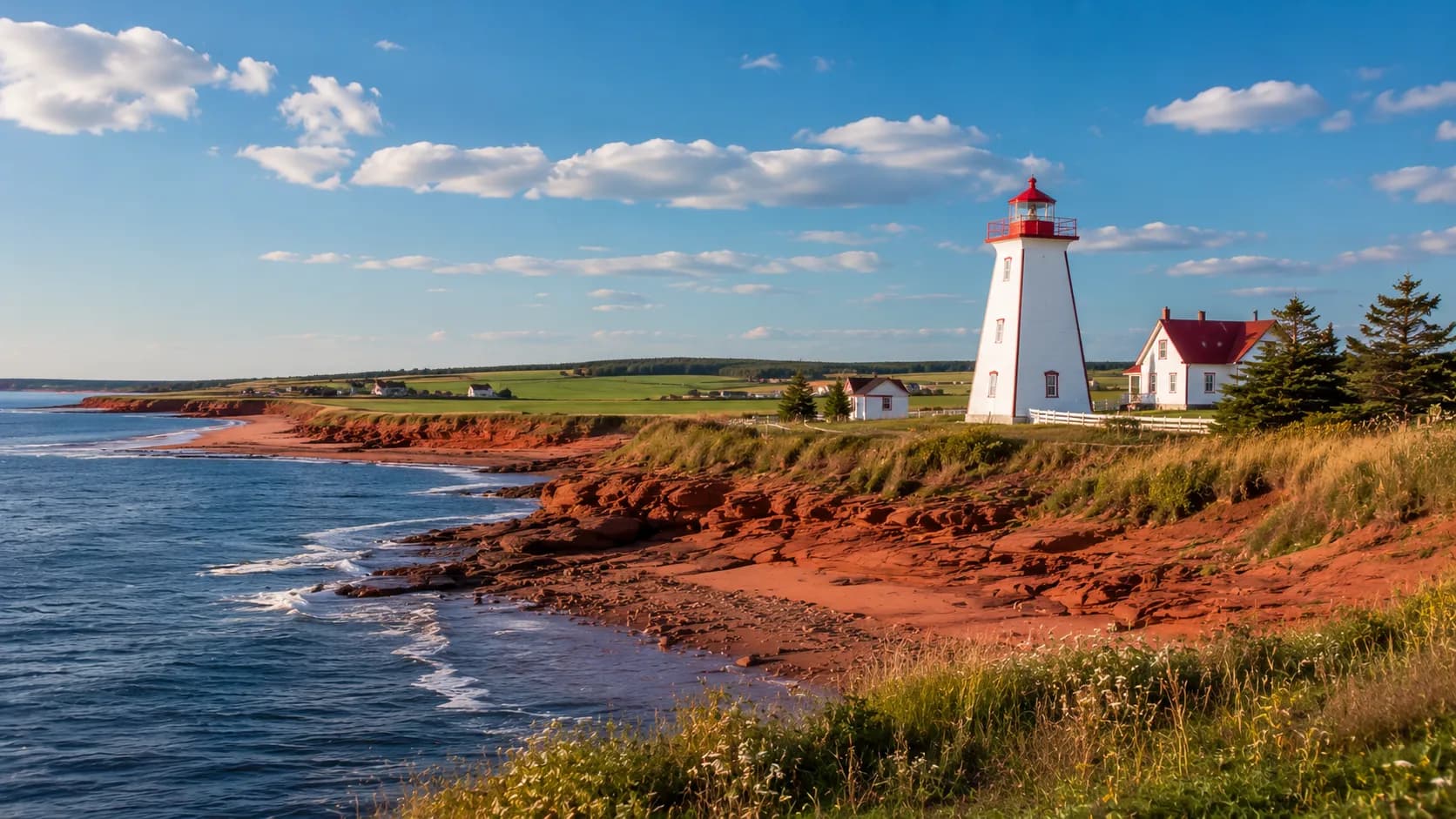
Prince Edward Island is defined by its red soil, gentle rolling farmland, and long coastline shaped by the Gulf of St. Lawrence. The iron-rich earth gives fields and cliffs their distinctive rust colour, and it makes the island one of Canada's most recognizable landscapes. Sandy beaches, lighthouses, and fishing harbours line the shore.
For most of its history the island could only be reached by ferry. That changed when the Confederation Bridge opened in 1997, linking PEI to New Brunswick on the mainland across the Northumberland Strait. The bridge stretches roughly 13 kilometres and is one of the longest of its kind over ice-covered water, a point of local pride and a detail the study guide mentions.
The island is divided into three counties: Prince in the west, Queens in the centre, and Kings in the east. No point on the island is far from the sea. The north shore, partly protected within Prince Edward Island National Park, has some of the warmest saltwater beaches in Canada thanks to the shallow Gulf of St. Lawrence, while the south shore faces the calmer Northumberland Strait.
Cities and communities beyond Charlottetown
Summerside, in Prince County, is the island's second city and the centre of the western part of the province. It grew around shipbuilding and the silver fox fur trade in the early twentieth century. Today it has an aerospace sector, a busy waterfront, and the College of Piping, which reflects the island's Scottish heritage.
Smaller communities each play a role. Cavendish, on the north shore, is the home of Green Gables and the heart of Anne tourism. Souris, in the east, is a fishing port and a ferry link to the Magdalen Islands. Montague and Georgetown serve Kings County. The Évangéline region, around Abram-Village and Wellington, is the centre of the island's Acadian and francophone community, with its own festivals and cultural centre.
The island economy in more detail
Agriculture leads, and potatoes lead agriculture. The sandy, well-drained red soil suits the crop, and PEI potatoes are shipped fresh, as seed potatoes, and as frozen french fries across Canada and abroad. Dairy, beef, grains, and vegetables round out the farming picture.
Fishing and aquaculture come next. Lobster is the most valuable catch, with spring and fall seasons that shape the island calendar. PEI blue mussels, grown on lines in sheltered bays, appear on menus across North America, and oysters from Malpeque Bay are famous in their own right.
Tourism is the third pillar, concentrated in summer, when visitors come for beaches, golf, seafood, Anne of Green Gables sites, and Charlottetown's festivals. Government, health care, and education are major employers year-round, and the province has also invested in wind energy, taking advantage of steady coastal breezes.
Culture, heritage, and island identity
Prince Edward Island is known worldwide as the setting of Anne of Green Gables, the beloved novel by Lucy Maud Montgomery. Readers from across the globe, especially Japan, travel to see the landscapes behind the story. This literary connection is a proud part of island identity, though the citizenship test focuses more on history and government than on fiction.
Islanders trace their roots mainly to Scottish, Irish, English, and Acadian settlers, and to the Mi'kmaq. Fiddle music, ceilidhs, church suppers, and lobster suppers remain part of community life. In recent years the province has welcomed newcomers from many countries, and Charlottetown in particular has become more diverse, with new residents drawn by immigration programs, the University of Prince Edward Island, and the calm pace of island life. Many of those newcomers are exactly the people preparing for this test.
Notable people and events in Discover Canada
For the test, the PEI-related names and events worth knowing sit mostly in the history and geography chapters of the study guide:
- The Charlottetown Conference of 1864, the first step toward Confederation.
- Sir John A. Macdonald, a delegate at Charlottetown and Canada's first prime minister in 1867.
- The Fathers of Confederation, the delegates who negotiated the union at Charlottetown, Quebec City, and London.
- The Mi'kmaq, the Indigenous people of the Atlantic region, including Prince Edward Island.
- Lucy Maud Montgomery, author of Anne of Green Gables, the island's most famous cultural export.
- The Confederation Bridge, the fixed link to New Brunswick described in the guide's section on the Atlantic provinces.
What the test asks about PEI
For Prince Edward Island, questions tend to focus on a few reliable facts: the capital is Charlottetown, the province is in the Atlantic region, it is the smallest province, and it is the Birthplace of Confederation because of the 1864 Charlottetown Conference. Knowing that PEI joined in 1873 rounds out the set. The citizenship test has 20 questions, you need 15 correct to pass, and you have 45 minutes to finish. You can build that recall with chapter quizzes and full-length practice exams that mirror the real format, free and without signing up.
Practice questions about Prince Edward Island
Try these before you move on. They follow the style of the real test, with one correct answer each and a short reason.
- What is the capital of Prince Edward Island? A) Summerside B) Charlottetown C) Halifax. Answer: B. Charlottetown is the capital; Summerside is the second city and Halifax is the capital of Nova Scotia.
- In which year did PEI join Confederation? A) 1864 B) 1867 C) 1873. Answer: C. The conference was held in 1864 and Canada was founded in 1867, but PEI joined in 1873.
- True or false: Prince Edward Island is Canada's smallest province by both area and population. Answer: True. It is the smallest on both counts.
- Why is PEI called the Birthplace of Confederation? A) It was the first province to join B) It hosted the 1864 Charlottetown Conference C) The first prime minister was born there. Answer: B. The 1864 conference opened the talks that led to Confederation.
- The Confederation Bridge connects PEI to which province? A) Nova Scotia B) New Brunswick C) Quebec. Answer: B. It crosses the Northumberland Strait to New Brunswick.
- Which region of Canada includes PEI? A) Central Canada B) The Prairies C) Atlantic Canada. Answer: C. PEI is one of the four Atlantic provinces.
Common mistakes and mix-ups
1864, 1867, and 1873 are three different events. 1864 is the Charlottetown Conference, 1867 is the founding of Canada, and 1873 is the year PEI joined. Learners often assume that the Birthplace of Confederation must have been a founding province. It was not.
Charlottetown is not the capital of the whole Atlantic region. Each province has its own capital: Halifax for Nova Scotia, Fredericton for New Brunswick, St. John's for Newfoundland and Labrador, and Charlottetown for PEI. The test can list the neighbouring capitals as distractors.
The bridge goes to New Brunswick, not Nova Scotia. A seasonal ferry still links PEI with Nova Scotia, but the fixed link crosses to New Brunswick.
Atlantic provinces versus Maritimes. The Maritimes are Nova Scotia, New Brunswick, and PEI. Add Newfoundland and Labrador and you have the four Atlantic provinces. The study guide uses the Atlantic grouping.
Smallest is not youngest. PEI is the smallest province, but the most recent province to join was Newfoundland and Labrador in 1949, and the newest territory is Nunavut, created in 1999.
Key facts to remember
- Capital: Charlottetown, named after Queen Charlotte.
- Region: Atlantic Canada.
- Joined Confederation: 1873 (Canada's smallest province).
- Birthplace of Confederation: the 1864 Charlottetown Conference.
- Indigenous people: the Mi'kmaq.
- Known for: red soil, potatoes, lobster and mussels, tourism, and Anne of Green Gables.
- Connected to New Brunswick by the Confederation Bridge, opened in 1997.
Once these facts feel familiar, keep them fresh with short, spaced sessions. A quick review round a few times a week locks the details into memory far better than cramming the night before. Steady practice is the surest path to a confident pass.