
Citizenship Test: British Columbia Facts
British Columbia facts for the Canadian citizenship test: capital Victoria, largest city Vancouver, the 1871 railway promise, and the Pacific coast economy.
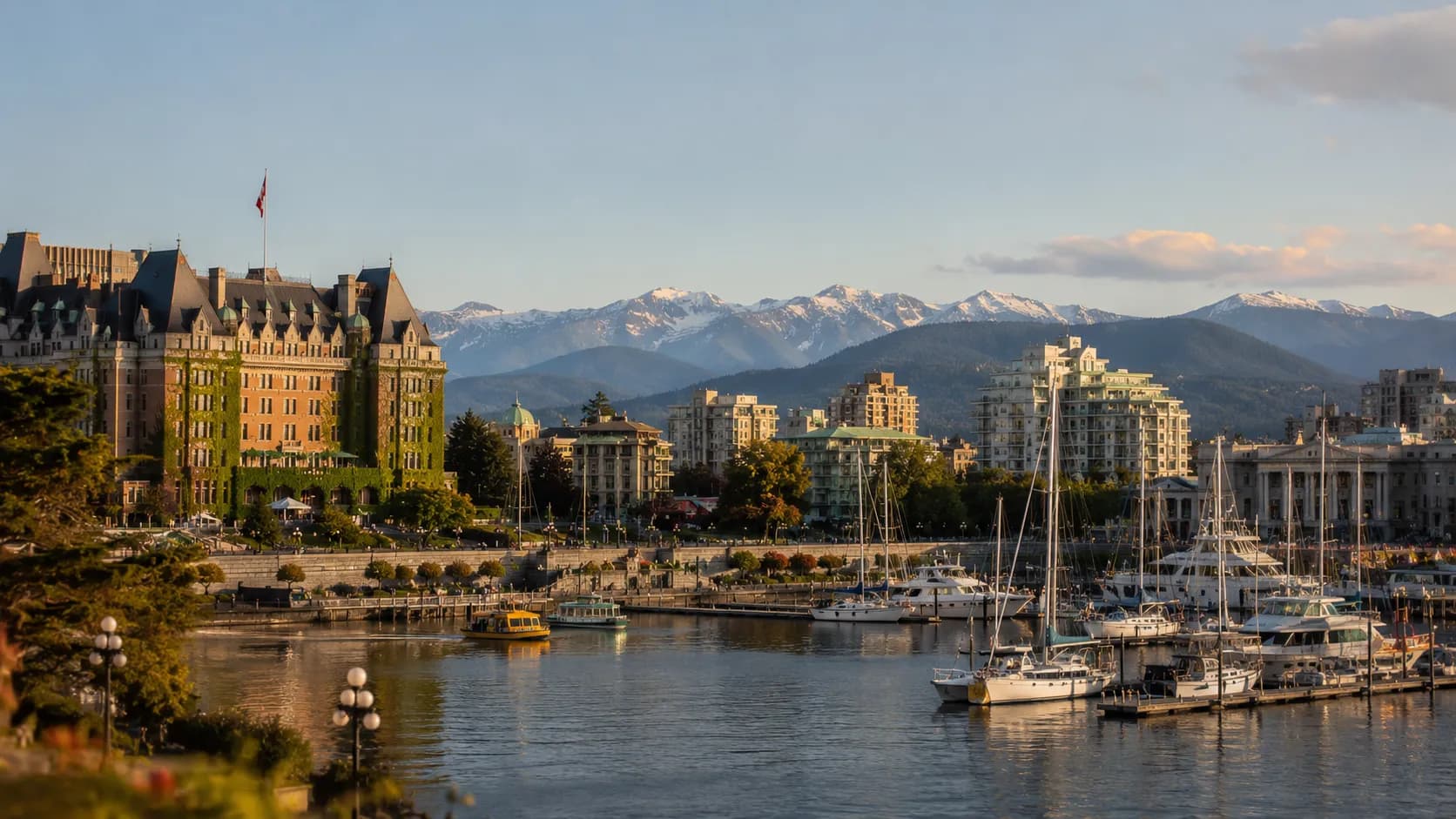
British Columbia's capital is Victoria, it lies on Canada's Pacific West Coast, and it joined Confederation in 1871 after Canada promised to build a railway linking it to the rest of the country. That railway promise is the detail the citizenship test most often ties to British Columbia, so it is worth learning alongside the capital and region. This guide sets those facts in context, walks through the province's history from First Nations to the gold rush and the railway, covers its geography, cities, economy, and people, and closes with practice questions and the classic Victoria versus Vancouver mix-up.
Capital and Region
The capital is Victoria, located on Vancouver Island, not on the mainland. This catches many people out, because the province's largest and best-known city is Vancouver, on the mainland coast. Remember the split: Victoria governs, Vancouver is the big city. If you are preparing for the test in the Vancouver area, the Richmond library offers a free practice programme.
Victoria began as a Hudson's Bay Company post, Fort Victoria, founded in 1843, and it was the capital of the colony of Vancouver Island before becoming the capital of the united colony and then of the province. Its legislature buildings face the Inner Harbour, and its mild climate and gardens give it a reputation as one of Canada's most pleasant cities to live in.
British Columbia is Canada's Pacific province, the westernmost, sitting on the West Coast. Discover Canada treats the West Coast as its own region, distinct from the Prairies to the east. Its position on the ocean shapes almost everything about it, from climate to trade to culture.
A Short History: From First Nations to the Railway
The Pacific coast has one of the densest and most varied Indigenous histories in Canada. Nations such as the Haida, the Coast Salish, the Nuu-chah-nulth, the Tsimshian, and the Kwakwaka'wakw built large cedar-plank villages, carved totem poles, and held potlatch ceremonies, while interior nations such as the Secwepemc and the Okanagan lived along the rivers and plateaus. Discover Canada highlights the totem poles and artistic traditions of the West Coast peoples.
European contact came late. Captain James Cook reached Nootka Sound on Vancouver Island in 1778, and Captain George Vancouver charted the coast in the 1790s, giving his name to the island and later the city. Fur traders of the North West Company and the Hudson's Bay Company then built posts along the rivers, and Fort Victoria followed in 1843.
The Fraser River gold rush of 1858 changed everything. Tens of thousands of prospectors, many from California, poured into the mainland, and Britain quickly created the colony of British Columbia to keep order. A second rush in the Cariboo country followed, and in 1866 the mainland and Vancouver Island colonies were united. James Douglas, the Hudson's Bay Company trader who governed both colonies, is remembered as the father of British Columbia.
Isolated and in debt, the colony joined Confederation in 1871 on the promise of a railway. The Canadian Pacific Railway was completed in 1885, when the last spike was driven at Craigellachie in the British Columbia interior. Thousands of Chinese workers were hired to build the most dangerous mountain sections; many died, and after the line was finished Canada imposed a head tax on Chinese immigrants. Discover Canada notes that the government apologized for this in 2006.
The 20th century brought Vancouver's rise as a port and metropolis, the internment of Japanese Canadians during the Second World War, for which Canada also later apologized, waves of immigration from Asia and Europe, and, in 2010, the Vancouver Winter Olympic Games. Today British Columbia is one of Canada's fastest-growing and most diverse provinces.
How British Columbia Joined Canada
British Columbia joined Confederation in 1871, the sixth province. It agreed to join only after Canada promised to build a railway connecting the isolated Pacific colony to the eastern provinces. That promise became the Canadian Pacific Railway, and the railway link is a classic test fact about the province.
The promise mattered because, in 1871, the only practical ways to reach the coast from Ontario were by ship around South America or by long overland trails through the United States. Sir John A. Macdonald's government saw the railway as the way to bind the new country together from sea to sea, and Discover Canada presents the completion of the line in 1885 as one of the defining achievements of early Canada.
Notable Names and Events from Discover Canada
Several people tied to British Columbia appear in the study guide. Terry Fox, from Port Coquitlam near Vancouver, lost a leg to cancer and in 1980 set out on the Marathon of Hope, running across Canada to raise money for research. He was forced to stop in Ontario, but the annual Terry Fox Run continues in his name. Rick Hansen, also from British Columbia, circled the globe in his wheelchair on the Man in Motion tour in the mid 1980s to raise awareness for spinal cord injuries.
The painter Emily Carr, born in Victoria, is celebrated for her canvases of West Coast forests and Indigenous villages and is mentioned among Canada's great artists. On the political side, James Douglas as colonial governor and the railway builders of the 1880s round out the province's cast. If a question names Terry Fox or Rick Hansen, think British Columbia and courage in the face of disability.
Geography and Landscape
British Columbia is dramatically mountainous. The Rocky Mountains rise along its eastern edge, shared with Alberta, while the long Pacific Ocean coastline defines the west. Between them lie vast forests, deep valleys, and rivers, making this one of Canada's most scenic provinces.
The Fraser River, the province's great waterway, rises in the Rockies and reaches the sea at Vancouver. The Okanagan Valley in the southern interior is dry and sunny, known for orchards, vineyards, and lakes. Off the north coast lie the islands of Haida Gwaii, homeland of the Haida. Discover Canada also notes that the province has one of the most extensive park systems in the world, with protected areas covering a large share of its territory.
The coastal climate is mild and rainy, unusually gentle for Canada, which is why Vancouver and Victoria rarely see the harsh winters of the Prairies. The interior is drier, with hotter summers and colder winters, and the mountains carry deep snow that feeds ski resorts such as Whistler. This mild, wet coast is a geography point that sometimes appears on the test.
Cities Beyond the Capital
Vancouver anchors a metropolitan region that includes Surrey, Burnaby, and Richmond, together the third-largest urban area in Canada after Toronto and Montreal. The city is known for Stanley Park, its port, its film studios, and a skyline set against the North Shore mountains.
In the interior, Kelowna is the centre of the Okanagan wine and fruit region, Kamloops is a transportation crossroads, and Prince George serves the forestry towns of the north. On Vancouver Island, Nanaimo is the second city after Victoria, and on the north coast Prince Rupert is a deep-water port and rail terminus. These do not appear on the test, but they show how the province is more than its two famous cities.
Economy and Trade
British Columbia's economy is built on its natural setting and its location. Key sectors include forestry, mining, film and television production, and tourism. Vancouver is a major centre for movie and TV filming, sometimes called Hollywood North. Discover Canada states that about half of all goods produced in the province are forestry products, which makes forestry the single most important sector to remember.
Fishing, especially salmon, has fed coastal communities for millennia and remains an industry today. The Okanagan supplies fruit and wine, the northeast produces natural gas, and Vancouver has grown into a technology hub. Tourism draws visitors to Whistler, the Rockies, and the coast in every season.
The Port of Vancouver is Canada's largest port and its main gateway for trade with the Asia-Pacific region. Grain from the Prairies, coal, potash, and containers all move through it, which is why the railway link to the rest of Canada still matters. This role as Canada's Pacific trading door is worth remembering, as it explains much of the province's growth and importance.
People and Culture
British Columbia is home to large Asian-Canadian communities, with deep roots that stretch back to the railway era and the gold rushes. Cities like Vancouver and Victoria are known for their multicultural neighbourhoods and international connections.
Chinese Canadians have been part of the province since the 1858 gold rush, and Vancouver's Chinatown is among the oldest in the country. Punjabi Sikh communities date from the early 1900s and are now especially strong in Surrey and the Fraser Valley. Japanese, Filipino, Korean, and Iranian communities add to the mix. Discover Canada notes that Chinese and Punjabi are the most spoken languages in the province after English, a fact that reflects this history.
Alongside this diversity, First Nations culture remains highly visible on the coast, from totem poles in Stanley Park and the Royal BC Museum to modern treaty negotiations and Indigenous-led tourism. The blend of Indigenous heritage, Asian communities, and a Pacific outlook gives the province a distinct character that reflects the wider Canadian mosaic.
What the Test Asks About British Columbia
The most likely questions cover the capital (Victoria), the largest city (Vancouver), the year it joined (1871), and the railway promise that brought it in. The Pacific coast, the Rocky Mountains, the Port of Vancouver, and forestry can appear as geography or economy details, and the Chinese railway workers and the head tax appear in the history chapters.
A reliable way to hold these facts is to practise them in a timed practice exam, then send anything you miss to smart review so it comes back at the right moment. The official guide, Discover Canada, is the source of every question, so skim its West Coast section once more before test day.
Practice Questions
Work through these six questions, then compare your answers. They use the real test format: one correct option and a short reason.
- 1. What is the capital of British Columbia? (a) Vancouver (b) Victoria (c) Kelowna (d) Prince George. Answer: (b) Victoria, on Vancouver Island. Vancouver is the largest city.
- 2. In what year did British Columbia join Confederation? (a) 1867 (b) 1870 (c) 1871 (d) 1885. Answer: (c) 1871. The railway it was promised was completed in 1885.
- 3. What did Canada promise British Columbia to persuade it to join? (a) A navy (b) A railway to the east (c) Free land (d) A new capital. Answer: (b) a railway, which became the Canadian Pacific Railway.
- 4. True or false: the Port of Vancouver is Canada's largest port. Answer: true. It is Canada's main gateway to the Asia-Pacific region.
- 5. Which event brought thousands of prospectors to the mainland in 1858? (a) The Klondike gold rush (b) The Fraser River gold rush (c) The fur trade (d) The Winter Olympics. Answer: (b) the Fraser River gold rush; the Klondike rush was later and in Yukon.
- 6. Which British Columbian ran the Marathon of Hope in 1980? (a) Rick Hansen (b) Terry Fox (c) Wayne Gretzky (d) Emily Carr. Answer: (b) Terry Fox, who ran to raise money for cancer research.
Five or six right means British Columbia is secure. If you missed the capital question, that is the single most valuable fix you can make.
Common Mix-Ups to Avoid
- Victoria versus Vancouver: Victoria is the capital, on Vancouver Island; Vancouver is the largest city, on the mainland.
- Vancouver Island versus the city of Vancouver: the island holds Victoria, not Vancouver. The city sits across the water on the mainland.
- 1871 versus 1885: the province joined in 1871; the railway was finished in 1885.
- 1867 versus 1871: British Columbia was not a founding province. The founders were Ontario, Quebec, Nova Scotia, and New Brunswick.
- Fraser River gold rush versus Klondike gold rush: the Fraser rush of 1858 was in British Columbia; the Klondike rush of the late 1890s was in Yukon.
- The Rocky Mountains are shared with Alberta; they form British Columbia's eastern edge, not its coast.
- West Coast versus Prairies: British Columbia is the West Coast region on its own; the Prairies are Alberta, Saskatchewan, and Manitoba.
Nearly every wrong answer about this province is one of these swaps. Say the pair out loud, capital Victoria, biggest city Vancouver, until it is automatic.
Key Facts Recap
- Capital: Victoria (on Vancouver Island)
- Largest city: Vancouver; metro includes Surrey, Burnaby, and Richmond
- Region: West Coast / Pacific, the westernmost province
- Joined Confederation: 1871, after Canada promised a railway; the Canadian Pacific Railway was completed in 1885
- Fraser River gold rush of 1858 led to the creation of the colony
- Landscape: Pacific coastline, Rocky Mountains, vast forests, Fraser River, Okanagan Valley, mild rainy coast
- Economy: forestry, mining, film and TV, tourism, fishing, Port of Vancouver (Canada's largest)
- Home to large Asian-Canadian communities and coastal First Nations; Chinese and Punjabi widely spoken
- Notable names: Terry Fox, Rick Hansen, Emily Carr
You need 15 out of 20 to pass the real test, with 45 minutes when you write it online, so nailing British Columbia's capital and its railway story gives you reliable easy points. When you are ready, work through a chapter quiz to confirm your recall.