
Citizenship Test: Newfoundland and Labrador Guide
Study Newfoundland and Labrador for the citizenship test: capital St. John's, the 1949 referendum, Cabot, the Vikings, the cod fishery and practice questions.
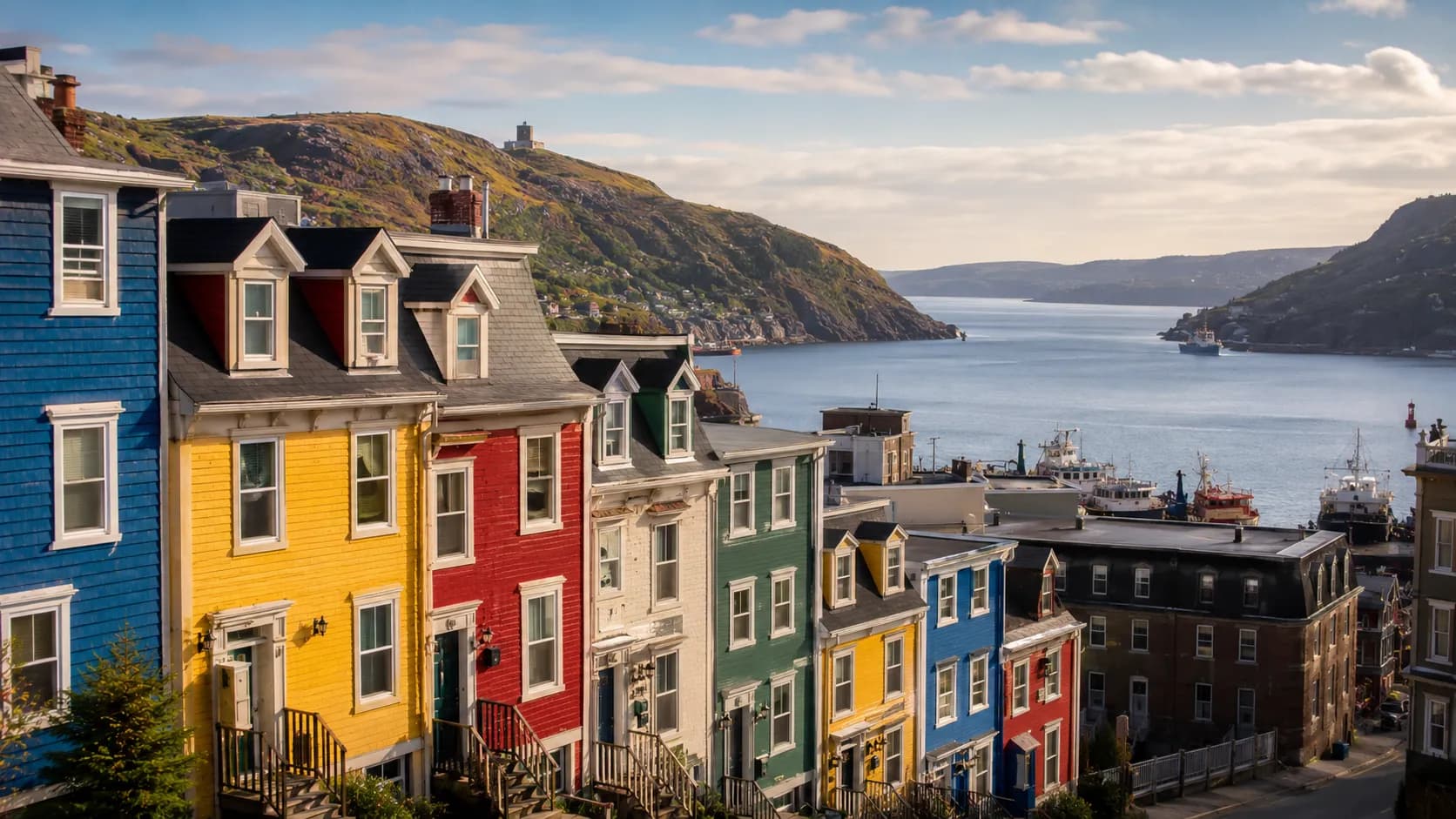
Newfoundland and Labrador is an Atlantic province whose capital is St. John's, and it was the last province to join Canada, in 1949. Its entry came by a referendum vote rather than at Confederation, which makes it a memorable detail for the citizenship test. Knowing the capital, the region and the year of joining covers most of what you need on this province, but the story behind those three facts, from Viking landings to the cod moratorium, makes them far easier to remember.
Capital and region
St. John's is the capital and largest city of Newfoundland and Labrador. It sits on the eastern edge of the island of Newfoundland and is one of the oldest cities in North America, with a sheltered harbour that has drawn fishers and traders for centuries. The colourful row houses climbing the hills above the harbour are one of the most recognizable sights in Atlantic Canada. In the same region, Prince Edward Island also has its own page, with Charlottetown and the 1864 Conference.
The province belongs to Atlantic Canada, the group of four provinces on the country's east coast, together with Nova Scotia, New Brunswick and Prince Edward Island. It has two distinct parts: the island of Newfoundland and the mainland region of Labrador to the northwest, across the Strait of Belle Isle. The test often expects you to place the province in the Atlantic region and to recall its capital.
A short history in five dates
Newfoundland's recorded history is older than that of any other part of Canada, which is why Discover Canada mentions it so early in the history chapter. These five dates give you the whole arc in order.
- Around the year 1000: Vikings from Greenland set up a camp at L'Anse aux Meadows, on the northern tip of the island, the earliest known European presence in North America.
- 1497: the explorer John Cabot, sailing for England, reached the coast and reported waters so full of cod that fishing fleets from Europe soon followed every summer.
- 1583: England claimed Newfoundland as its first overseas colony, and St. John's grew as a base for the fishery.
- 1949: after a close referendum, Newfoundland joined Canada as the tenth province, with Joey Smallwood as its first premier.
- 1992: the federal government closed the northern cod fishery, the largest layoff in Canadian history, forcing the province to rebuild its economy.
How it became part of Canada
Newfoundland and Labrador was the last province to join Confederation, entering in 1949. Unlike the provinces that formed Canada in 1867, it stayed out for more than eighty years. It ran its own affairs as a self-governing British dominion for a time, then struggled financially in the 1930s and handed control back to a commission appointed from London. After the Second World War, residents were asked to decide their future.
Two referendums were held in 1948. The options were to keep the commission, to return to self-government, or to join Canada. Joey Smallwood led the pro-Confederation campaign, arguing that Canadian family allowances, pensions and markets would improve daily life in the outports. The second vote gave Confederation a narrow majority, and on March 31, 1949, Newfoundland became a province, with Smallwood as first premier. This is the sequence the test cares about: last province, 1949, by referendum.
Geography and landscape
The province is known for a rugged Atlantic coastline, drifting icebergs and a cool maritime climate. Cape Spear, near St. John's, is the easternmost point of North America, a fact that sometimes appears in study material. Every spring, icebergs calved from Greenland glaciers drift south past the coast along a route nicknamed Iceberg Alley, and whale watching follows in summer.
Labrador, on the mainland, is far larger and more sparsely settled than the island, with boreal forest, tundra, the Torngat Mountains in the north and a long coast facing the Labrador Sea. The island of Newfoundland holds most of the population and the capital. On the island's west coast, Gros Morne National Park exposes rock from deep inside the Earth, one of the reasons it is a UNESCO World Heritage site, as is L'Anse aux Meadows.
Its own time zone and other quirks
Newfoundland keeps its own time zone, half an hour ahead of Atlantic time and an hour and a half ahead of Toronto and Ottawa. National broadcasters still say "half an hour later in Newfoundland," and the phrase is a good memory hook for the province's distinct identity. The island also has a dialect shaped by centuries of settlers from southwest England and southeast Ireland, with words and turns of phrase heard nowhere else in Canada.
Two St. John's landmarks turn up in general knowledge questions. On Signal Hill, overlooking the harbour entrance, Guglielmo Marconi received the first transatlantic wireless signal in 1901. Gander, in the centre of the island, was a major refuelling airport in the early days of transatlantic flight, and in September 2001 its residents famously hosted thousands of passengers from planes diverted after the attacks on the United States.
Communities beyond the capital
Most of the province's people live on the Avalon Peninsula around St. John's, but several other centres matter. Corner Brook, on the west coast, is the island's second city and a long-time paper mill town. Gander and Grand Falls-Windsor serve the central island. In Labrador, Happy Valley-Goose Bay grew around a wartime air base, while Labrador City and Wabush are iron ore mining towns near the Quebec border. Churchill Falls, also in Labrador, hosts one of the largest hydroelectric plants in the country.
Hundreds of small coastal villages, called outports, ring the island. Many were reachable only by boat until the mid-twentieth century, and some were abandoned under resettlement programs after 1949. Their names, from Heart's Content to Come By Chance, are part of the province's charm.
Indigenous peoples of the province
Before Europeans arrived, the island was home to the Beothuk, who were displaced and lost to disease and conflict by the early nineteenth century. Today the province's Indigenous peoples include the Mi'kmaq on the island, the Innu of central and northern Labrador, and the Inuit of the Labrador coast. In 2005 the Labrador Inuit gained self-government over a region called Nunatsiavut, one of several modern land claim agreements you may see mentioned when you study Indigenous rights in Canada.
People, culture and economy
Newfoundlanders are known across Canada for their friendliness, a distinct local dialect and a strong musical and storytelling tradition. This culture grew out of centuries of life in fishing outports along the coast, where kitchen parties, fiddle and accordion music and a dry sense of humour helped people through long winters.
The economy was historically built on the Atlantic cod fishery, which shaped settlement patterns and daily life for generations. Overfishing collapsed the stocks, and the 1992 cod moratorium put tens of thousands of people out of work almost overnight. The province rebuilt around offshore oil produced from platforms off the coast, along with mining in Labrador, hydroelectricity, shellfish and tourism drawn by icebergs, whales and the scenery. You can build background knowledge like this through the chapter quizzes before testing yourself.
Practice questions
Test yourself before moving on. Each question below is written in the style of the official test, with the correct answer and a one-line reason.
- What is the capital of Newfoundland and Labrador? (a) Corner Brook (b) St. John's (c) Halifax (d) Gander. Answer: (b). St. John's is the capital and largest city; Halifax is the capital of Nova Scotia.
- In what year did Newfoundland join Canada? (a) 1867 (b) 1905 (c) 1949 (d) 1999. Answer: (c). It was the last province to join, after a referendum; 1999 is when Nunavut was created.
- True or false: Newfoundland and Labrador is a territory. Answer: false. It is a province, one of the four in Atlantic Canada.
- Who reached Newfoundland in 1497? (a) Jacques Cartier (b) John Cabot (c) Samuel de Champlain (d) Henry Hudson. Answer: (b). Cabot, sailing for England, reached the coast in 1497; Cartier explored the St. Lawrence later, in the 1530s.
- Which fish shaped the province's economy for centuries? (a) salmon (b) tuna (c) cod (d) trout. Answer: (c). The Atlantic cod fishery was the backbone of the economy until the 1992 moratorium.
- Where is the easternmost point of North America? (a) Cape Breton (b) Cape Spear (c) Cape Cod (d) Cape Race. Answer: (b). Cape Spear, near St. John's, is the easternmost point.
Common mistakes and mix-ups
A few errors come up again and again when people study this province. Check them off so they do not cost you a mark.
- Mixing up 1949 with 1867: Newfoundland did not take part in Confederation. It joined 82 years later, and it is the only province that joined by referendum.
- Writing St. John instead of St. John's: Saint John is a city in New Brunswick. The capital of Newfoundland and Labrador is St. John's, with the apostrophe and the s.
- Confusing Cabot with Cartier: John Cabot reached Newfoundland in 1497 for England; Jacques Cartier claimed the St. Lawrence region for France in 1534.
- Forgetting Labrador: the official name has two parts, and Labrador is on the mainland, not on the island.
- Assuming the province is in the Maritimes: the Maritimes are Nova Scotia, New Brunswick and Prince Edward Island. Add Newfoundland and Labrador and you get Atlantic Canada.
What the test may ask
For the citizenship test you should be able to name St. John's as the capital, identify the province as part of Atlantic Canada, and recall that it joined Canada in 1949 as the last province to do so. Questions may also touch on the cod fishery, John Cabot, the Vikings at L'Anse aux Meadows or the two-part name, Newfoundland and Labrador. All of these come from the official study guide, Discover Canada, which is the only source the test draws on.
The official test has 20 questions, and you need 15 correct (75%) to pass, with 45 minutes online. Practising with full-length mock exams helps these regional facts stick. Try a timed practice exam once you feel ready; the app is free and needs no signup.
Key facts recap
- Capital: St. John's, one of North America's oldest cities
- Region: Atlantic Canada, on the east coast
- Joined Canada: 1949, the last province to do so, by referendum, with Joey Smallwood as first premier
- Two parts: the island of Newfoundland and mainland Labrador
- Early history: Vikings at L'Anse aux Meadows around 1000, John Cabot in 1497
- Cape Spear is the easternmost point of North America
- Own time zone, half an hour ahead of Atlantic time
- Economy: historic cod fishery (moratorium in 1992), now offshore oil, mining, hydro and tourism
Once these facts feel familiar, reinforce them with spaced review sessions so they stay fresh on test day.