
The Canadian Citizenship Ceremony and Oath: What to Expect
The Canadian citizenship ceremony: how it works, the full oath, what to bring, online vs in person, and what happens next. A clear, free guide.
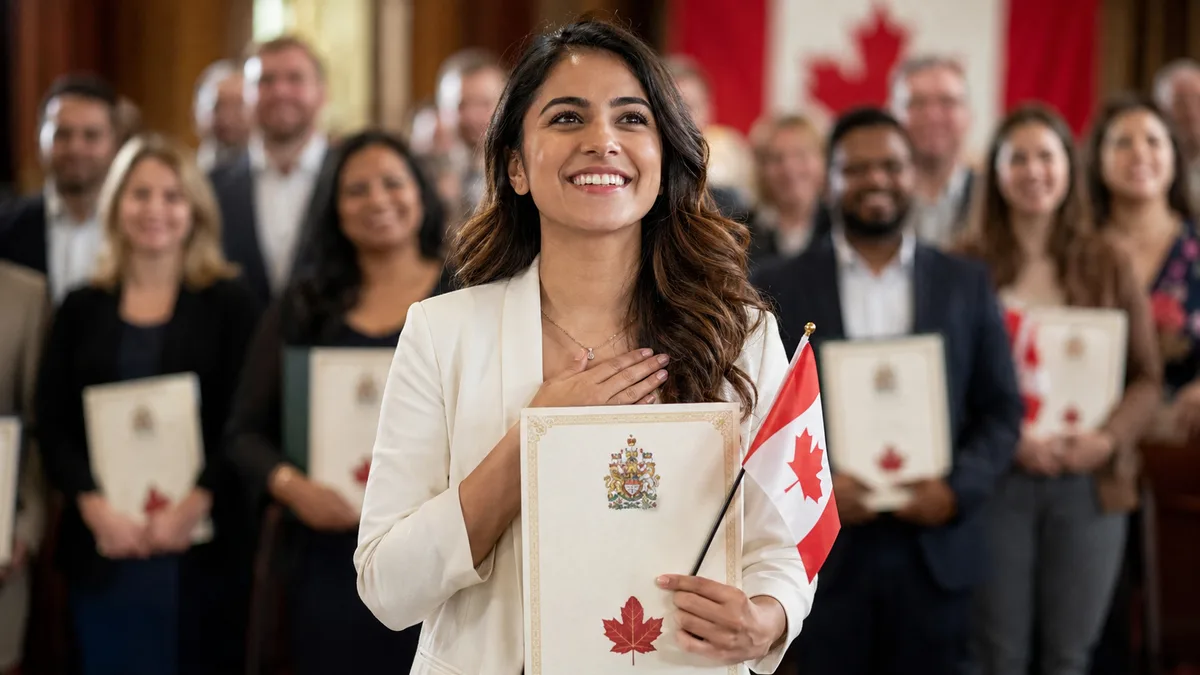
The citizenship ceremony is the very last step to becoming Canadian: you only officially become a citizen the moment you take the oath. It happens in person or online by video, usually lasts 30 to 90 minutes, and ends with you receiving your citizenship certificate. This guide explains what the ceremony is, when it happens, how it unfolds, what the oath means, and what changes in your life once you are a citizen. It is a general guide: the official source is always canada.ca.
Key takeaways
- You become a citizen the moment you take the oath, not before, even after your application is approved.
- The ceremony can be in person or online (by video), and the oath is identical either way.
- You then receive your citizenship certificate, the official and lasting proof of your status.
- Bring your invitation, your PR card (even if expired) and your identity documents.
- Once a citizen, you can apply for a Canadian passport, vote, and leave and return to Canada without residency limits.
What is the ceremony and when does it happen?
The ceremony comes at the very end of the journey, once your application is approved and, if required, you have passed the citizenship test. It is the culmination of the path described in our guide on how to become a Canadian citizen: submitting the application, confirming eligibility, taking the knowledge test for those aged 18 to 54, then the official invitation. IRCC writes to invite you, giving the date, time and format. You do not need to do anything to trigger the invitation: it arrives once your file is ready.
The gap between approval and the ceremony varies by office and by the volume of applications. Some people get their invitation a few weeks after the test, others wait several months. The invitation clearly states the format. Since 2020, many ceremonies are held online, by video conference, but in-person ceremonies still exist and carry strong symbolic weight for many new Canadians.
How does the ceremony work?
The ceremony always follows the same thread: welcome, address, oath, national anthem, then presentation of the certificate. It is presided over by a citizenship judge or an authorized official, who welcomes the new citizens and explains the meaning of the commitment being made. The tone is solemn but warm, and everything stays accessible: nothing is left to improvisation, and each step is announced.
- You receive an invitation with the date, time and format (in person or by video).
- A citizenship judge or presiding official welcomes everyone and gives a short address.
- You take the Oath of Citizenship, in English or French, all together.
- You sing the national anthem, O Canada.
- You receive your citizenship certificate, the official proof of your new status.
The whole event rarely runs longer than an hour and a half. You have nothing to recite from memory and no exam to sit that day: the demanding part, the knowledge test, is already behind you. The ceremony is a moment of recognition, not assessment.
What does the Oath of Citizenship say?
The oath is the pledge by which you swear allegiance to the Sovereign and promise to observe the laws of Canada and fulfil your duties as a citizen. You can take it as a swearing ("I swear") or a solemn affirmation ("I affirm"), depending on your personal beliefs. Since June 2021, the wording explicitly recognizes the Aboriginal and treaty rights of Indigenous peoples. Here is the official wording in force:
"I swear (or affirm) that I will be faithful and bear true allegiance to His Majesty King Charles the Third, King of Canada, His Heirs and Successors, and that I will faithfully observe the laws of Canada, including the Constitution, which recognizes and affirms the Aboriginal and treaty rights of First Nations, Inuit and Métis peoples, and fulfil my duties as a Canadian citizen."
Each part has a concrete meaning. Allegiance to the Sovereign is allegiance to the Crown as a symbol of the Canadian state, not to a person in a private capacity: King Charles III is Canada's head of state within a constitutional monarchy. The promise to observe the laws covers the Constitution and all of Canadian law. The recognition of Indigenous rights reminds everyone that citizenship is exercised on lands where First Nations, Inuit and Métis peoples are the first inhabitants. Finally, fulfilling your duties points to shared responsibilities: obeying the law, taking part in democratic life, and serving on a jury if called.
Receiving your certificate and singing O Canada
After the oath, you receive your citizenship certificate: this is the document that officially proves you are Canadian. It replaces your permanent resident status, and you will need it to apply for a passport or to prove your citizenship. Check that your name and date of birth appear correctly, and report any error to IRCC without delay. Keep the certificate somewhere safe, because replacing it takes time and paperwork.
The ceremony also includes singing the national anthem, O Canada, often performed in both official languages. No one expects a perfect performance: it is a collective, symbolic gesture. Many new citizens describe this moment, hand on heart, as the most moving part of the day. If you like, you can learn the words ahead of time so you can take part fully.
In person or online: what is the difference?
In substance, there is no difference: either way you take the same oath and receive the same certificate, with the same legal value. The online ceremony happens from home, by video, using a connection link sent with your invitation. It suits people who live far from an office or who have travel constraints. The in-person ceremony gathers several new citizens in a room, with flags and an official address, and is often felt to be more solemn and more festive.
IRCC decides which format is offered, based on its capacity and your region. In some cases you can express a preference, for example asking for an in-person ceremony, but that choice is not guaranteed. Whatever the format, get your documents ready and log on or arrive early to avoid any last-minute stress.
How to prepare and what to bring
Preparation comes down to three things: gathering your documents, testing your equipment if the ceremony is online, and letting loved ones know. No content review is needed, since the test is already done. Here is what to have on hand:
- Your ceremony invitation, printed or on screen.
- Your permanent resident card (even if expired), which IRCC will collect.
- Your identity documents and anything else requested in the invitation.
- For an online ceremony: a device with a camera, a stable connection and a quiet space.
- The loved ones you want to invite: in-person ceremonies welcome family subject to seating, and your loved ones can join you on screen when online.
Plan to arrive or connect early. Dressing up is appreciated but not required; many take the chance to mark the occasion. It is a proud moment meant to be shared, and nothing stops you from photographing it once the ceremony is over.
What changes once you are a citizen
Becoming a citizen opens new rights and lifts some of the constraints tied to permanent resident status. You can now apply for a Canadian passport, one of the most useful travel documents in the world. You can register to vote and take part in federal, provincial and municipal elections, and run for certain offices. You are no longer bound by the residency obligation that applies to permanent residents: your status is not lost if you live abroad for a long time.
In return, citizenship comes with responsibilities: obeying the law, serving on a jury if summoned, and taking part in the life of your community. To keep your civic knowledge sharp after the ceremony, our spaced repetition review tool helps you retain the essentials about Canada's institutions, history and symbols over the long term.
The ceremony comes after the citizenship test, often the step people worry about most. The good news: you can prepare for free right now with our mock exams and chapter quizzes, so you arrive at the ceremony calm and proud.