
Canadian Military History for the Citizenship Test: WWI to Korea
Canada's military history for the citizenship test: 1812, Vimy Ridge, Dieppe, D-Day, Korea, peacekeeping, and the meaning of the poppy.
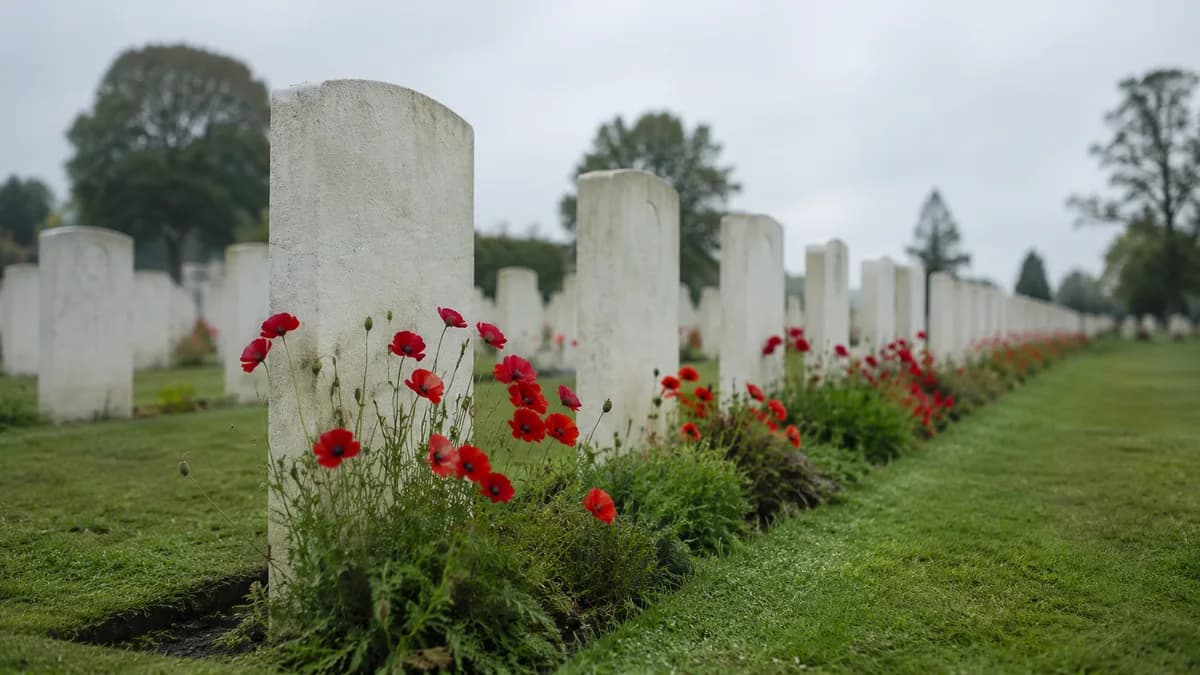
Military history shows up on almost every citizenship test: the War of 1812, Vimy Ridge in April 1917, D-Day on June 6, 1944, the Korean War, peacekeeping, and Remembrance Day on November 11. The official guide "Discover Canada" gives these events several pages, because they explain how the country defended its territory, what it contributed elsewhere in the world, and why so many people wear a poppy every autumn.
This article follows the chronological order, from the defence of the territory in 1812 to the Canadian Armed Forces of today. It keeps to what is actually testable: dates, names, places, and a few figures published by Veterans Affairs Canada. To place this chapter inside the wider syllabus, keep the guide Canada Explained close at hand, since it covers history, government, symbols, and rights.
Two episodes come up so often that each has its own detailed article: the Battle of Vimy Ridge and D-Day at Juno Beach. They are summarized here, with a pointer to the full text when you want to go further. The tone stays factual: the goal is to understand and remember, not to judge.
Why military history carries so much weight on the test
Military questions are common because they combine precise facts with a large part of Canadian identity. A date, a place, a name: the answer can be checked, which makes excellent material for a multiple-choice exam.
These events also thread through other chapters. The War of 1812 explains the border with the United States. The First World War explains Canada's place in the world and the independent status it gained afterwards. The Second World War explains the country's industrial growth and the arrival of new immigrants. Peacekeeping explains much of Canada's diplomatic reputation. Studying this material means studying several sections at once.
1812: defending the territory
The War of 1812 was fought between the United States and Britain, and much of the fighting took place in what is now Canada. American armies invaded several times between 1812 and 1814, and they were pushed back by British soldiers, Canadian volunteers, and First Nations allies.
Three names come up again and again. Major-General Sir Isaac Brock secured the surrender of the American garrison at Detroit in the summer of 1812, then died in battle at Queenston Heights in October of the same year. Tecumseh, a Shawnee chief, built the Indigenous alliance that made those early victories possible and was killed in 1813. Laura Secord walked a long distance through the woods in 1813 to warn British soldiers of a coming attack.
The outcome matters as much as the battles: the United States did not conquer Canada, and the border settled afterwards became one of the longest peaceful borders in the world. The campaigns are covered in detail in our article on the War of 1812.
From rebellion to Confederation: a defence takes shape
Between 1837 and 1867 Canada had no national army, but the crises of the period pushed the colonies to build shared institutions. The rebellions of 1837 and 1838, in Upper and Lower Canada, demanded a government responsible to voters rather than to London. They failed militarily, yet their cause eventually won out: responsible government was granted in 1848.
In the 1860s, raids launched from the United States by the Fenians, an Irish nationalist group, reminded the colonies how exposed they were. That threat, together with economic and railway arguments, fed the movement that led to Confederation on July 1, 1867. Defence then rested on a volunteer militia, supported by British troops who gradually left the country. In 1885, the North-West Resistance, led by Louis Riel and the Metis, was put down by troops carried west on the new railway, an episode still debated today.
The Boer War: Canada's first overseas commitment
The South African War, also called the Boer War, from 1899 to 1902, was the first time Canadians fought overseas in large numbers. More than 7,000 Canadian volunteers took part and more than 260 lost their lives, as many from disease as from wounds.
The commitment divided the country. Many English-speaking Canadians saw a duty to the British Empire; many French-speaking Canadians felt the conflict was no business of Canada's. Prime Minister Sir Wilfrid Laurier chose a compromise: send volunteers rather than conscripts. For the test, remember the period and the main idea: this was Canada's first overseas war, and it previewed the debates that would return in both world wars.
The First World War, 1914-1918
More than 600,000 Canadians served in the First World War, in a country of roughly eight million people, and more than 60,000 died. About 170,000 more were wounded. Those proportions, enormous for such a small population, explain why this war still holds such a place in the country's memory.
The Canadian Corps made its name in April 1915 at the Second Battle of Ypres, where its soldiers held the line during the first large chlorine gas attack. On July 1, 1916, at Beaumont-Hamel, the Newfoundland Regiment was almost wiped out in a single morning; Newfoundland was then a separate colony and would not join Canada until 1949.
On April 9, 1917, at Vimy Ridge, the four Canadian divisions attacked together for the first time and took a position other armies had failed to capture. The victory cost more than 10,000 casualties, including nearly 3,600 dead. Many see it as a moment of national birth, and April 9 is now Vimy Ridge Day. The preparation and the assault are explained step by step in our article on Vimy Ridge.
In the autumn of 1917, under General Sir Arthur Currie, the first Canadian to command the Canadian Corps, the troops took the village of Passchendaele in the mud of Flanders at a cost of roughly 16,000 casualties. The poem "In Flanders Fields", written in 1915 by the military doctor John McCrae, born in Guelph, Ontario, came out of this war; McCrae died in France in January 1918. At home, the conscription crisis of 1917 divided the country deeply, and it was during this conflict that the first Canadian women won the federal vote.
Between the wars: a more independent country
Between 1918 and 1939 Canada cut its armed forces sharply while gaining diplomatic independence. The country signed the Treaty of Versailles in its own name in 1919 and took a seat at the League of Nations, something unthinkable a generation earlier.
The Statute of Westminster, in 1931, recognized that Canada and the other dominions were no longer bound by British laws and could run their own foreign policy. The Great Depression, from 1929, then left little money for defence: by 1939 the permanent army numbered only a few thousand soldiers, the navy a handful of ships, and the air force a limited number of modern aircraft. All of it would be rebuilt within a few years.
The Second World War, 1939-1945
Canada declared war on Germany on September 10, 1939, one week after Britain and after a vote in its own Parliament: the first time the country went to war by its own decision. More than one million Canadians and Newfoundlanders served, out of a population of about 11.5 million. More than 44,000 died and roughly 54,000 were wounded. More than 50,000 women wore the uniform, in the women's services of all three branches and as military nurses.
The Battle of the Atlantic was the longest campaign of the war, running from 1939 to 1945. The Royal Canadian Navy, starting from a handful of ships, escorted convoys of food, fuel, and ammunition to Britain and finished the war among the largest navies in the world. More than 2,000 of its members lost their lives, along with about 1,600 sailors of the Canadian merchant navy. The British Commonwealth Air Training Plan, based in Canada, trained more than 130,000 Allied aircrew.
Two hard dates come up often. In December 1941, nearly 2,000 Canadians sent to Hong Kong were killed or taken prisoner during the Japanese attack. On August 19, 1942, the Dieppe Raid sent nearly 5,000 Canadians against a fortified port on the French coast: about 900 were killed and close to 2,000 taken prisoner in a single day. The lessons of Dieppe, especially about intelligence and naval support, shaped the planning for the Normandy landings.
On June 6, 1944, D-Day, about 14,000 Canadian soldiers landed on Juno Beach in Normandy, and 359 Canadians were killed that day. Juno was one of the five landing beaches, and Canada was responsible for all of it. The full account of the day and the campaign that followed is in our article on D-Day and Juno Beach.
Two other campaigns deserve a place in your notes. In Italy, from July 1943, roughly 93,000 Canadians fought, including at Ortona in December 1943, and nearly 6,000 died there. In the autumn of 1944, the First Canadian Army cleared the Scheldt estuary to open the port of Antwerp, then liberated the Netherlands through the winter and spring of 1945, while the Dutch population was suffering from famine. More than 7,600 Canadians died in that fighting. The Netherlands still sends tulips to Ottawa every year in thanks, and Princess Margriet was born there in 1943, in a hospital room temporarily declared extraterritorial.
The Korean War, 1950-1953
More than 26,000 Canadians served in the Korean War, and 516 lost their lives. After North Korea invaded South Korea in June 1950, Canada answered the United Nations call and sent ground troops, warships, and air transport.
The most cited episode is the Battle of Kapyong in April 1951, where a Canadian battalion held a key position against a massive offensive and helped protect the road to Seoul. An armistice was signed on July 27, 1953, without a final peace treaty. About 7,000 more Canadians served between the armistice and the end of 1955 to monitor the ceasefire. Korea remains the third deadliest conflict in Canadian history, after the two world wars.
Peacekeeping and Lester B. Pearson
Lester B. Pearson won the Nobel Peace Prize in 1957 for proposing a United Nations emergency force during the Suez Crisis of 1956. He was foreign minister at the time and later served as Prime Minister of Canada from 1963 to 1968, the years when the country adopted the maple leaf flag.
The idea of an interposition force, made up of neutral soldiers placed between two opponents, shaped Canadian foreign policy for decades. More than 125,000 Canadians have taken part in United Nations peace missions since 1948, in Cyprus, the Middle East, Haiti, Bosnia, and elsewhere. The Peacekeeping Monument in Ottawa honours them. Canada also joined NATO operations, notably in Afghanistan from 2001 to 2014, where about 40,000 Canadian personnel served and 158 of them died.
The Canadian Armed Forces today
The Canadian Armed Forces have three branches: the Royal Canadian Navy, the Canadian Army, and the Royal Canadian Air Force. Service is entirely voluntary. There are roughly 68,000 members of the Regular Force and about 27,000 reservists, plus the Canadian Rangers, who provide a presence in the North and in remote regions.
Their tasks vary widely: defending Canadian territory and North American airspace alongside the United States through NORAD, taking part in NATO and United Nations operations, and helping during floods, ice storms, and forest fires. The Victoria Cross remains the highest military honour available to Canadians, and 96 Canadians have received it over the course of history. No citizen is required to serve, but the official guide notes that defending the country is one of the ways people can contribute to society.
Remembrance Day and the poppy
Remembrance Day is observed on November 11 at 11 a.m., in memory of Canadians who died in the service of their country. The date recalls the 1918 armistice, which took effect at the eleventh hour of the eleventh day of the eleventh month. Two minutes of silence are kept, often with the Last Post and a reading from a poem.
The poppy comes straight from John McCrae's poem, which describes red flowers growing between the crosses of the war cemeteries of Flanders. Canadians wear it over the heart from the last Friday of October until November 11, and the Royal Canadian Legion distributes millions of them each year in support of veterans. The national ceremony takes place at the National War Memorial in Ottawa, where the Tomb of the Unknown Soldier has stood since 2000. Many towns hold their own ceremony, and Veterans' Week runs from November 5 to 11.
Practice questions on military history
Here are eleven questions in the style of the real exam, with the answer in bold. Cover the answer, say yours out loud, then check.
- On what day did the Canadian attack at Vimy Ridge begin? April 9, 1917.
- Who wrote the poem "In Flanders Fields"? John McCrae, a military doctor born in Guelph, Ontario, in 1915.
- When is Remembrance Day observed? November 11, with two minutes of silence at 11 a.m.
- On which beach did Canadian soldiers land on June 6, 1944? Juno Beach, in Normandy.
- How many Canadians served in the First World War? More than 600,000, in a country of about eight million people.
- Which Canadian raid took place on August 19, 1942? The Dieppe Raid, on the French coast.
- Which Canadian won the Nobel Peace Prize in 1957? Lester B. Pearson, later Prime Minister.
- What are the three branches of the Canadian Armed Forces? The Royal Canadian Navy, the Canadian Army, and the Royal Canadian Air Force.
- What is the highest military honour available to Canadians? The Victoria Cross, received by 96 Canadians.
- How did the Korean War end? With an armistice signed on July 27, 1953.
- Which country did Canadian troops liberate in the spring of 1945? The Netherlands.
If three or more answers escape you, do not reread the whole article: go back only to the sections involved, then run the list again the next day. Active recall a day later is what fixes the dates in memory.
How to study this material without mixing it up
The most reliable method is to anchor each conflict on a single pivot date, then attach the names to it. 1812 for the defence of the territory, 1917 for Vimy, 1942 for Dieppe, 1944 for Juno, 1953 for the Korean armistice, 1957 for Pearson's Nobel. Six anchors are enough to rebuild the rest.
Next, place those anchors in the full sequence of events with the Canadian history timeline, then practise with our set of history questions for the test. The two major battles each have a dedicated article: Vimy Ridge and the Juno Beach landing.
For active practice, rotate through the three tools on the site: timed practice exams for real conditions, chapter quizzes to work on history alone, and smart review, which brings back the questions you missed at the right moment. To connect this chapter with the rest of the syllabus, come back to the guide Canada Explained.