
The Battle of Vimy Ridge Explained (April 9, 1917)
The Battle of Vimy Ridge, April 9 to 12, 1917: why it mattered, how Canada prepared, the cost, the memorial and the test questions on this date.
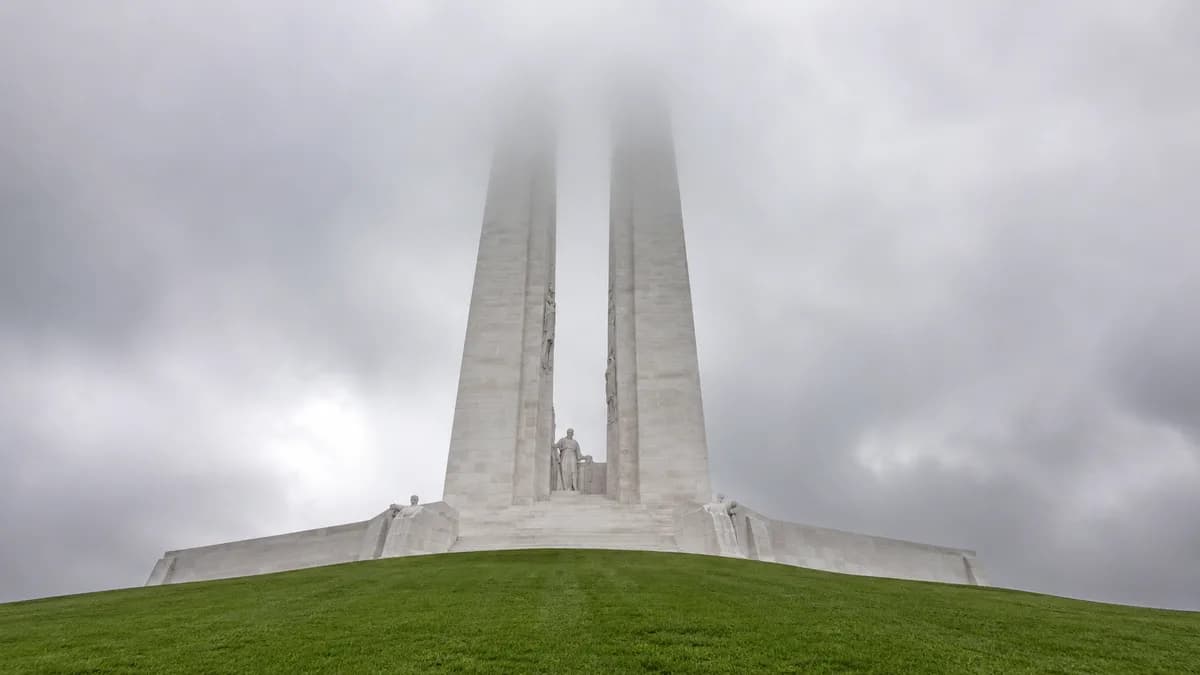
The Battle of Vimy Ridge was fought from April 9 to 12, 1917, in northern France, and it is the military event most often asked about on the citizenship test. The date to remember is straightforward: April 9, 1917, the day the attack began. It shows up in history questions as reliably as 1867 does for Confederation. To place Vimy within the wider Discover Canada chapter, see the guide Canada Explained.
Two facts make this battle memorable. First, all four divisions of the Canadian Corps fought together for the first time. Second, they took a ridge that French and British armies had failed to hold since 1914. The success came quickly, but the price was high: more than 10,600 Canadian casualties in four days, according to Veterans Affairs Canada.
This article covers the First World War context, how the Canadian Corps prepared, what happened day by day, the men who commanded, the memorial that stands on the ridge today, and the way the test approaches the subject. If you are reviewing all of Canada's conflicts, start instead with Canadian military history for the test, which runs from the First World War to Korea.
Vimy in one minute
Seven facts will answer almost every test question about Vimy. The rest of this article explains where those facts come from and why they matter.
- Date: April 9 to 12, 1917, with the assault starting on Easter Monday, April 9, at 5:30 a.m.
- Place: Vimy Ridge, in northern France near Arras, overlooking the Douai plain.
- Who: the Canadian Corps, close to 100,000 men, with all four divisions attacking side by side for the first time.
- Command: British Lieutenant-General Julian Byng, with Canadian Major-General Arthur Currie leading the 1st Division.
- Result: the ridge was taken in four days, where earlier offensives had failed.
- Cost: more than 10,600 Canadian casualties, close to 3,600 of them fatal, according to Veterans Affairs Canada.
- Memory: April 9 is Vimy Ridge Day, and the Canadian National Vimy Memorial has stood on the ridge since 1936.
These markers sit close to other dates on the syllabus, and that is where many candidates slip. If the years keep blurring together, the approach described in memorize the key dates helps you put them back in order instead of learning them one by one.
Why Vimy Ridge mattered in 1917
Vimy Ridge mattered because it looked out over the whole Douai plain: whoever held it could see for kilometres and direct artillery onto anything that moved below. Roughly seven kilometres long, it peaks at Hill 145, the height that gives its name to the most bitterly contested part of the battlefield.
The German army had held the ridge since the autumn of 1914 and had two and a half years to turn it into a fortress. Three successive lines of trenches, dugouts driven deep into the chalk, thick belts of barbed wire and machine gun nests sited to fire along the slope waited for any attacker. The ground itself favoured the defence, since the attacking infantry had to climb in the open.
The Canadian attack did not stand alone. It formed the northern wing of the Battle of Arras, a British offensive launched on April 9, 1917, to pull German reserves away before a major French attack on the Chemin des Dames a week later. Taking Vimy protected the left flank of that whole operation. Without the ridge, German gunners would have kept watching and shelling Allied positions at will.
Why the French and British had failed before
Before the Canadians arrived, French forces attacked the ridge repeatedly in 1915 and never managed to hold it, at a cost commonly put at around 150,000 killed and wounded. That record is what made the 1917 victory stand out.
The 1915 assaults ran into the same wall every time. Infantry climbed the slope in the open, the artillery lacked shells and accuracy, the wire stayed intact, and the few gains were swept away by German counterattacks launched from the far side of the crest. Below ground, both sides also fought a mining war, digging galleries to blow up each other's positions.
British troops took over the sector from the French in 1916, and the Canadian Corps moved in during October 1916, straight from the Battle of the Somme. The Canadians therefore spent the winter of 1916 and 1917 facing the ridge, watching it, mapping it and preparing an attack set for the spring. That long familiarity with the ground counted for as much as the reinforcements.
How the Canadian Corps prepared the attack
Preparation explains the result: for months the Canadian Corps mapped the ground, silenced German artillery, dug tunnels and rehearsed every soldier until he knew his objective by heart. Nothing was left to improvisation on the morning of the assault.
- Air reconnaissance and repeated trench raids to record every trench, dugout and machine gun nest.
- Sound ranging and flash spotting to locate German guns, counter-battery work directed by Lieutenant-Colonel Andrew McNaughton.
- A network of tunnels and underground subways that brought troops safely up to the start line, with water, electric light and dressing stations.
- More than one million shells fired in the weeks before the attack, a bombardment the German defenders nicknamed the week of suffering.
- A creeping barrage timed to the minute, behind which the infantry advanced in short, regular bounds.
- Full-scale taped outlines of the battlefield behind the lines, where battalions rehearsed their advance until it became automatic.
- Maps issued down to platoon level, so that every small group knew what to do if its leaders fell.
Two technical changes weighed heavily. A new type of shell fuze detonated on contact with barbed wire instead of digging a crater, which finally cut clean lanes through the belts. And counter-battery work located and destroyed a large share of the German artillery before the assault even started, so the return fire that met the attacking waves was far weaker than expected.
The other change was human. Platoons were reorganized to combine riflemen, bombers, rifle grenadiers and light machine gun crews, so a single platoon could work around a strongpoint and destroy it on its own. Each soldier received a precise objective and a timetable. Pushing responsibility that far down the chain of command was unusual in 1917, and it kept the attack moving even where officers had been killed.
Four divisions, one Canadian Corps
April 9, 1917, was the first time all four divisions of the Canadian Corps attacked together, on the same front, at the same hour. That organizational detail, more than the size of the operation, is what lodged in the country's memory.
Close to 100,000 Canadians were in the sector, drawn from every province. Among them were French-speaking battalions, including the 22nd Battalion, ancestor of the Royal 22e Regiment, Indigenous soldiers, farmers' sons from the Prairies, factory workers from eastern cities and a large number of recent immigrants born in Britain. That mixture belongs to the story of the battle as much as the plan of attack does.
The picture needs one qualification. The Canadian Corps served under the British First Army, commanded by General Henry Horne, and British units fought alongside it, including an infantry brigade attached to the 2nd Canadian Division. British batteries supplied a large share of the guns. Vimy was a Canadian victory, but it took place inside a much larger Allied operation.
How the battle unfolded, April 9 to 12, 1917
The attack went in at 5:30 a.m. on Easter Monday, April 9, 1917, through wind-driven sleet, and most of the ridge fell that same day. The men came out of the tunnels and jumping-off trenches at the exact moment the creeping barrage began to move.
The 1st, 2nd and 3rd Divisions reached their objectives through the morning and early afternoon, following the curtain of shells ahead of them. The 4th Division, given the hardest ground, was held up at Hill 145, the highest point, where an untouched German position raked the slope with machine gun fire. The summit was only taken the following day, April 10.
The last German strongpoint, a knoll at the northern end of the ridge, fell on April 12. The German army then pulled back several kilometres into the plain. The Canadian Corps took roughly 4,000 prisoners along with guns and equipment. In four days, a position held for two and a half years had changed hands.
What followed is more complicated, and the test does not ask about it. The Battle of Arras, of which Vimy was the northern wing, bogged down over the following weeks, and the French offensive on the Chemin des Dames turned into a costly failure. Vimy remained the one clean success of a disappointing spring, which partly explains the attention it received in the Allied press.
Who commanded the Canadian Corps at Vimy
The Canadian Corps was commanded by British Lieutenant-General Sir Julian Byng, and Canadian Major-General Arthur Currie, leading the 1st Division, played a central part in the planning. Remember both names: they come up often in military history questions.
Byng had led the Corps since 1916. He gave his subordinates room to act, insisted on rehearsals until every battalion knew its role, and listened to his Canadian officers. His men called themselves the Byng Boys. He later served as Governor General of Canada from 1921 to 1926, under the title Baron Byng of Vimy, an office described in our article on the role of the Governor General.
Currie, a British Columbia real estate broker turned soldier, had studied French reports on the lessons of Verdun and argued for precise methods: careful reconnaissance, limited objectives, artillery used with system rather than sheer weight. In June 1917, two months after Vimy, he replaced Byng and became the first Canadian to command the Canadian Corps. He went on to lead it at Hill 70, Passchendaele and through the Hundred Days of 1918.
The cost of the ridge: casualties and Victoria Crosses
Taking the ridge cost Canada more than 10,600 casualties in four days, close to 3,600 of them fatal, according to Veterans Affairs Canada. The official guide Discover Canada uses the rounded figure of 10,000 killed or wounded, which points to the same order of magnitude.
Those numbers deserve their wartime context. Roughly 620,000 Canadians and Newfoundlanders served between 1914 and 1918, and some 60,000 never came home, in a country of fewer than eight million people at the time. Almost every town and village lost men, which is why war memorials still stand in so many Canadian downtowns.
Four Victoria Crosses, the highest award for valour in the British Empire, were granted for actions on the ridge: to Private William Milne, Sergeant Ellis Sifton, Captain Thain MacDowell and Private John Pattison. Milne and Sifton were killed on the day of their action, and Pattison died two months later. The four citations capture the nature of the fighting: men rushing machine guns alone or in small groups.
Why Vimy became a symbol of Canadian identity
Vimy became a symbol because the country saw in it proof that Canadians who planned, trained and fought as one body could succeed where larger armies had failed. The idea of a country stepping out of colonial status and becoming a nation grew from that reading.
The war did change Canada's standing in the world. The Canadian Corps built a reputation as shock troops of the British Empire, a reputation Vimy sealed. In 1919, Canada signed the Treaty of Versailles in its own name and took a seat in the League of Nations, international recognition it had not held before 1914.
The official guide Discover Canada sums up this reading in two sentences: some historians say Canada came of age as a country during this battle, and April 9 is celebrated as Vimy Day. Since 2003, a federal act has made April 9 a national day of remembrance, and the flag on the Peace Tower in Ottawa flies at half-mast that day.
What historians say about the Vimy legend
Historians do not dispute the victory; they debate the claim that the Canadian nation was born on that particular day. Knowing the debate will not change the answer the test expects, but it makes the topic more interesting and easier to hold in memory.
Three arguments come up. First, the birth-of-a-nation phrase took hold gradually after the war, carried by veterans, ceremonies and above all the unveiling of the memorial in 1936, rather than by the newspapers of April 1917. Second, later Canadian operations at Hill 70, Passchendaele, Amiens and through the Hundred Days were often larger and more decisive in purely military terms.
Third, the country was not united in 1917. The conscription crisis that same year set much of French Canada against the English-speaking majority, and the December 1917 election was one of the most bitter in Canadian history. Similar questions about identity and about what holds Canadians together return in later periods, as our article on modern Canada shows.
The Canadian National Vimy Memorial
The white monument that crowns the ridge today is the Canadian National Vimy Memorial, designed by sculptor Walter Allward and unveiled on July 26, 1936. It stands on Hill 145, exactly where the 4th Division met the stiffest resistance in 1917.
Allward, a Toronto sculptor, won a 1921 competition that drew more than 150 designs. Construction took about a decade, using a pale limestone quarried on the Adriatic coast. Two tall pylons, representing Canada and France, frame some twenty carved figures. The best known of them, a draped woman with her head bowed, represents Canada mourning her fallen sons.
Carved into the walls are the names of 11,285 Canadians who died in France and whose graves were never found. The 1936 unveiling by King Edward VIII drew thousands of veterans and family members who had crossed the Atlantic for what became known as the Vimy pilgrimage. The memorial was restored and rededicated in 2007, with Queen Elizabeth II present.
The site itself is part of the story. In 1922, France granted Canada the free and perpetual use of about one hundred hectares on the ridge, in recognition of the Canadian sacrifice. Preserved trenches, mine craters and fenced areas grazed by sheep remain, because unexploded munitions still lie in the ground. Canadian student guides lead visitors through the site year round.
What the test asks about Vimy
Test questions about Vimy almost always turn on four things: the date, the place, the force involved and the meaning of the battle. None of them ask for tactical detail or exact casualty figures.
Practice with the questions below, worded the way you will meet them on test day. Answer from memory first, then check yourself.
- When did the Battle of Vimy Ridge take place? April 9 to 12, 1917; the attack began on April 9, 1917.
- Where is Vimy Ridge? In northern France, near Arras.
- Which force captured Vimy Ridge? The Canadian Corps, with all four of its divisions fighting together for the first time.
- Why is this battle important to Canada? Because Canadians succeeded where others had failed, and many see it as the moment Canada came into its own as a nation.
- Who commanded the Canadian Corps at Vimy? Lieutenant-General Julian Byng, with Arthur Currie leading the 1st Division.
- What is Vimy Ridge Day? April 9, the day Canada commemorates the battle.
- What stands on the ridge today? The Canadian National Vimy Memorial, on land granted to Canada by France.
The most common mistake is mixing up Vimy with the Normandy landings. Vimy means 1917 and the First World War; Juno Beach means June 6, 1944, and the Second World War. If the two blur together in your mind, read D-Day and Juno Beach right after this article to keep the conflicts apart.
How to revise Vimy before test day
Hold on to three things and you will answer correctly: April 9, 1917, Vimy Ridge in northern France, and four Canadian divisions attacking together for the first time. Everything else, memorial included, attaches naturally to those three points.
Revision works best when reading alternates with practice. Work through the history chapter with the chapter quizzes, then measure yourself under real conditions with the timed practice exams, and let smart review bring back the dates you missed. Our guide to the history questions on the test gathers the other events on the syllabus.
One closing thought. Vimy sticks in the mind once you see it as more than a victory: it is a place of remembrance that Canada still maintains in France today. To set the battle beside the other landmarks of the chapter, return to the guide Canada Explained, then continue with Canadian military history.