
Women's Right to Vote in Canada
When did Canadian women get the right to vote? Key dates, the Persons Case, and what to remember for the citizenship test.
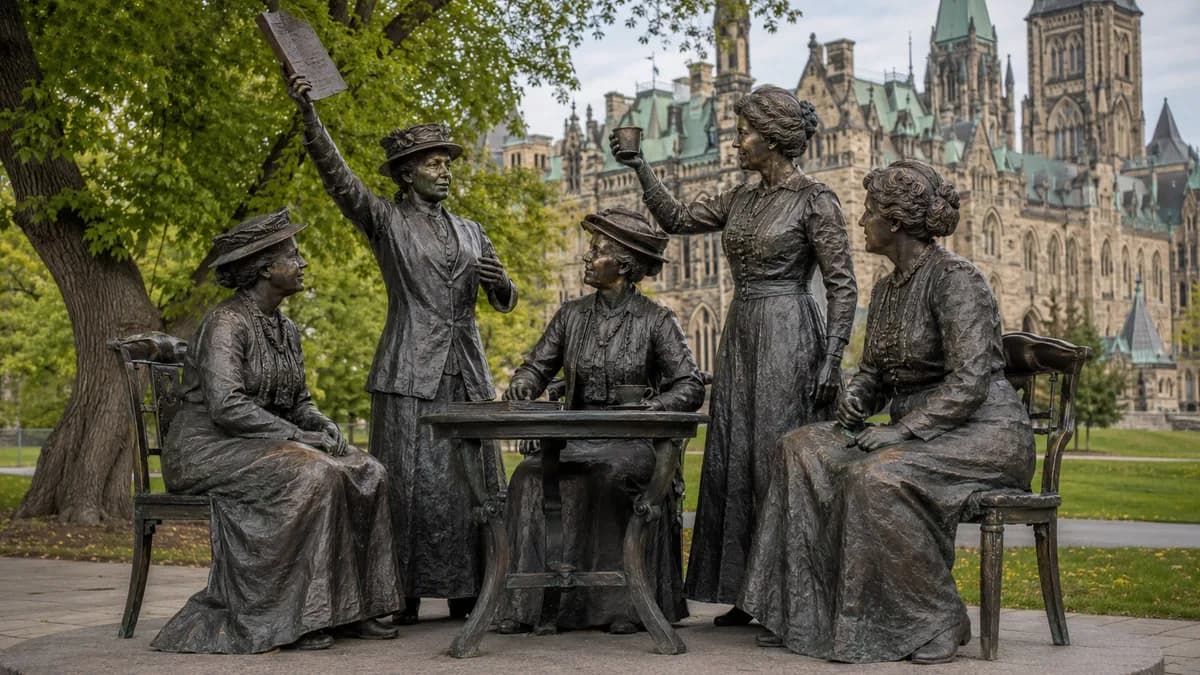
Most Canadian women gained the right to vote in federal elections in 1918, and Manitoba became the first province to grant most women the provincial vote in 1916. Getting there took decades of organizing, and full voting rights for every community took even longer. This guide walks through the timeline, the people who led the fight, the difference between provincial and federal rights, and the groups who had to wait, so you can answer test questions on this topic with confidence.
How women won the right to vote
Women won the vote through steady campaigning, province by province, until the federal government acted in 1918. The movement grew out of the late nineteenth and early twentieth centuries, when suffragists argued that women who paid taxes, raised families, and worked in their communities deserved a say in who governed them.
Manitoba led the way in 1916, becoming the first province to let most women vote and run in provincial elections. Saskatchewan and Alberta followed the same year, and British Columbia and Ontario joined in 1917. Momentum built quickly during the First World War, when many women took on new roles in factories, on farms, and in hospitals while men served overseas.
In 1918, Parliament extended the federal vote to most Canadian women, a decisive step toward equal citizenship. The change meant women could help choose the members of Parliament who make national laws. In just a few years, their organizing had reshaped Canadian democracy.
A timeline of women's suffrage in Canada
A short timeline shows how quickly the key milestones followed one another. Keep these dates handy, because the citizenship test tends to focus on the earliest and most important ones.
- 1916: Manitoba becomes the first province to grant most women the right to vote and hold provincial office.
- 1917: Saskatchewan, Alberta, British Columbia, and Ontario extend the provincial vote to most women.
- 1918: most Canadian women gain the right to vote in federal elections.
- 1921: Agnes Macphail becomes the first woman elected to the House of Commons.
- 1929: the Persons Case rules that women are persons who can be appointed to the Senate.
- 1940: Quebec becomes the last province to grant women the provincial vote.
- 1960: many Indigenous peoples gain the right to vote in federal elections without giving up their status.
The Persons Case and the Famous Five
In 1929, the Persons Case decided that women were persons under the law who could be appointed to the Senate. Until then, the government argued that the word persons in the Constitution did not include women, which kept them out of the Senate.
Five women from Alberta challenged that reading. Known as the Famous Five, they were Emily Murphy, Nellie McClung, Henrietta Muir Edwards, Louise McKinney, and Irene Parlby. They asked the courts to clarify whether women counted as persons for the purpose of Senate appointments.
Canada's highest court at the time said no, but the women appealed to the Judicial Committee of the Privy Council in Britain, then the final court of appeal for Canada. In 1929, that body overturned the decision and ruled that women were indeed persons eligible for the Senate.
The ruling did more than open the Senate. It confirmed that women could hold public office at the highest levels and strengthened democratic rights across the country. To see how such rights fit together today, read the Charter of Rights and Freedoms explained.
Key figures who shaped the vote
A handful of determined women turned public opinion and opened doors that had been closed for generations. Their names come up often in study material, so it helps to connect each one to a specific achievement.
Nellie McClung was a writer and speaker on the Prairies whose sharp humour won over crowds and pressured politicians in Manitoba and beyond. Emily Murphy became the first female magistrate in the British Empire and led the group that launched the Persons Case. Louise McKinney was one of the first women elected to a legislative assembly in the British Empire, in Alberta in 1917.
Agnes Macphail broke a different barrier. In 1921, she became the first woman elected to the House of Commons, taking a seat in a chamber that had been entirely male since Confederation. She went on to champion prison reform and the rights of farmers and workers. Together, these women showed that the vote was a starting point, not a finish line.
Provincial vote versus federal vote
Canada holds separate provincial and federal elections, so women gained the vote at different times depending on which level of government was involved. Understanding this split explains why 1916 and 1918 are both correct answers to different questions.
Provinces set their own election rules, so each province decided on its own when women could vote provincially. Manitoba moved first in 1916, several provinces followed in 1917, and Quebec was the last to act, granting women the provincial vote only in 1940.
The federal vote is set by Parliament and applies across the country. When Parliament extended the vote to most women in 1918, it covered federal elections everywhere in Canada, even in provinces that had not yet changed their own rules. On the test, 1916 refers to the first province, while 1918 refers to the federal milestone. To review how the two levels of government divide their powers, try a focused quiz in the learning section.
The women and communities who had to wait longer
The 1918 milestone did not cover everyone, and some communities waited decades longer for the same right. The early laws still carried restrictions based on race and Indigenous status, so full voting rights arrived unevenly.
Many Chinese and Japanese Canadians, including women, were barred from voting until the late 1940s, when those restrictions were finally lifted. Many Indigenous peoples faced the longest wait. First Nations people with status did not gain the right to vote in federal elections without giving up that status until 1960.
Remembering this fuller picture matters for two reasons. It keeps the story accurate, and it reflects how the test frames voting rights as something that expanded step by step rather than all at once. The vote we often summarize with the year 1918 was a major advance, but equal access to the ballot came later for several groups.
Why this matters for the test
Expect the citizenship test to ask about the year women gained the federal vote, the first woman elected to Parliament, and the Persons Case. These are among the most commonly tested facts about Canadian democracy and women's history.
Anchor your memory to a few key points: 1916 for Manitoba as the first province, 1918 for the federal vote, 1921 for Agnes Macphail, and 1929 for the Persons Case and the Famous Five. Official study material from the government covers these events, and you can read the primary source in the Discover Canada study guide.
For the wider picture of Canadian history and government, see the guide Canada Explained. When you are ready, take a timed practice exam or use spaced review to lock these dates into long-term memory.