
The Canadian Flag: History and Meaning
The Canadian flag explained for the citizenship test: the maple leaf, the official colours, and the date it was first raised, February 15, 1965.
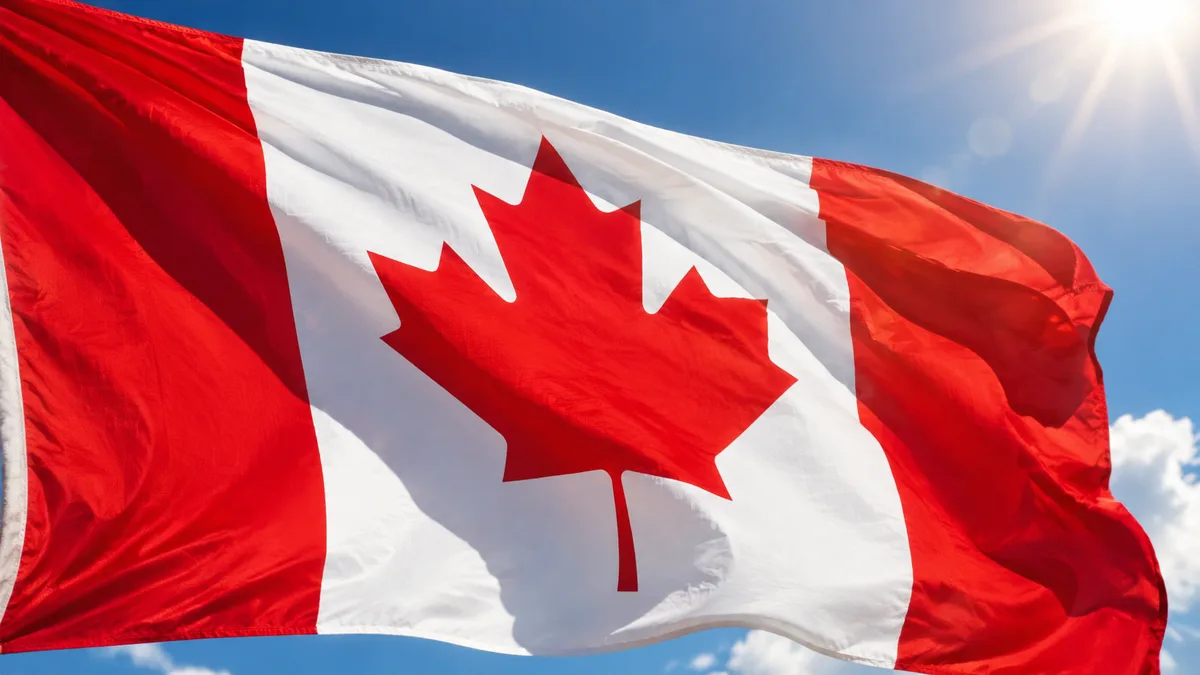
The Canadian flag has a single red 11-point maple leaf on a white square, framed by two red bands. It was first raised on February 15, 1965, a date now marked each year as National Flag of Canada Day. For the citizenship test, remember this design, the year 1965, the country's official colours, and the fact that this flag replaced the older Canadian Red Ensign.
What the flag looks like
The flag is a red and white design with a single red 11-point maple leaf in the centre. A red band sits on each vertical edge, a white square stands in the middle, and the maple leaf rests inside that white square. The layout is simple: two red bands on either side of a central white square. This clean shape is why so many candidates memorize the flag on the first try.
The leaf has eleven points, a purely graphic choice made so the shape stays clear even when the flag moves in the wind. The design does not represent any specific species of maple; it is a stylized leaf built to read easily and be recognized from a distance. That simplicity is deliberate: a strong symbol should be quick to see and easy to draw.
First raised in 1965
The current National Flag of Canada was first raised on February 15, 1965. On that day, the maple leaf flag was officially raised on Parliament Hill in Ottawa and became Canada's official flag. The date is one of the most commonly tested facts about the flag, so lock it in.
Since then, February 15 is marked each year as National Flag of Canada Day. It is not a public holiday, but a day of commemoration that recalls the adoption of the flag. The Government of Canada presents the flag and its history on Canada.ca, an official source that is useful for review.
The Great Flag Debate
The 1965 flag grew out of a long national discussion, often called the Great Flag Debate. For months, lawmakers and the public argued passionately over the design the new flag should carry. Many wanted a distinctly Canadian emblem; others wished to keep references to the country's British history.
The debate set many proposals against one another before the single maple leaf design was chosen and approved by Parliament. That decision ended decades of hesitation over a truly national flag. Understanding this context helps explain why the maple leaf, a symbol already widely tied to the country, ultimately won out.
The discussion ran mainly through 1964 and into early 1965, and it touched on more than colours and shapes. It raised a larger question: what should stand for Canada on its own flag. When the maple leaf design was finally settled, it offered an answer that most people could share, whatever their background or region. That is why the flag is often described as a unifying symbol rather than the emblem of any single group.
The flag it replaced: the Canadian Red Ensign
Before 1965, Canada used the Canadian Red Ensign. This red flag carried the British Union Jack in the upper corner and a shield representing Canada. It reflected the country's historic ties to the United Kingdom and served as an unofficial, then customary, flag for many years.
The shift from the Red Ensign to the maple leaf marks an important step: Canada adopted an emblem of its own, rather than reusing another country's flag. For the test, it is enough to remember that the current flag replaced the Canadian Red Ensign in 1965.
The Red Ensign had grown out of British naval tradition, and its use in Canada developed gradually rather than through a single clear decision. That slow, informal history is part of why the country eventually wanted a flag defined on purpose, with a design chosen for Canada itself. If you see the Red Ensign named as the old flag on a practice question, you can connect it directly to the 1965 change.
Red and white, Canada's official colours
Red and white are Canada's official colours. They are the only colours on the flag, and a test question may simply ask you to name them. They appear again and again in the country's symbols and emblems.
These two colours were declared Canada's official colours by King George V in 1921. That choice came more than forty years before the flag itself, which naturally guided the palette chosen in 1965. Remember red and white as a pair that goes hand in hand with Canadian symbols.
The meaning of the maple leaf
The red maple leaf has long been a symbol of Canada, well before the 1965 flag. It was already tied to the country in the nineteenth century and appeared on badges, coins, and monuments. Placing it at the centre of the flag confirmed a symbol the public already recognized.
Today the maple leaf is Canada's most recognized image around the world. It appears in other national symbols of Canada, which is why it holds the central place on the flag. It evokes nature, forests, and a shared identity from coast to coast.
The pairing of the leaf with red and white carries its own quiet meaning. The white square gives the leaf a clear background, so the eye goes straight to it, while the two red bands frame the centre and balance the design. Nothing in the flag is decorative for its own sake: each part supports one clear symbol at the heart of the flag. That focus is a large reason the flag reads so well on a pole, on a badge, or on a small pin.
National Flag of Canada Day
National Flag of Canada Day falls on February 15, the anniversary of the flag's first raising in 1965. It is a day of commemoration rather than a public holiday, and it invites Canadians to reflect on the flag and what it represents. Schools, communities, and public buildings often mark the date.
For the test, the day is a helpful memory hook: if you remember National Flag of Canada Day is February 15, you also remember the date the flag was first raised. The two facts point to the same day, so learning one reinforces the other. That kind of linked memory is exactly what short daily review is good at building.
Displaying and respecting the flag
The flag is treated as a national symbol, so it is displayed with care and respect. In everyday terms, that means flying it in good condition, keeping it clear of the ground when possible, and giving it a place of honour when shown with other flags. These customs are guidance and courtesy rather than a set of test traps.
You do not need to memorize detailed flag protocol for the citizenship test, but it helps to understand the spirit behind it. Respect for the flag reflects respect for the country and the rights and responsibilities that come with citizenship. Seeing the flag flown at ceremonies, including citizenship ceremonies, connects the symbol to the moment you formally become a citizen.
Symbols related to the flag
The flag is only one of the national symbols the test may cover. Knowing it alongside its neighbours helps you answer faster. Here are a few symbols often tied to the flag and the country.
- The maple leaf, the central emblem on the flag
- Red and white, the official colours since 1921
- The beaver, an animal long linked to the country's history
- National Flag of Canada Day, every February 15
- The former Canadian Red Ensign, used before 1965
Why the flag appears on the test
The flag comes up on the test because it is one of the basic symbols every new citizen should know. Questions focus mainly on the date, the design, and the colours. They are short and direct, which makes them easy points to earn if you have reviewed well.
To prepare, alternate theory and practice. Test yourself with our timed practice exams, review symbols by theme in the chapter quizzes, then lock in what escapes you with smart review. This short loop fixes facts like the 1965 date without painful memorization.
What to remember for the test
Sum up the flag in a few clear facts before the test. Here are the points to lock in.
- A red 11-point maple leaf on a white square
- Two red bands on the sides
- First raised: February 15, 1965
- Official colours: red and white, since 1921
- It replaced the Canadian Red Ensign
To place the flag among the other topics, see the guide Canada Explained. Then check your knowledge with our timed practice exams to spot what you still need to review.