
How the Parliament of Canada Works
The Parliament of Canada made simple: its three parts, how a bill becomes law, and what to remember for the citizenship test.
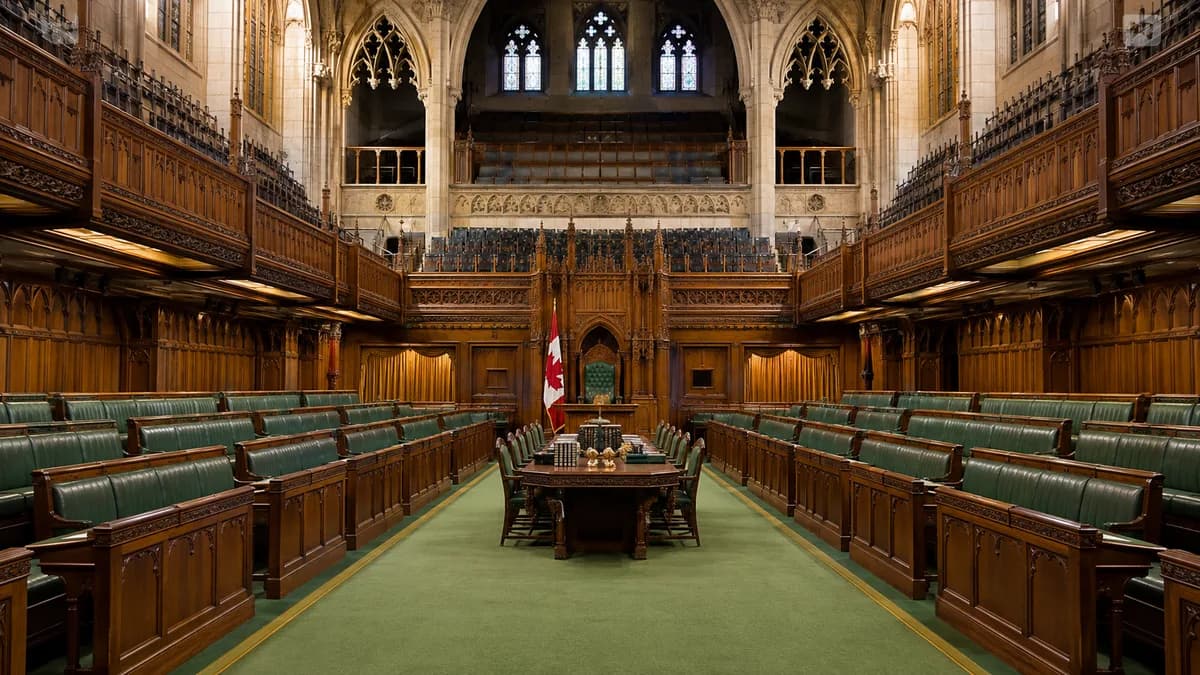
The Parliament of Canada makes federal laws and is made up of three parts: the Sovereign, the Senate and the House of Commons. A bill must be passed by both the House of Commons and the Senate, and then receive Royal Assent, before it becomes law. Parliament sits in Ottawa, the country's capital. That is the core of it; the rest of this article explains the role of each part and the exact path a law takes.
The three parts of Parliament
The federal Parliament brings together the Sovereign, the Senate and the House of Commons, which work together to make the country's laws. None of these parts makes law on its own. The design shares power on purpose, so that no single person or chamber decides everything. It is inherited from the British parliamentary system and adapted to Canada's federation.
The Sovereign (the Crown) is the first part. At the federal level, the Sovereign is represented by the Governor General. The second part is the Senate, made up of senators who are appointed, not elected. The third part is the House of Commons, made up of Members of Parliament (MPs) elected directly by Canadians. Together, these three elements form the law-making branch of the country.
- The Sovereign: King Charles III, represented federally by the Governor General.
- The Senate: appointed senators who review and study legislation.
- The House of Commons: MPs elected by voters in ridings (electoral districts).
- The place: the federal Parliament sits in Ottawa.
The role of the Sovereign and the Governor General
The Sovereign of Canada is King Charles III, but he does not carry out these duties day to day: at the federal level, he is represented by the Governor General. Canada is a constitutional monarchy, which means the head of state is a king or queen, but their powers are limited by the Constitution and exercised on the advice of elected officials.
The Governor General performs the Sovereign's duties in Canada. The Governor General gives Royal Assent to bills, summons and dissolves Parliament, and fills a role that is largely ceremonial and symbolic. In practice, the Governor General acts on the advice of the Prime Minister and Cabinet. This is an important point: the Sovereign and the Sovereign's representative reign, but elected officials govern.
The House of Commons: the elected chamber
The House of Commons is the elected part of Parliament: its members, the MPs, are chosen by voters. It is the more powerful of the two chambers, because it draws its authority directly from the vote of citizens. Most important bills, especially those dealing with money and taxes, begin their journey there.
Each MP represents a riding, which is a geographic area of the country, also called an electoral district. In a federal election, voters in each riding vote for the person they want as their MP. The party that wins the most seats usually forms the government, and its leader becomes the Prime Minister. The government must keep the confidence of the House to stay in power, which is a key feature of the parliamentary system. To dig deeper into how the two chambers compare, read our article on the Senate and the House of Commons.
Because the House is elected, it is answerable to the public at every election. MPs raise the concerns of the people in their ridings, debate government decisions and vote on new laws. This direct link between voters and lawmakers is the heart of Canadian democracy, and it explains why the House of Commons is often described as the centre of political life in Ottawa.
The Senate: the chamber of second thought
The Senate is the appointed chamber of Parliament: senators are not elected, they are appointed. The Senate is sometimes called the chamber of "sober second thought," because its role is to study carefully the bills already passed by the House of Commons. Senators can propose amendments, ask questions and draw attention to problems that might otherwise be missed.
Because they are not elected and do not run campaigns, senators can take the time to examine texts in a more measured way. The Senate also represents the regions and provinces of the country, so that smaller or less populated areas still have a strong voice in the making of federal law. A bill must be passed by the Senate, just as by the House of Commons, before it can continue on its path toward Royal Assent.
How a bill becomes law
A bill becomes law only after it has been passed by both the House of Commons and the Senate, and then received Royal Assent. Each stage acts as a check on the one before it. Here is the path a bill usually follows from start to finish.
- Step 1: the bill is introduced and debated in the House of Commons, where MPs study it and vote.
- Step 2: if it passes the House of Commons, the bill is sent to the Senate.
- Step 3: senators study the bill, may propose changes, and then vote in turn.
- Step 4: if the Senate passes it, the bill is presented to the Governor General.
- Step 5: the Governor General grants Royal Assent on behalf of the Sovereign, and the bill becomes law.
Within each chamber, a bill is not voted on just once. It is read and debated in stages, and a committee studies it closely and may suggest changes before it comes back for a final vote. This careful, repeated review is meant to catch mistakes and improve the text, which is why turning an idea into a federal law can take many months.
If either chamber rejects the bill or amends it, it cannot move forward as it stands. That is why a law must clear each of these stages. You can read the government's official explanation of this process on the How Canadians Govern Themselves page of the Discover Canada guide.
Where Parliament meets in Ottawa
The federal Parliament sits in Ottawa, the capital of Canada, on Parliament Hill. This is where MPs and senators gather to debate, study bills and vote. Knowing the capital is a common test point, so remember it clearly: federal laws for the whole country are made in Ottawa, while each province and territory has its own separate legislature for provincial and territorial matters.
Parliament does its work in sessions. After a federal election, the Governor General summons Parliament so that it can begin its work. When an election is called, Parliament is dissolved and the process starts again with a new group of elected MPs. Between these points, the two chambers meet, committees examine bills in detail, and legislation moves forward step by step.
Royal Assent: the final step
Royal Assent is the final approval that turns a passed bill into law; it is given by the Governor General on behalf of the Sovereign. Without this step, even a text approved by both chambers does not have the force of law. Royal Assent is a reminder that the Crown is part of Parliament and that laws are made in the name of the Sovereign.
In modern practice, Royal Assent is almost always granted: the Governor General follows the will of the elected Parliament. The step still matters, both constitutionally and symbolically. Parliament sits within the three branches of government: the legislative branch makes laws, the executive applies them and the judicial branch interprets them.
Why this matters for the test
Questions about Parliament come up often on the citizenship test, because they are part of the basic knowledge about how government works. You might be asked to name the three parts of Parliament, to explain how a law is made, or to say where the federal Parliament sits. These are among the most common topics.
The best preparation is regular practice. First review the chapter with our topic quizzes, test yourself with our timed practice exams, then strengthen weak spots with smart review. For the bigger picture, see the guide Canada Explained.