
Quebec on the Citizenship Test: Capital and Key Facts
Quebec City is Quebec's capital, a founding province of 1867. History, New France, French culture, practice questions and traps on the citizenship test.
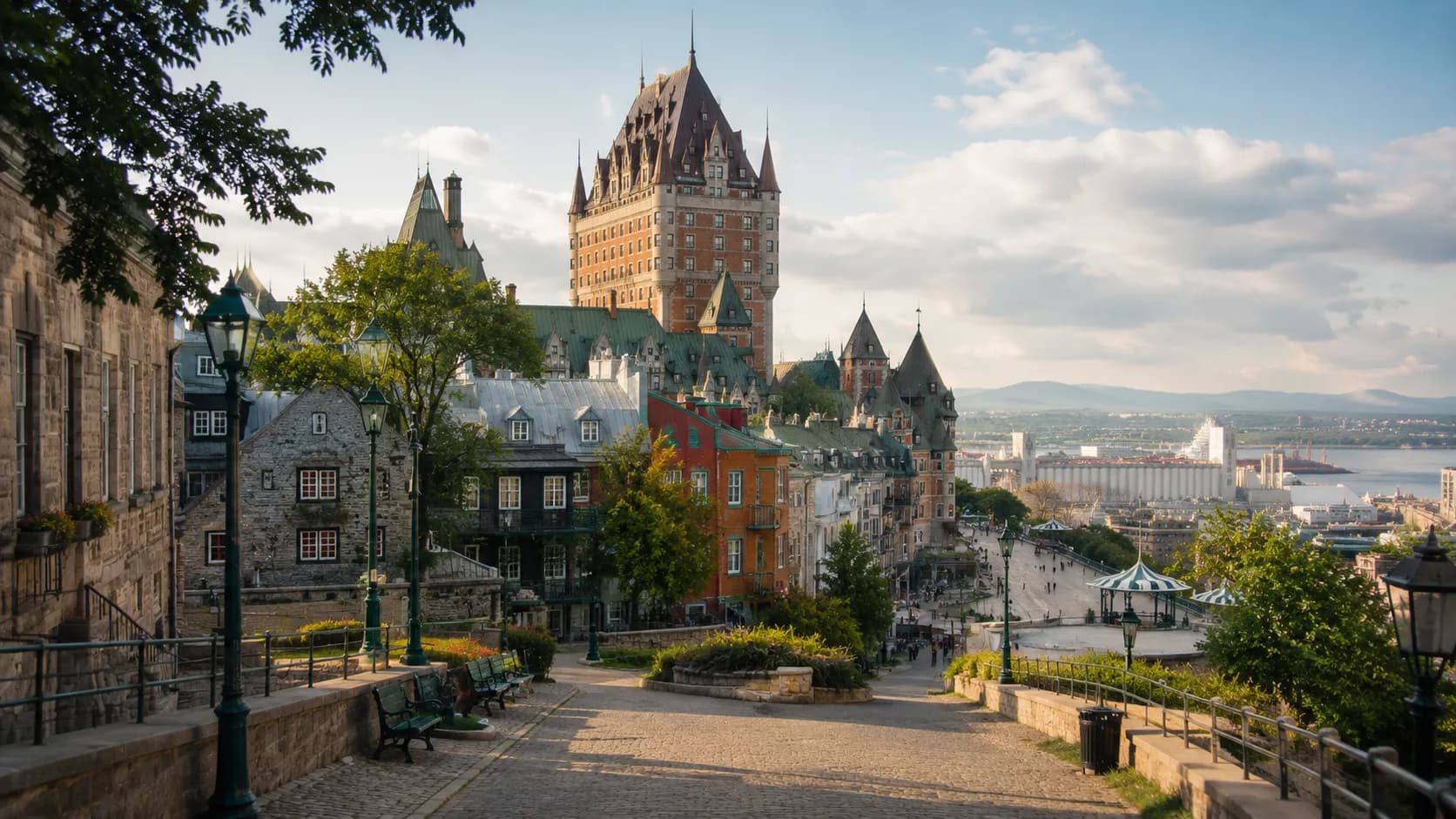
Quebec's capital is Quebec City, a province in Central Canada that has been part of Confederation since 1867. Quebec is home to the largest French-speaking population in Canada, around 8.5 million people. Its largest city is Montreal, which should not be confused with the capital. These distinctions come up often on the citizenship test, as do the founding of Quebec City by Samuel de Champlain in 1608 and the recognition of the Quebecois as a nation. This guide walks through, section by section, what the official Discover Canada guide expects you to know about Quebec, with a timeline, the people to remember, practice questions and the mistakes to avoid.
Capital and Region of Quebec
Quebec City is the provincial capital, while Montreal is the largest city in the province. Many candidates confuse the two, but the seat of the provincial government, the National Assembly, is indeed in Quebec City, founded on the banks of the St. Lawrence River. To avoid ambiguity, the guide says Quebec City when it means the capital and simply Quebec when it means the province.
Quebec belongs to the region known as Central Canada, alongside Ontario. It is the only province where French is the sole official language, giving it a cultural character unlike anywhere else in the country. Quebec is also Canada's largest province by area: its territory stretches from the shores of the St. Lawrence to Nunavik in the far north, home to Inuit communities.
Timeline: From First Nations to Modern Quebec
Before Europeans arrived, the land that became Quebec was home to many Indigenous peoples: the Innu, the Cree, the Algonquin, the Mohawk, the Huron-Wendat and, in the north, the Inuit. Jacques Cartier sailed up the St. Lawrence in 1534 and 1535 and claimed the land for the King of France. The word Canada itself comes from kanata, meaning village in the Iroquoian language, and Cartier is the one who spread it.
- 1534: Jacques Cartier raises a cross at Gaspé and claims the territory for France
- 1608: Samuel de Champlain founds Quebec City, the first permanent settlement of New France
- 1642: Ville-Marie is founded, later to become Montreal
- 1759: the Battle of the Plains of Abraham, a British victory that ends New France
- 1774: the Quebec Act restores French civil law and guarantees religious freedom for Catholics
- 1867: Quebec becomes one of the four founding provinces of Canada
- 1960s: the Quiet Revolution modernizes Quebec's state, education system and economy
- 2006: the House of Commons recognizes that the Quebecois form a nation within a united Canada
This is probably the longest chain of events the official guide gives for any single province. Focus on the dates the test can ask about directly: 1534 for Cartier, 1608 for Champlain, 1759 for the Plains of Abraham and 1867 for Confederation. The other milestones mainly help you understand why Quebec kept its language and institutions.
History and New France
Quebec grew out of the French colony of New France. Quebec City was founded by Samuel de Champlain in 1608, making it one of the oldest European settlements in North America. This date is a key fact to know for the exam. For more than 150 years, New France developed along the St. Lawrence through the fur trade, missions and the farms of the habitants.
In 1759, on the Plains of Abraham, British troops under General Wolfe defeated the French under the Marquis de Montcalm; both commanders died in the battle. New France came under British control, but the Quebec Act of 1774 preserved French civil law and the Catholic religion. In 1867, Quebec became one of the four founding provinces of Canada. Its French history explains its distinct legal tradition, based on civil law, while the rest of Canada follows common law.
People from Quebec in Discover Canada
The official guide names several Quebec figures the test may mention. Jacques Cartier and Samuel de Champlain top the list, followed by the Count of Frontenac, who defended Quebec City against the English. Sir George-Étienne Cartier, a Father of Confederation, convinced French Canadians to join the 1867 project. Sir Wilfrid Laurier, the first French-Canadian prime minister, led the country from 1896 to 1911 and appears on the five-dollar bill.
The guide also covers Louis-Joseph Papineau and the rebellions of 1837 and 1838, which led to responsible government, as well as the Quiet Revolution of the 1960s, when Quebecers took control of their economy and institutions. Finally, the 1980 and 1995 referendums on sovereignty, both rejected, are noted as important moments in the country's recent history.
Geography and the St. Lawrence River
The St. Lawrence River lies at the heart of Quebec's history and economy. This great waterway made exploration, the fur trade and the growth of cities possible. To this day, it connects the interior of the continent and the Great Lakes to the Atlantic Ocean through the St. Lawrence Seaway, and the major ports of Montreal and Quebec City depend on it.
- The St. Lawrence River, a major historical and economic route
- Quebec City, the historic capital on the river, with its fortified Old Quebec
- Montreal, a metropolis built on an island in the St. Lawrence
- The Gaspé Peninsula and the Gulf of St. Lawrence to the east
- The Canadian Shield, the Laurentians and the northern forests
- Nunavik, Inuit territory in Quebec's far north
Quebec is also known for hydroelectric power, generated from its many rivers and the huge dams of the north. This resource makes the province a leader in clean energy in Canada and lets it export electricity to neighbouring provinces and the United States.
Cities, Population and Language
Quebec is home to the largest French-speaking population in Canada, about 8.5 million people. Montreal is the second largest city in the country and a major cultural centre, while Quebec City keeps a unique historic charm with its fortified Old Quebec, a World Heritage site. Laval, Gatineau (across from Ottawa), Sherbrooke, Trois-Rivières and Saguenay round out the list of major cities.
The French language is central to the province's identity, and the Charter of the French Language makes it Quebec's official language. The province also has a historic English-speaking community, mostly in Montreal, and welcomes immigrants from many French-speaking countries, including Haiti, North Africa and West Africa. To prepare, you can review the facts about Quebec in the learning section.
Economy and Culture
Quebec's economy relies heavily on hydroelectric power and aerospace, two sectors where the province excels. Montreal is an important hub of the global aerospace industry, and the official guide also highlights Quebec's role in pulp and paper, forestry, mining and information technology. Quebec culture, with its language, cuisine, music, cinema and festivals, is recognized across the country.
Civil law, inherited from France, sets the Quebec legal system apart from the rest of Canada. This feature, like the recognition of the Quebecois as a nation by the House of Commons, shows the province's unique place in the federation. Quebec's national holiday falls on June 24, Saint-Jean-Baptiste Day, and the Quebec Winter Carnival brings the capital to life every winter.
Practice Questions About Quebec
Check your knowledge with these questions modelled on the official test format. Pick an answer, then read the explanation to understand the trap, if there is one.
- What is the capital of Quebec? a) Montreal b) Quebec City c) Laval. Answer: b) Quebec City. Montreal is the largest city, not the capital.
- Who founded Quebec City, and in what year? a) Jacques Cartier, 1534 b) Samuel de Champlain, 1608 c) Wolfe, 1759. Answer: b) Champlain in 1608. Cartier explored the river in 1534 but founded no lasting settlement.
- True or false: Quebec follows common law like the other provinces. Answer: false. Quebec uses civil law, inherited from France.
- What happened in 1759 on the Plains of Abraham? a) the founding of Montreal b) a British victory over France c) Confederation. Answer: b) a British victory that ended New France.
- What was the Quiet Revolution? a) a civil war b) a period of rapid modernization in Quebec in the 1960s c) the rebellion of 1837. Answer: b) the rapid modernization of Quebec in the 1960s.
- True or false: the House of Commons recognized that the Quebecois form a nation within a united Canada. Answer: true.
Five or more correct out of six: you are ready for the Quebec questions. Below that, reread the timeline, then take a free mock exam to practise under the same 45-minute clock you will face on test day.
Common Mistakes: Quebec City, Montreal and Other Traps
Mixing up Quebec City and Montreal is by far the most common error. Montreal is bigger, better known abroad and receives more immigrants, but the capital is still Quebec City. Here are the other traps we see among candidates.
- Quebec City versus Montreal: the capital is Quebec City, the largest city is Montreal.
- Cartier versus Champlain: Cartier explores in 1534, Champlain founds Quebec City in 1608.
- Plains of Abraham: a British victory in 1759, not a French one, and both generals died there.
- Quiet Revolution: a social and political transformation of the 1960s, not an armed conflict.
- Official language: Quebec's only official language is French; New Brunswick is the only officially bilingual province.
- Quebecois nation: recognized by the House of Commons within a united Canada, which does not mean a separate country.
For each trap, memorize the pair of names or dates together. Test questions often place the right answer and its false twin side by side, and that is exactly where points are lost.
What the Test Asks About Quebec
Questions about Quebec often focus on the capital, the founding of Quebec City in 1608 and the province's French-speaking character. Remember that Quebec City is the capital, that Montreal is the largest city, and that Quebec is a founding province from 1867. The Plains of Abraham, civil law and the recognition of the Quebecois nation complete the list of must-know facts.
- Provincial capital: Quebec City
- Largest city: Montreal, Canada's second largest city
- Region: Central Canada, with Ontario
- Founding of Quebec City: by Champlain, in 1608; Cartier's exploration in 1534
- Joined Confederation: founding province, 1867
- Notable facts: largest French-speaking population, St. Lawrence River, civil law, hydroelectric power and aerospace, Quebecois nation recognized
The test has 20 questions, with a pass mark of 15 out of 20 in 45 minutes, based on the official Discover Canada guide, available on the Government of Canada website. After memorizing these facts, lock them in with smart review, which keeps bringing back the questions you missed until they stick.