
26 Citizenship Test Questions on Provinces and Capitals
26 practice questions on Canada's 13 provinces and territories: every capital, the year each joined, the classic traps, and memory tips that work.
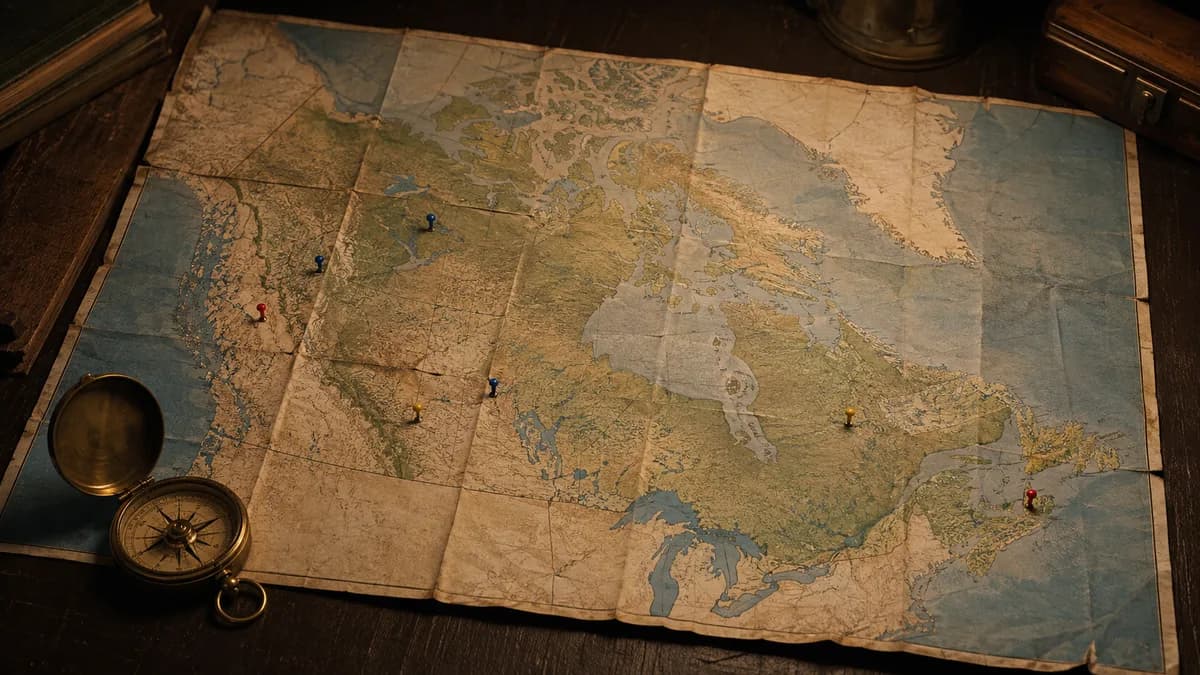
Canada has 10 provinces and 3 territories, so there are 13 capitals to know for the citizenship test: Toronto, Quebec City, Halifax, Fredericton, Winnipeg, Victoria, Charlottetown, Regina, Edmonton, St. John's, Yellowknife, Whitehorse, and Iqaluit. Ottawa is the capital of the country and sits in Ontario. Here are 26 practice questions, two per province and territory, each with the correct answer and a short explanation.
Out of the 20 questions on the test, only a handful cover provinces, capitals, and the years each one joined Confederation. They are also the easiest points to lock in: the list is closed, it has not changed since Nunavut was created in 1999, and none of these questions require reasoning, only recall. Since you need 15 correct answers out of 20 to pass, dropping two capitals for lack of review is expensive. To see where this topic sits among the others, read our guide to citizenship test questions by topic.
Treat this set as a test, not as reading. Read the question, say your answer out loud, and only then check it: active recall is what fixes facts in memory, not passive rereading. The questions are grouped by region, in the order used by the official Discover Canada guide, moving east to west and then north.
The 13 capitals at a glance
Canada has 13 provincial and territorial capitals, plus Ottawa, the national capital, which is located in Ontario. Here is the full list, sorted by region and paired with the year each province or territory joined the country, the two facts the exam combines most often.
- Newfoundland and Labrador (Atlantic): St. John's, joined Confederation in 1949
- Prince Edward Island (Atlantic): Charlottetown, 1873
- Nova Scotia (Atlantic): Halifax, 1867
- New Brunswick (Atlantic): Fredericton, 1867
- Quebec (Central Canada): Quebec City, 1867
- Ontario (Central Canada): Toronto, 1867 (Ottawa, the capital of Canada, is also in Ontario)
- Manitoba (Prairies): Winnipeg, 1870
- Saskatchewan (Prairies): Regina, 1905
- Alberta (Prairies): Edmonton, 1905
- British Columbia (West Coast): Victoria, 1871
- Yukon (North): Whitehorse, a separate territory since 1898
- Northwest Territories (North): Yellowknife, joined Canada in 1870
- Nunavut (North): Iqaluit, created in 1999
Keep this list as your reference: the 26 questions below work through it one entry at a time, in the same order. If you then want the full profile of a single province, each one has its own page, for example Ontario on the citizenship test.
Atlantic provinces (questions 1 to 8)
The Atlantic provinces are Newfoundland and Labrador, Prince Edward Island, Nova Scotia, and New Brunswick, and their capitals are St. John's, Charlottetown, Halifax, and Fredericton. Two of them are among the four original provinces of 1867; the other two joined later, including the very last province to join Canada.
Question 1. What is the capital of Newfoundland and Labrador? Answer: St. John's. It is the capital of the easternmost province, and the only Canadian capital whose name contains an apostrophe, a small detail that makes it easy to remember.
Question 2. In what year did Newfoundland and Labrador join Confederation? Answer: 1949. It was the last province to join Canada, more than 80 years after the four original provinces.
Question 3. What is the capital of Prince Edward Island? Answer: Charlottetown. Learn Prince Edward Island and Charlottetown as a single block: two British royal names that belong together. If you live in the province, our Prince Edward Island citizenship test guide covers the local details.
Question 4. In what year did Prince Edward Island join Confederation? Answer: 1873. It joined six years after the Confederation of 1867, which makes it the fourth date on the timeline you need to memorize.
Question 5. What is the capital of Nova Scotia? Answer: Halifax. Halifax is the capital of Nova Scotia, one of the four provinces present at the birth of the country.
Question 6. In what year did Nova Scotia join Confederation? Answer: 1867. It is one of the four founding provinces, together with New Brunswick, Ontario, and Quebec.
Question 7. What is the capital of New Brunswick? Answer: Fredericton. The capital of New Brunswick is neither Moncton nor Saint John: it is Fredericton, a classic trap we cover further down.
Question 8. In what year did New Brunswick join Confederation? Answer: 1867. It is the fourth of the original provinces, which already gives you four provinces attached to a single date.
Central Canada (questions 9 to 12)
Central Canada is made up of Ontario and Quebec, whose capitals are Toronto and Quebec City. It is also the region that hides the single most common confusion on this topic, because Ottawa, the capital of the country, sits in Ontario without being the capital of Ontario.
Question 9. What is the capital of Ontario? Answer: Toronto. Toronto is the provincial capital of Ontario, even though Ottawa is also located within Ontario's borders.
Question 10. What is the capital of Canada, and which province is it in? Answer: Ottawa, in Ontario. Ottawa is the national capital rather than a provincial capital, a distinction the exam checks regularly.
Question 11. What is the capital of Quebec? Answer: Quebec City. It is the only case where the capital carries exactly the same name as the province, which makes it the easiest of the thirteen to remember.
Question 12. In what year did Quebec join Confederation? Answer: 1867. Quebec and Ontario are two of the four provinces that formed Canada that year, so Ontario shares the same date.
Prairie provinces (questions 13 to 18)
The three Prairie provinces are Manitoba, Saskatchewan, and Alberta, and their capitals are Winnipeg, Regina, and Edmonton. This is the region that produces the most errors after Central Canada, because two of its capitals are overshadowed by a better-known neighbouring city.
Question 13. What is the capital of Manitoba? Answer: Winnipeg. Winnipeg is both the capital of Manitoba and the first Prairie capital you reach travelling from east to west.
Question 14. In what year did Manitoba join Confederation? Answer: 1870. Manitoba was the first province added after 1867, the same year the Northwest Territories became part of Canada.
Question 15. What is the capital of Saskatchewan? Answer: Regina. Careful: it is not Saskatoon, even though that name sounds much closer to the province's own.
Question 16. In what year did Saskatchewan join Confederation? Answer: 1905. It shares that date with its neighbour Alberta, giving you two provinces for a single year to memorize.
Question 17. What is the capital of Alberta? Answer: Edmonton. It is not Calgary, the other major Alberta city, but Edmonton that houses the provincial government.
Question 18. In what year did Alberta join Confederation? Answer: 1905. Alberta and Saskatchewan joined together on the same date, a pair worth learning as one item.
West Coast (questions 19 and 20)
The West Coast is the only region in the guide made up of a single province, British Columbia, whose capital is Victoria. Two questions therefore cover the whole region, but they hide one of the most persistent traps on the list.
Question 19. What is the capital of British Columbia? Answer: Victoria. The capital is Victoria, not Vancouver, even though Vancouver is the name that comes to mind first for most people.
Question 20. In what year did British Columbia join Confederation? Answer: 1871. It joined Canada four years after the original provinces, right after Manitoba and before Prince Edward Island.
Northern territories (questions 21 to 26)
The three territories are Yukon, the Northwest Territories, and Nunavut, and their capitals are Whitehorse, Yellowknife, and Iqaluit. They are territories, not provinces, and that distinction is worth just as many points as the capitals themselves.
Question 21. What is the capital of Yukon? Answer: Whitehorse. Whitehorse is the capital of the westernmost territory, the one that borders Alaska.
Question 22. In what year did Yukon become a separate territory? Answer: 1898. Yukon separated from the Northwest Territories that year, making it the second territory on the Canadian map.
Question 23. What is the capital of the Northwest Territories? Answer: Yellowknife. The name of the territory is plural, but it has only one capital, Yellowknife.
Question 24. In what year did the Northwest Territories become part of Canada? Answer: 1870. That is the same year Manitoba joined, a convenient coincidence that lets you revise both at once.
Question 25. What is the capital of Nunavut? Answer: Iqaluit. Iqaluit is the country's newest capital, the seat of the most recently created territory.
Question 26. In what year was Nunavut created? Answer: 1999. It is the most recent date on the whole timeline and the last change made to Canada's political map.
When did each province join Canada?
The last province to join Canada was Newfoundland and Labrador, in 1949; the last territory is Nunavut, created in 1999. At the other end, Ontario, Quebec, Nova Scotia and New Brunswick never "joined" anyone: they are the four founding provinces of 1867. Here is the full order, useful for the questions that ask which province came first or last:
- 1867: Ontario, Quebec, Nova Scotia, New Brunswick (Confederation).
- 1870: Manitoba, and the Northwest Territories.
- 1871: British Columbia.
- 1873: Prince Edward Island.
- 1898: Yukon (territory).
- 1905: Saskatchewan and Alberta.
- 1949: Newfoundland and Labrador, the tenth and last province.
- 1999: Nunavut, the thirteenth and last territory.
Those entry dates tell the story of the country's growth from sea to sea; to understand why it all starts in 1867, read our guide When did Canada become a country?.
The classic traps to avoid
Five confusions explain the large majority of mistakes on this topic: Toronto and Ottawa, Victoria and Vancouver, Regina and Saskatoon, Edmonton and Calgary, Fredericton and Moncton. In each case the better-known city is not the capital, and that gap is exactly what the exam exploits.
Toronto or Ottawa? Toronto is the capital of Ontario; Ottawa is the capital of Canada and is also located in Ontario. One province therefore contains two capitals, one provincial and one national. If the question says "capital of Canada," answer Ottawa; if it says "capital of Ontario," answer Toronto.
Victoria or Vancouver? The capital of British Columbia is Victoria. Vancouver is not the capital of anything, and the fact that its name is more familiar does not change the expected answer.
Regina or Saskatoon, Edmonton or Calgary? On the Prairies the same logic applies twice: the capital of Saskatchewan is Regina, and the capital of Alberta is Edmonton. Saskatoon and Calgary are traps of the same kind, so treating them as one rule ("it is never the city I think of first") saves you from both mistakes at once.
Fredericton or Moncton? The capital of New Brunswick is Fredericton, not Moncton and not Saint John. This trap is rarer than the others, but it shows up regularly in question banks because the province has several cities of comparable profile.
Provinces or territories? Canada has 10 provinces and 3 territories, 13 entities in total. If a question asks how many provinces there are, the answer is 10, not 13; if it asks how many territories, the answer is 3. Yukon, the Northwest Territories, and Nunavut are never provinces, however the question is worded.
How to memorize the 13 capitals
The fastest method is to learn the capitals in regional blocks of three or four, then attach them to the timeline of the years each province and territory joined the country. Thirteen isolated items are hard to retain; four groups of three or four, recited east to west and then north, stay in memory far longer.
Start with the Atlantic (St. John's, Charlottetown, Halifax, Fredericton), move to Central Canada (Quebec City, Toronto), continue across the Prairies (Winnipeg, Regina, Edmonton), then the West Coast (Victoria), and finish in the North (Whitehorse, Yellowknife, Iqaluit). Recite that route out loud two or three times a day for a week: saying it aloud works better than rereading the list.
Then layer the timeline on top. It holds fewer markers than you might expect, because several entities share the same year:
- 1867: Ontario, Quebec, Nova Scotia, and New Brunswick, the four original provinces
- 1870: Manitoba and the Northwest Territories
- 1871: British Columbia
- 1873: Prince Edward Island
- 1898: Yukon
- 1905: Saskatchewan and Alberta, together
- 1949: Newfoundland and Labrador, the last province to join
- 1999: Nunavut, the newest territory
Eight dates therefore cover all thirteen entities. That work pays off twice, since the same years come back in the test questions on dates and in the history questions.
A third technique, the hardest and the most useful: test yourself backwards. Instead of starting from the province to find the capital, start from the capital and name the province, then the year. If you can answer in both directions, no wording of the question can catch you out on test day.
Always check your answers against the official source: the Discover Canada study guide on canada.ca is the only reference the real questions are drawn from. Then turn reading into reflexes: drill the chapter as a quiz, and let spaced review bring back the capitals you missed at exactly the right moment.
Next step: from the list to a mock exam
If you answered at least 23 of these 26 questions correctly, provinces and capitals are covered; below that, go back over only the regions you missed before running the full set again. This topic is worth just a few points out of 20, but they are the most profitable points on the whole test: no interpretation, no nuance, simply a closed list of thirteen items.
Once the list is solid, put it back in context with our complete guide to questions by topic, then measure yourself under real conditions with a timed 20-question mock exam. On the day a capital comes up, the answer should arrive without hesitation, and that is exactly what this set trains you to do.