
Ontario on the Citizenship Test: Capital and Key Facts
Toronto is Ontario's capital, Canada's most populous province. History, geography, economy, practice questions and common traps on the citizenship test.
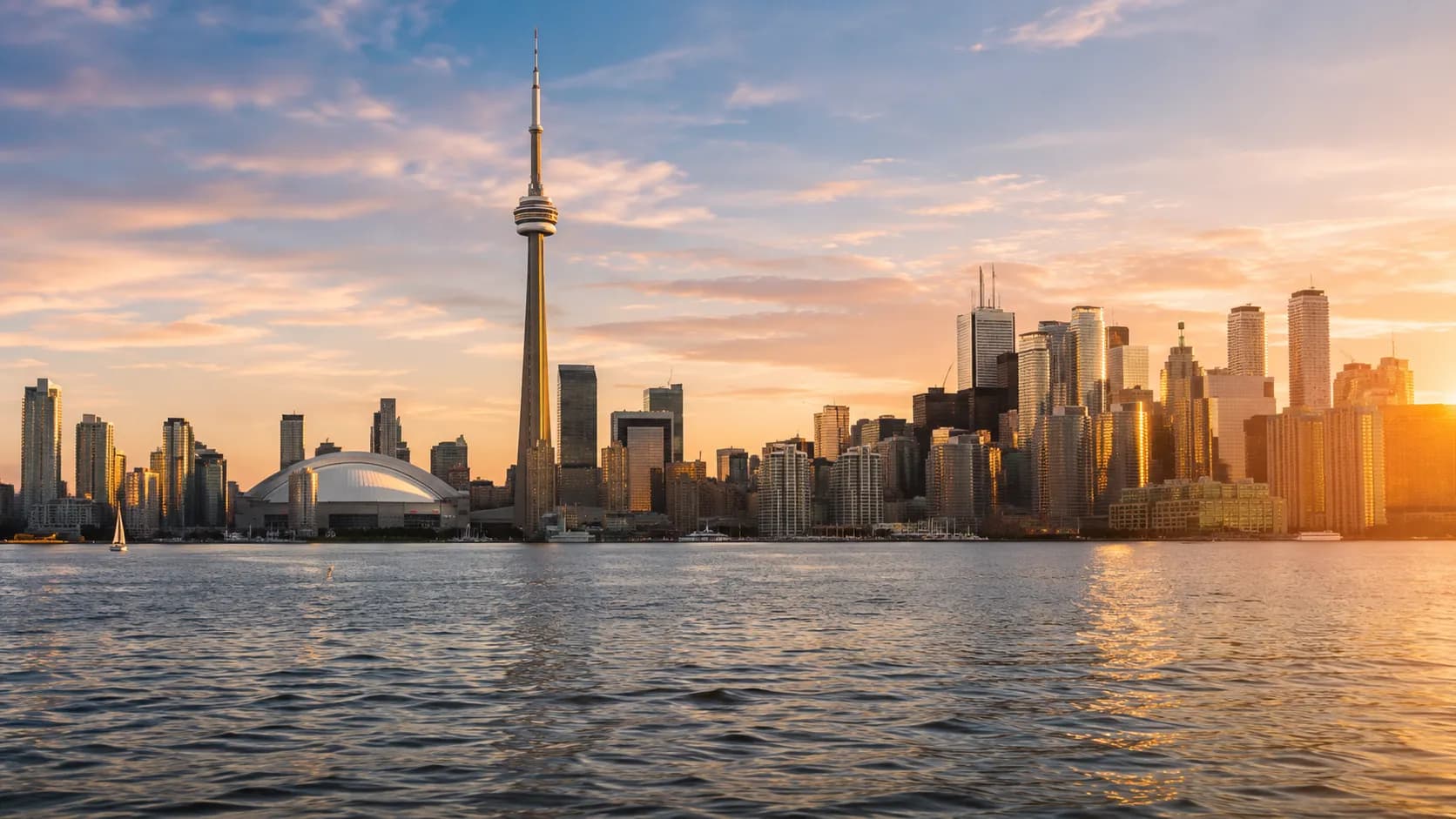
Ontario's capital is Toronto, a province in Central Canada that has been part of Confederation since 1867. Ontario is the most populous province in the country, home to roughly 15 million people, and Toronto is also Canada's largest city. Ottawa, the national capital where Parliament sits, is in Ontario as well. These facts come up often on the citizenship test, so they are well worth memorizing. This guide gathers what the official Discover Canada guide says about Ontario: its geography, history, economy, the people you should know, the classic traps and a set of practice questions to check what you have learned.
Capital and Region of Ontario
Toronto is the provincial capital of Ontario and the largest city in Canada. Be careful not to mix up the two capitals that the province holds. Toronto is the seat of the provincial government, with its Legislative Assembly at Queen's Park, while Ottawa, farther east on the Ottawa River, is the national capital of Canada, where the federal Parliament sits. Both cities are in Ontario, but they play very different roles.
Ontario belongs to the region known as Central Canada, alongside neighbouring Quebec. Together, these two provinces are home to more than half of Canada's population. Discover Canada divides the country into five regions: Atlantic Canada, Central Canada, the Prairies, the West Coast and the North. Telling the provincial capital apart from the national capital is a classic test trap, so keep it simple: Toronto for the province, Ottawa for the country.
Timeline: From Indigenous Peoples to Modern Ontario
Ontario's history begins long before Europeans arrived. The Anishinaabe, the Haudenosaunee (Iroquois), the Huron-Wendat and the Cree lived on this land for thousands of years, around the Great Lakes and in the northern forests. French explorers and traders, followed by the British, arrived in the 17th century, drawn by the fur trade along the lakes and rivers.
- 1780s: Loyalists arrive after the American Revolution, having stayed loyal to the British Crown
- 1791: Upper Canada is created, the forerunner of Ontario, with the future Toronto as its capital
- 1812 to 1814: the War of 1812 against the United States, with several battles fought on Ontario soil
- 1841: Upper Canada and Lower Canada are joined in the Province of Canada
- 1867: Ontario becomes one of the four founding provinces of the Dominion of Canada
- 20th century: industrialization, car manufacturing, mass immigration and the rise of Toronto as the country's financial centre
This timeline explains why Ontario takes up so much room in the official guide. The province brings together Loyalist history, the birth of Canada's parliamentary institutions and the economic growth of the 20th century. Focus on two dates above all: 1791 for the creation of Upper Canada and 1867 for Confederation. The other milestones mainly help you keep events in the right order.
History and Joining Confederation
Ontario is one of the four founding provinces of Canada in 1867. Along with Quebec, Nova Scotia and New Brunswick, it signed the act that created the Dominion of Canada on July 1, 1867. That date is one of the most important to know for the exam. The country's first prime minister, Sir John A. Macdonald, was a lawyer from Kingston, Ontario, and the new federal government settled in Ottawa.
The region was first home to many Indigenous peoples, and later welcomed Loyalists who came from the United States after the American Revolution. This history helps explain why Ontario became the political and industrial heart of the country. Ottawa was chosen as the national capital by Queen Victoria well before Confederation: this small lumber town, halfway between Toronto and Montreal and safely away from the American border, offered a compromise between the English-speaking and French-speaking regions.
People and Events from Ontario in Discover Canada
Several figures in the official guide are tied to Ontario. Major-General Sir Isaac Brock, who died at the Battle of Queenston Heights in 1812, and Laura Secord, who walked for hours in 1813 to warn British troops of an American attack, are two heroes of the War of 1812 linked to the Niagara region. John Graves Simcoe, the first Lieutenant Governor of Upper Canada, passed a law in 1793 to abolish slavery, well ahead of the rest of the British Empire.
Sir John A. Macdonald, Canada's first prime minister, built his whole career in Kingston. The guide also mentions the Underground Railroad, the secret network that helped thousands of enslaved Americans reach freedom in Upper Canada before the American Civil War. These names and events sometimes appear on the test, so make sure you connect them to the right province and the right era.
Geography and Landscape
Ontario borders four of the five Great Lakes, making it a province shaped by fresh water. It is home to the famous Niagara Falls, one of the most visited natural attractions in North America, located on the border with the United States. In the north, the province reaches Hudson Bay and James Bay, and the Canadian Shield covers much of the land with ancient rock, forests and countless lakes.
- Shares a border with four of the five Great Lakes, a major source of fresh water
- Niagara Falls, world famous and visited by millions
- Vast forests and lakes across the north of the province, on the Canadian Shield
- A densely populated south around Toronto and Ottawa
- A northern coastline on Hudson Bay and James Bay
Southern Ontario, milder and more urban, contrasts with the north, covered in forests and thousands of lakes. This geographic variety supports agriculture, industry and tourism alike. For the test, remember that the Great Lakes are shared with the United States and that the southern corridor around Toronto, Hamilton and Niagara is one of the most densely populated areas in the country.
Cities, Population and Immigration
Most new immigrants settle in Ontario, which makes it the most diverse province in Canada. Toronto, Ottawa, Mississauga, Hamilton and London are among the province's largest cities. Ottawa is Ontario's second city, Mississauga and Brampton belong to the Greater Toronto Area, Hamilton is historically the steel city, and Windsor, across from Detroit, is tied to the auto industry. Farther north, Sudbury, Thunder Bay and Timmins depend on mining and forestry.
This strong immigration has shaped Ontario's cultural and economic life for generations. The province is also home to the largest French-speaking community in Canada outside Quebec, the Franco-Ontarians, found mainly in the east and the north. If you are preparing for the test, remember that Ontario is often cited as the leading destination for newcomers. You can study this topic chapter by chapter in the learning section.
Economy and Culture
Ontario is Canada's manufacturing heartland and its financial centre. Toronto is home to the Toronto Stock Exchange and the country's largest banking sector. In Ottawa, the federal government employs tens of thousands of people. The auto industry in the south, mining in the north, including the nickel of Sudbury, and hydroelectric power generated at Niagara Falls round out the picture. The province blends industry, finance, natural resources and public administration.
Culturally, Ontario reflects the diversity of modern Canada, with communities from around the world. The Parliament of Canada sits in Ottawa, on Parliament Hill, placing the province at the centre of the country's democratic life. Toronto is known for the CN Tower, its festivals and its sports teams, while Ottawa hosts several national museums and the main Canada Day celebrations on July 1.
Practice Questions About Ontario
Test yourself with these questions modelled on the official exam format. Read each item, pick an answer, then check the explanation. Real test questions are multiple choice or true or false, exactly like these.
- What is the capital of Ontario? a) Ottawa b) Toronto c) Hamilton. Answer: b) Toronto. Ottawa is the capital of Canada, not of the province.
- True or false: Ontario is the most populous province in Canada. Answer: true, with roughly 15 million people.
- How many Great Lakes border Ontario? a) two b) four c) five. Answer: b) four. Lake Michigan lies entirely within the United States.
- Who chose Ottawa as the national capital? a) Sir John A. Macdonald b) Queen Victoria c) Samuel de Champlain. Answer: b) Queen Victoria, before Confederation.
- In what year did Ontario join Confederation? a) 1791 b) 1867 c) 1905. Answer: b) 1867, as a founding province.
- True or false: most new immigrants to Canada settle in Ontario. Answer: true, Ontario is the top destination for newcomers.
If you got at least five out of six right, you have the essentials on Ontario down. If not, reread the relevant sections and then try again under real conditions with a timed mock exam, free and with no signup.
Common Mistakes: Toronto, Ottawa and Other Traps
The most frequent mistake is answering Ottawa when asked for the capital of Ontario. It is an understandable slip, since Ottawa is the capital of the country and sits inside the province, but the expected answer is Toronto. Here are the mix-ups we see most often among candidates.
- Toronto versus Ottawa: Toronto is the provincial capital, Ottawa the national capital. Both are in Ontario.
- Ottawa in Quebec: no, Ottawa is in Ontario. Gatineau, across the Ottawa River, is in Quebec.
- Great Lakes: Ontario borders four, not five. Lake Michigan is entirely American.
- Date of entry: 1867 as a founding province, not 1791 (Upper Canada) or 1841 (Province of Canada).
- Largest city in Canada: Toronto, ahead of Montreal and Vancouver.
- Loyalists: they came from the United States after the American Revolution, not from Britain.
A good habit is to write each trap on a flashcard and reread it the night before the exam. Test questions are worded simply, but the answer choices often play on exactly these confusions.
What the Test Asks About Ontario
Questions tied to Ontario often focus on the capital, Confederation and the location of Ottawa. Remember that Toronto is the provincial capital and the largest city in the country, that Ottawa is the national capital, and that Ontario is a founding province from 1867. The Great Lakes, Niagara Falls and Ontario's role as the country's leading financial and manufacturing centre also come up regularly.
- Provincial capital: Toronto, also Canada's largest city
- National capital located in Ontario: Ottawa, chosen by Queen Victoria
- Region: Central Canada, with Quebec
- Joined Confederation: founding province, 1867
- Population: about 15 million, the most populous province and the top destination for immigrants
- Notable facts: four of the five Great Lakes, Niagara Falls, financial and manufacturing centre
The test has 20 questions, with a pass mark of 15 out of 20 in 45 minutes, based on the official Discover Canada guide, which you can read on the Government of Canada website. Once these facts are locked in, reinforce them through smart review, which brings back the questions you missed at the right moment.