
35 Canadian Citizenship Test Government Questions (With Answers)
Test yourself with 35 Canadian citizenship test government questions from Discover Canada: monarchy, Parliament, elections, with answers and explanations.
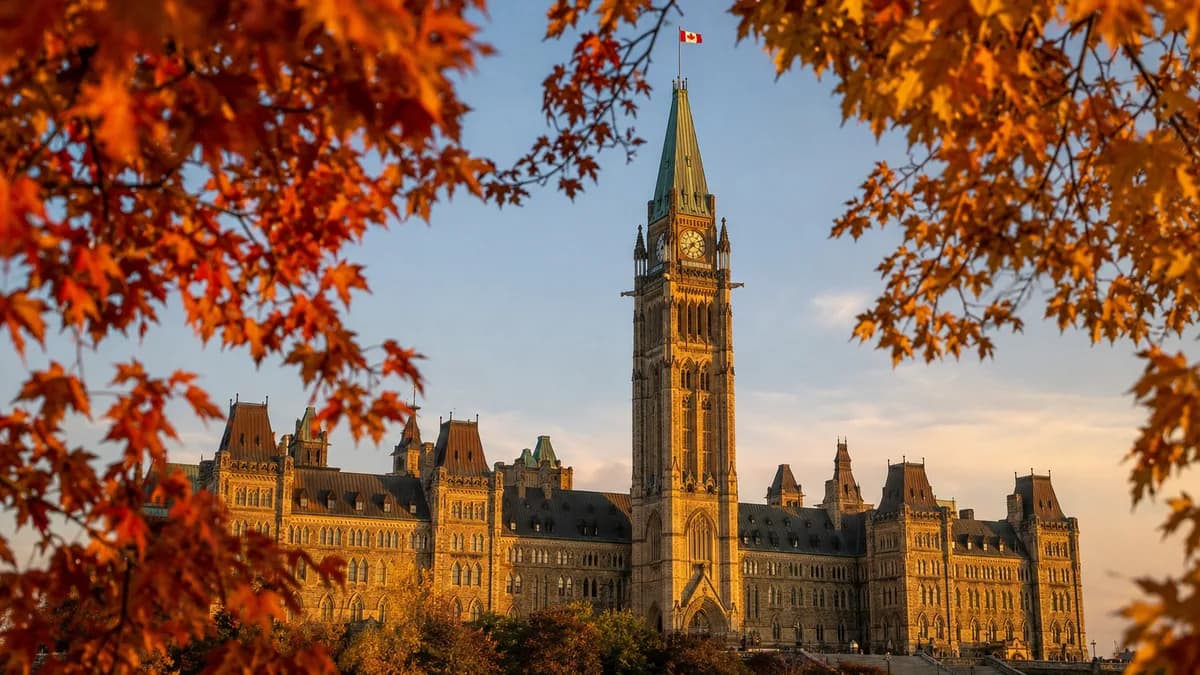
Government is one of the two heaviest topics on the Canadian citizenship test: together with history, it supplies the largest share of the 20 questions on the real exam. If you have not mastered the constitutional monarchy, Parliament, the three levels of government, and how elections work, you start with a handicap that is hard to recover from. This article gives you 35 practice questions on government, each with the correct answer and a one-sentence explanation. Every fact comes from the official Discover Canada study guide, the only source of the test.
These 35 questions cover a single topic in depth. To see how government fits alongside history, geography, rights, and symbols, start with our complete breakdown of citizenship test questions by topic, the hub for this whole series.
Study method: cover the answer, say yours out loud, then check. Write down every miss, that becomes your review list at the end of the article.
Constitutional monarchy and the Crown (questions 1 to 6)
Canada is a constitutional monarchy, and the exam almost always checks that you know who the head of state is and who represents the Sovereign. These six questions cover the essentials.
1. Who is Canada's head of state? The Sovereign, King Charles III. Canada is a constitutional monarchy: the Sovereign is the head of state, while the Prime Minister leads the government.
2. Who represents the Sovereign in Canada? The Governor General. The Governor General is appointed by the Sovereign on the advice of the Prime Minister, usually for five years.
3. Who represents the Crown in each province? The Lieutenant Governor. Every province has its own Lieutenant Governor, appointed by the Governor General on the advice of the Prime Minister, usually for five years.
4. What three terms describe Canada's system of government? A parliamentary democracy, a constitutional monarchy, and a federal state. These three phrases appear together in many multiple-choice questions, so learn them as a set.
5. Who is Canada's head of government? The Prime Minister. Do not mix up the two roles: the Sovereign is the head of state, the Prime Minister is the head of government.
6. What does it mean that Canada is a constitutional monarchy? The Sovereign is the head of state but acts within the limits of the Constitution, and the government is run by ministers who answer to the elected representatives. Remember the formula: the Sovereign reigns, the elected representatives govern.
The Parliament of Canada (questions 7 to 12)
The make-up of Parliament is one of the most frequently tested subjects: you need to know who is elected, who is appointed, and how a bill becomes law. For a full explanation of each chamber, read how the Parliament of Canada works.
7. What are the three parts of the Parliament of Canada? The Sovereign, the Senate, and the House of Commons. A federal law must pass through all three parts to exist.
8. How are senators chosen? They are appointed by the Governor General on the advice of the Prime Minister. Senators are not elected, which is a classic trap in multiple-choice questions.
9. How are members of the House of Commons chosen? They are elected by voters in their riding. The House of Commons is the elected chamber of Parliament, the one that directly represents the people.
10. How does a bill become a law? It must be passed by the House of Commons and the Senate, then receive Royal Assent, granted by the Governor General in the Sovereign's name. Without Royal Assent, there is no law.
11. What is a member of Parliament (MP)? A person elected to the House of Commons to represent the voters of their riding. Each riding in the country sends exactly one MP to Ottawa.
12. Which part of Parliament is appointed rather than elected? The Senate. Remember the contrast: Senate appointed, House of Commons elected.
The three branches of government (questions 13 to 16)
The exam regularly asks you to name the three branches of the federal government and say what each one does. Four questions are enough to lock this topic down.
13. What are the three branches of government in Canada? The executive, the legislative, and the judicial branch. Each has a distinct role, and the test likes to check that you keep them apart.
14. Who is part of the executive branch? The Prime Minister and the Cabinet. This is the branch that runs the day-to-day business of government.
15. What is the role of the legislative branch? To make the laws. At the federal level that job belongs to Parliament, meaning the Sovereign, the Senate, and the House of Commons.
16. What is the role of the judicial branch? To interpret and apply the law through the courts. Judges are independent of the other two branches.
The three levels of government (questions 17 to 21)
Because Canada is a federal state, responsibilities are shared between three levels of government, and the test checks that you know who handles what.
17. What are the three levels of government in Canada? The federal government, the provincial and territorial governments, and the municipal or local governments. Each level has its own responsibilities.
18. Name some responsibilities of the federal government. National defence, foreign policy, citizenship, currency, criminal law, and trade between provinces. These are the matters of national and international concern.
19. Name some responsibilities of the provinces. Education, health care, natural resources, highways, and property and civil rights. Education and health care are the two answers tested most often.
20. Name some responsibilities of municipal governments. Local planning, streets and roads, snow removal, firefighting, emergency services, recycling, and public transit. These are the everyday services in your city or town.
21. What is the head of a provincial government called? The Premier. Each province has its own Premier, just as the country has a Prime Minister at the federal level.
Federal elections (questions 22 to 27)
Federal elections are a guaranteed topic on the test: the right to vote, ridings, the secret ballot, and how a government is formed. The official rules of the test itself are described on the citizenship test page on canada.ca.
22. Who has the right to vote in a federal election? Canadian citizens who are at least 18 years old on voting day and on the voters' list. All three conditions matter: citizenship, age, and registration.
23. What is a riding, or electoral district? A geographic area represented by a member of Parliament in the House of Commons. Every voter casts a ballot for a candidate in their own riding.
24. How is the winner decided in each riding? The candidate with the most votes wins the seat, even without an absolute majority. This is the first-past-the-post system.
25. Is your vote secret in Canada? Yes, voting is by secret ballot: no one is allowed to watch how you vote, and you do not have to tell anyone who you voted for. This right protects every voter's freedom.
26. When must federal elections be held? On the third Monday of October every four years following the most recent general election. An election can, however, be called earlier.
27. What happens after a general election? The party with the most elected members usually forms the government and its leader becomes Prime Minister, while the party with the second-most seats becomes the Official Opposition. The opposition's role is to peacefully oppose government proposals or try to improve them.
The Prime Minister and Cabinet (questions 28 to 31)
The test checks that you know how the Prime Minister comes to power and who the Cabinet answers to.
28. How is the Prime Minister chosen? The Prime Minister is the leader of the party with the most seats in the House of Commons. Voters do not vote directly for the Prime Minister; they elect their local MP.
29. What is the Cabinet? The team of ministers chosen by the Prime Minister, usually from among the MPs, each responsible for a government department. The Cabinet makes the important decisions about how the country is run.
30. Who are the Prime Minister and Cabinet responsible to? To the House of Commons: this is the principle of responsible government. They must keep the confidence of the elected members to stay in power.
31. What is the role of the Official Opposition? To peacefully oppose government proposals, question them, and try to improve them. It is formed by the party with the second-largest number of seats.
The justice system (questions 32 to 35)
Four basic ideas about justice cover what comes up on the exam: the presumption of innocence, the rule of law, the courts, and the role of the police.
32. What principle protects a person accused of a crime? The presumption of innocence: everyone is presumed innocent until proven guilty. The justice system guarantees everyone due process under the law.
33. What is the highest court in Canada? The Supreme Court of Canada. It is the country's final court of appeal.
34. What does the rule of law mean? No person, group, or government is above the law. The law applies equally to everyone.
35. What is the role of the police in Canada? To keep people safe and to enforce the law. The Royal Canadian Mounted Police enforces federal laws and serves as the provincial police in several provinces and territories.
How to study these questions effectively
The best way to lock in these 35 answers is to work through them in several formats: rereading, chapter quizzes, then a timed mock exam. A single read is not enough, because the real test rewords the same facts in dozens of different ways.
- Redo your mistakes first. Go back over the questions you missed and reread the matching section of the guide before anything else.
- Drill the trap pairs. Head of state versus head of government, appointed Senate versus elected House, federal versus provincial: most wrong answers come from these mix-ups.
- Switch to exam format. Take a free timed mock exam to confirm your knowledge holds up under the pressure of the clock.
- Review chapter by chapter. The chapter quizzes let you target only the government topic until it is solid.
- Space out your reviews. The smart review mode automatically brings back the questions you miss, at the right moment to memorize them.
Next step: cover the other topics
If you can answer these 35 questions correctly, the government topic is under control; the next move is to cover the remaining topics with the same method. Continue with the rights and responsibilities questions, the other civic pillar of the test, then the geography questions for the provinces, regions, and capitals.
To plan your whole preparation, go back to the citizenship test questions by topic guide: it shows the weight of each subject and the most efficient study order. The day these 35 answers come to you without thinking, the government portion of the exam will not be able to surprise you.