
Sir John A. Macdonald, First Prime Minister
Sir John A. Macdonald, Canada's first Prime Minister in 1867: his role, Confederation and the railway. What to remember for the citizenship test.
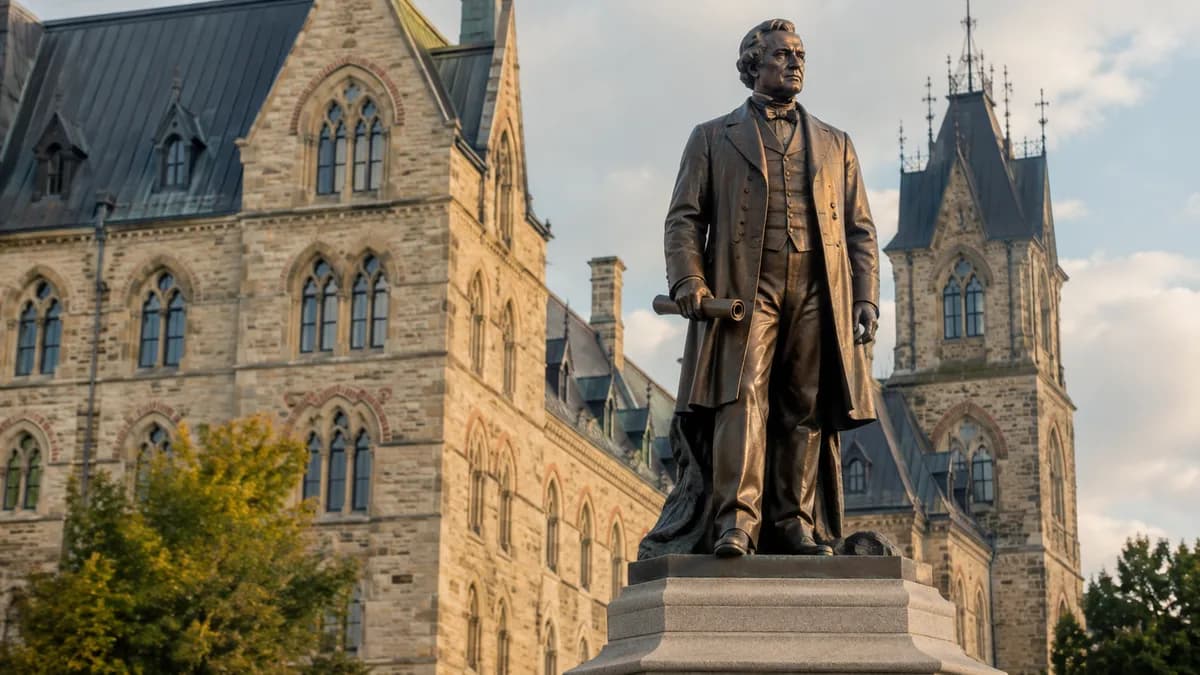
Sir John A. Macdonald was Canada's first Prime Minister, taking office in 1867. He was also a Father of Confederation and led the union of the provinces that created the country. For the citizenship test, remember three simple things: his name, his role as the first head of government, and the year 1867. This guide places those facts in context so you can understand them rather than memorize them blindly.
A leader of Confederation
Macdonald played a central part in the birth of Canada. Along with other leaders of the British North American colonies, he worked to bring separate provinces together into a single country. When Confederation in 1867 created the Dominion of Canada, he became its first head of government.
At first, the new union had four provinces: Ontario, Quebec, Nova Scotia, and New Brunswick. Bringing these colonies together, with their very different interests, took long negotiations. Macdonald stood out as a skilled negotiator, able to bring opposing views closer and build lasting compromises.
This founding role is why his name appears so often in questions about the country's history. The Fathers of Confederation are the politicians who designed and defended the plan for union, and Macdonald ranks at the very front of that group.
The plan for union took shape at major conferences held in 1864, at Charlottetown and then at Quebec. Representatives of the colonies discussed the rules of the future country and how power would be shared between the central government and the provinces. These debates led to the principles written into the British North America Act, the law that created Canada in 1867.
From Scotland to Canada
Macdonald was born in Scotland and came to Canada as a child. His family emigrated to the colony of Upper Canada, in the Kingston area of present-day Ontario. He grew up in this new country, was educated there, and became a lawyer before entering politics.
His path from immigrant to head of government speaks directly to people preparing for citizenship today. Like millions of newcomers after him, he built his life in an adopted country. His personal story is a reminder that Canada was shaped in large part by immigration.
Before Confederation, Macdonald was already a leading politician in the colony of the Province of Canada, which joined Upper and Lower Canada. This long political experience prepared him to lead at the conferences that produced the 1867 union. He did not start from nothing: he knew the workings of power and the tensions between regions well.
Becoming the first Prime Minister
Macdonald became Prime Minister in 1867, the same year Canada was created. As leader of the Conservative Party, he formed the first government of the new Dominion. He was later knighted, which is the source of the "Sir" placed before his name.
He served as Prime Minister for many years, across two separate periods. After a first term, he left office, then returned to lead the government again and stayed at its head until the end of his life. This longevity made him one of the most influential figures of the country's early decades.
Macdonald died in office in 1891, still serving as Prime Minister. Across nearly a quarter of a century, he left a deep mark on the institutions, borders, and direction of the young country. For the test, the essential point fits in one sentence: he was the very first person to hold the office of Prime Minister of Canada.
Westward expansion
Macdonald's governments oversaw the country's expansion westward. After 1867, Canada grew as new provinces and territories joined the federation. Manitoba, British Columbia, and Prince Edward Island joined the country during this period of rapid growth.
This expansion turned Canada from a small group of eastern provinces into a country reaching west toward the Pacific. It also had deep and sometimes painful consequences for Indigenous peoples whose lands lay in the path of that growth, part of the history that Canada acknowledges today.
To keep order across these vast new lands, Macdonald's government created the North-West Mounted Police in 1873. This force, an ancestor of today's Royal Canadian Mounted Police, became one of the lasting symbols of the era. It shows how quickly the young country had to build institutions to match its growing size.
The Canadian Pacific Railway
Macdonald's government oversaw the building of the Canadian Pacific Railway, completed in 1885. This transcontinental line linked the country from coast to coast and helped new provinces join Canada. British Columbia, in particular, had made a railway a condition of joining.
The railway was an enormous technical feat for its time. It had to cross thousands of kilometres of prairie, forest, and the Rocky Mountains. Many workers, including many Chinese immigrant labourers, took part in this project under very hard and often dangerous conditions.
The final spike of the railway was driven at Craigellachie, British Columbia, in November 1885. That single moment marked the completion of a line that had once seemed almost impossible to build. It sealed the promise that had brought British Columbia into Canada and gave the country a physical link from the Atlantic to the Pacific.
Once finished, the railway carried people and goods from one end of the country to the other. It became a symbol of national unity and remains closely tied to Macdonald's political legacy.
The railway also sped up the settlement of the West. It made it easier for settlers to reach the Prairies and for crops to travel to markets in the East and abroad. For the test, it is enough to remember the main idea: this railway linked the country from coast to coast and supported its growth.
His era and its challenges
Macdonald's era laid the foundations of modern Canada, but it also included dark chapters. His governments put in place policies toward Indigenous peoples, such as the residential school system, that Canada now recognizes as deeply unjust and harmful. A balanced understanding of history takes account of both his achievements and these wrongs.
For the test, the focus is on the core facts: his role as first Prime Minister and Father of Confederation, and the building of the railway. But knowing the wider context helps you answer with confidence and understand why these events still matter.
His era also saw the young federation build its first institutions: a Parliament in Ottawa, a public service, and national economic policies. Macdonald argued for a strong, united country, distinct from its neighbour to the south. These choices shaped the way Canada developed over the decades that followed.
Why this matters for the test
Naming Canada's first Prime Minister is one of the most common history questions on the test. The official government guide presents Macdonald among the country's founding figures. You can consult the official resource Discover Canada on canada.ca for the reference text.
Here are the key facts to memorize about Sir John A. Macdonald.
- Canada's first Prime Minister
- Took office in 1867
- Born in Scotland, came to Canada as a child
- A Father of Confederation and Conservative leader
- Led the union of the provinces
- His governments led westward expansion
- Oversaw the Canadian Pacific Railway, completed in 1885
To connect this fact to other topics, see the guide Canada Explained. Then study the country's history chapter in our chapter quizzes to anchor these landmarks.
Spaced repetition helps these facts stick. Train with our practice exams to check your knowledge, then go over your mistakes with smart review, which brings back missed questions at the right time.
How he is remembered today
Macdonald remains a major figure in Canadian history, studied and debated. His face long appeared on the ten dollar bill, and statues, schools, and streets across the country carry his name. At the same time, views of his record have evolved, and some of these commemorations are now the subject of discussion.
For the citizenship test, the essentials stay clear and factual: Sir John A. Macdonald was Canada's first Prime Minister, a Father of Confederation, and his governments built the railway that linked the country. These are the points you should be able to recognize on test day.
Studying Macdonald also helps you understand how Canada's system of government began. The country he helped create is a federation, with a central Parliament and provincial governments, a structure that still shapes daily life today. Seeing that link makes the history easier to remember and more meaningful.