
18 Canadian Citizenship Test Economy Questions
18 practice questions on Canada's economy with answers: trade, the three types of industries, natural resources, NAFTA and CUSMA, the G7 and the dollar.
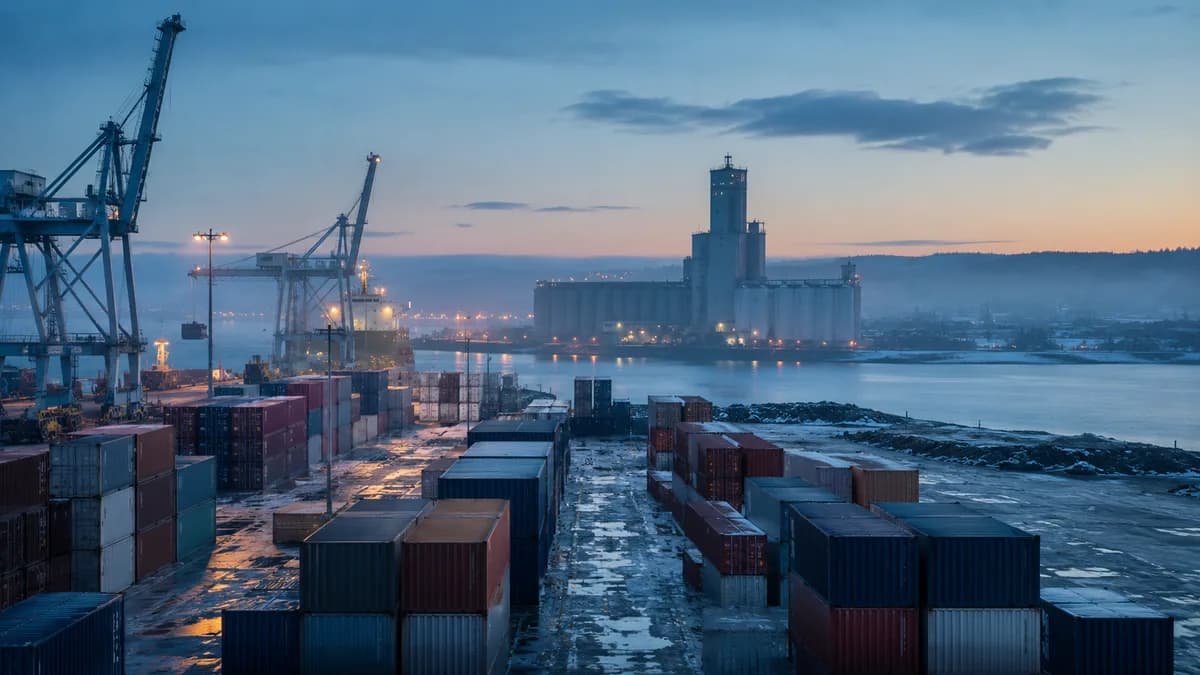
The economy chapter of the Discover Canada guide comes down to a few simple ideas: Canada is a trading nation, the United States is its largest trading partner, and the country has three main types of industries. Here are 18 practice questions with the correct answer and a short explanation for each.
The economy is one of the six main topic areas in the official guide, and it is also one of the shortest. You will probably see only one or two economy questions out of the 20 on the test, but since you need 15 correct answers to pass, no topic is worth skipping. To see how the economy compares with other topics in question volume, check our guide to citizenship test questions by topic.
What makes this chapter pleasant to review is that it rests on short lists and proper nouns: three types of industries, five natural resource industries, two free trade agreements, one dominant trading partner. If you would rather understand the big picture before testing yourself, read Canada's economy explained for the citizenship test, then come back here to practise.
One method tip: read the question, say your answer out loud, and only then look at the solution. That small act of recall fixes information in memory far better than passive rereading.
Canada as a trading nation (questions 1 to 3)
The sentence to memorize word for word is the one in the guide: Canada has always been a trading nation and commerce remains the engine of economic growth. Almost every economy question on the test revolves around that idea or its immediate corollary, the importance of the United States as a partner. If you only memorize one paragraph from the chapter, make it that one.
Question 1. What does the Discover Canada guide say about Canada and trade? Answer: Canada has always been a trading nation, and commerce remains the engine of economic growth. That phrasing appears almost verbatim in the guide, which makes it an obvious target for exam questions.
Question 2. Who is Canada's largest international trading partner? Answer: the United States. This is probably the single most frequently tested fact in the whole economy chapter, and the answer does not change no matter how the question is worded.
Question 3. Why does trade matter to Canadians? Answer: because Canadians could not maintain their standard of living without trading with other nations. The guide explicitly links foreign trade to the living standards of the population.
The phrase trading nation is not an empty formula: it sums up several centuries of economic history. The fur trade was the country's first major commercial activity and shaped the exploration of the territory, before timber and then Prairie wheat took over as the great exports. That continuity between history and today's economy is why the guide treats the two chapters as one coherent whole.
The three main types of industries (questions 4 to 7)
The guide sorts the Canadian economy into three main types of industries: service industries, manufacturing industries, and natural resource industries. The exam may ask you to name all three, to say which one employs the most Canadians, or to recognize a specific example. Learn the list in that order: service, manufacturing, natural resources.
Question 4. What are the three main types of industries in Canada? Answer: service industries, manufacturing industries, and natural resource industries. Remember that these three categories cover the entire economy as the guide describes it.
Question 5. Which type of industry employs the most Canadians? Answer: service industries. The guide states that more than 75 percent of working Canadians have jobs in services, which makes it by far the largest employer in the country.
Question 6. Give examples of service industries. Answer: transportation, education, health care, construction, banking, communications, retail, tourism, and government services. If a question offers any of these fields, the correct category is always services.
Question 7. What do Canadian manufacturing industries produce? Answer: goods sold in Canada and around the world, such as paper, high technology equipment, aerospace technology, automobiles, machinery, food, and clothing. Central Canada, meaning southern Ontario and Quebec, is described as the industrial and manufacturing heartland of the country.
The classic trap in this section is sorting the examples. Construction and banking belong to services, even though the first puts up buildings and the second handles money. A sawmill or a mine belongs to natural resources, while a plant that turns that wood into paper belongs to manufacturing. When in doubt, ask yourself whether the activity extracts a resource, turns raw material into a finished product, or provides a service to a person: the answer almost always falls into place.
Natural resources region by region (questions 8 to 11)
The five natural resource industries to know are forestry, fishing, agriculture, mining, and energy. These industries shaped the country's history and still support the economy of many regions, and a large share of Canada's exports remains made up of natural resource commodities. The exam likes to pair a resource with a province, so drill those pairs.
Question 8. What are Canada's natural resource industries? Answer: forestry, fishing, agriculture, mining, and energy. The list is short, so recite it until it comes without hesitation.
Question 9. Which province is associated with oil, gas, and the oil sands? Answer: Alberta. The oil sands of northern Alberta and the province's oil and gas industry are mentioned in the section on the Prairies.
Question 10. Which province holds some of the world's richest deposits of potash and uranium? Answer: Saskatchewan. The province is also nicknamed the breadbasket of the world for its grain production, which makes it a good example of a region that lives off both farming and mining.
Question 11. Which province is known for its forestry industry and its major Pacific port? Answer: British Columbia. Its forests, its salmon fishery, and the Port of Vancouver, Canada's gateway to Asia and the Pacific, sum up its economy.
The other regions are easy to remember through a single association. The Atlantic Provinces live on fishing, forestry, mining, and farming, with offshore oil and gas in Newfoundland and Labrador and the major East Coast port of Halifax. Quebec is a heavyweight in hydroelectricity and in pulp and paper. The Prairies combine energy resources with some of the most fertile farmland in the world. The North is rich in minerals, including diamonds in the Northwest Territories. If the link between resources and provinces still feels shaky, review the provinces and their capitals first.
Free trade with the United States and Mexico (questions 12 and 13)
Three dates structure the history of North American free trade: 1988 for the agreement between Canada and the United States, 1994 for NAFTA which added Mexico, and 2020 for CUSMA which replaced NAFTA. Read the wording carefully: a question that mentions all three countries points to NAFTA or CUSMA, while a question that mentions only the United States points to the 1988 agreement.
Question 12. Which free trade agreement did Canada, the United States, and Mexico form, and when did it come into force? Answer: the North American Free Trade Agreement, NAFTA, which came into force in 1994. It followed the free trade agreement Canada signed with the United States in 1988.
Question 13. Which agreement replaced NAFTA? Answer: the Canada, United States, Mexico Agreement, known as CUSMA, which came into force on July 1, 2020. Americans call it the USMCA and Mexicans call it the T-MEC, but it is the same treaty.
These three years join the list of dates you need for the test, alongside 1867, 1914, and 1982. If numbers are your weak point, practise with our set of citizenship test dates questions: grouping them into a single study session works far better than meeting them at random.
Canada and the G7 (questions 14 and 15)
Canada belongs to the G7, the group of major advanced economies, and it is the easiest international fact to remember from the economy chapter. A question may ask whether Canada is a member, or ask you to name the other countries in the group.
Question 14. Is Canada a member of the G7? Answer: yes. The G7 brings together seven major advanced economies that coordinate their positions on global economic issues, and Canada is one of them.
Question 15. Which other countries are in the G7? Answer: France, Germany, Italy, Japan, the United Kingdom, and the United States, along with Canada. A quick trick: four European countries, one Asian, and two North American.
You may run into the name G8 in older study material: Russia took part in the group from the late 1990s until it was excluded in 2014. That is why some unofficial guides and revision sheets still refer to the G8. If a question offers you both, stick with the current seven-member line-up.
Why trade creates jobs (question 16)
The link between trade and jobs is the reasoning the exam expects from you: Canada produces far more than its domestic market can absorb, so a large share of jobs depends on exports. That is true of the factories of Central Canada as much as of the sawmills, mines, and fisheries of the regions.
Question 16. How does international trade support jobs in Canada? Answer: because a large part of what the country produces is sold abroad, many Canadian jobs depend directly on exports. The guide notes that the economy of many areas still depends on developing natural resources, much of which is exported.
This reasoning also explains why the guide puts so much weight on the United States. When a single partner absorbs the majority of Canadian exports, the health of cross-border trade touches the wages and jobs of entire cities, from the auto plants of Ontario to the ports of British Columbia. The exam tests that logic through a simple question, but understanding it keeps you from mixing up the answers.
The Canadian dollar and banking basics (questions 17 and 18)
The country's currency and the institution that issues its banknotes are general knowledge expected of a new citizen, even though they take up little space in the guide. Two answers cover it: the Canadian dollar and the Bank of Canada.
Question 17. What is Canada's currency? Answer: the Canadian dollar, divided into 100 cents. The one-dollar coin is nicknamed the loonie, after the bird pictured on it, and the two-dollar coin is called the toonie.
Question 18. Which institution issues Canadian banknotes? Answer: the Bank of Canada, the country's central bank. It is responsible for the currency and for monetary policy, while chequing accounts and loans are handled by commercial banks.
These two questions come up less often than those on trade or industries, but they cost almost nothing to learn. Take the chance to check that you can also recognize the loon on the one-dollar coin: it is a point of contact between the economy chapter and the chapter on Canadian symbols.
How to review the economy chapter efficiently
The best strategy for this chapter is to treat it as a set of short lists and resource-province pairs, not as a text to read. Write the three types of industries on one line, the five natural resource industries on a second, and the three free trade dates on a third. Three lines, and you have covered most of what the exam can ask.
Always check your answers against the official source. The economy chapter of the Discover Canada study guide published on canada.ca is the only reference the real questions are drawn from, and it is short: a careful read takes about fifteen minutes.
Then turn reading into reflexes. Run the matching chapter quiz to test yourself under closed-question conditions, and let spaced review bring back the questions you missed a few days later. That delayed repetition is what prevents forgetting, especially for isolated facts like Saskatchewan potash or the date CUSMA came into force.
A simple plan in three short sessions works very well here. First session: read the chapter in the guide and write out your three lines of lists. Second session, the next day: run the 18 questions above without looking at the answers and note the ones you miss. Third session, two or three days later: rework only your mistakes, then follow up with a mock exam mixing every topic. A quarter of an hour per session is enough for this chapter.
One last piece of advice: do not try to memorize precise figures for GDP, exports, or employment. The guide stays deliberately general on those numbers, and so does the exam. What you are asked for are names, categories, and relationships, not detailed statistics.
Next step: put the economy back in the full test
If you answered at least 15 of these 18 questions correctly, the economy chapter is in good shape and you can move on to another topic. The economy will only earn you a point or two on test day, but they are easy points, and at a pass mark of 15 out of 20 every correct answer counts.
To understand the subject rather than just memorize it, read Canada's economy for the citizenship test, which explains trade, resources, and CUSMA in context. To check where your other topics stand, go back to the complete guide to questions by topic, then measure yourself under real conditions with a timed 20-question mock exam. On the day a question about Canada's largest trading partner comes up, you will answer without even thinking.