
Canadian Citizenship Test Quiz: Test Yourself in 5 Minutes
Take a quick Canadian citizenship test quiz to see where you stand in 5 minutes, then open the full free question bank when you are ready to go deeper.
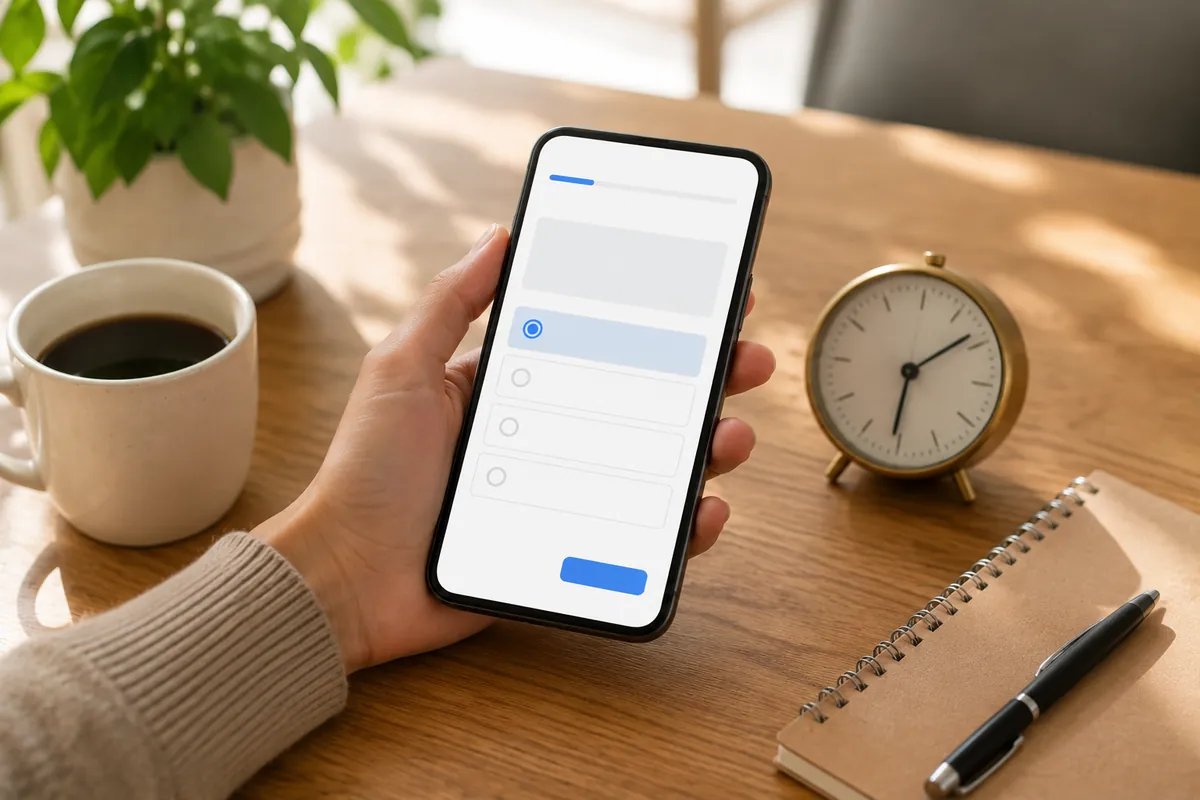
Five minutes of quiz practice every day prepares you for the citizenship test better than one long cram session the night before. Short, regular sessions work with the way memory actually behaves: you review facts just before you forget them, you build a habit that is easy to keep, and you turn an intimidating mountain into small daily steps. Here is how to build that routine and make it stick right up to test day.
Why short daily practice beats cramming
Human memory forgets new information fast. This is the forgetting curve: a few hours after a long read of Discover Canada, many of the dates, names, and institutions have already faded. Cramming fills your head the night before, but the information has no time to settle, and next-day nerves finish the job. You end up feeling like you have forgotten everything at the worst possible moment.
Spaced repetition fixes this. By reviewing a fact at short, repeated intervals (today, tomorrow, three days from now), you catch each memory just before it disappears and strengthen it every time. A daily five-minute quiz makes you revisit the same topics several times a week with almost no effort. That is exactly what your brain needs to hold on to the 20 questions of the real format.
There is also the habit effect. Five minutes is short enough that it never becomes an excuse: you are never too busy for five minutes. Attach the quiz to something you already do, like your first coffee or your commute, and the session becomes automatic. After a couple of weeks, you will not have to think about it at all.
How to structure a 5-minute session
A good short session has a clear rhythm. Do not try to cover the whole guide at once: aim for depth on one topic a day. Here is a simple flow that fits inside five minutes.
- Minute 1: warm up with two or three questions from yesterday's topic to check that it stuck.
- Minutes 2 to 4: answer five or six new questions on today's topic, and read the feedback on each one, especially the ones you miss.
- Minute 5: make a mental note (or a written one) of the single thing you got wrong today, to review tomorrow.
Instant feedback is the heart of the method. Getting an answer wrong and immediately reading the correct one anchors the memory far better than passive re-reading. Do not avoid the hard questions: those are the ones that move you forward.
A weekly topic rotation
The test covers several broad areas. Rather than mixing everything, give each day to one topic: you will see every subject come back each week, which naturally builds spaced repetition. Here is a rotation that works well.
- Monday, history: Indigenous peoples, exploration, Confederation in 1867, the world wars.
- Tuesday, government: constitutional monarchy, the roles of the Governor General, the Prime Minister, and Parliament.
- Wednesday, rights and responsibilities: fundamental freedoms, the duty to vote, the obligation to obey the law.
- Thursday, geography: provinces, territories, capitals, regions, and borders.
- Friday, symbols and society: the flag, anthem, beaver, maple leaf, national holidays.
- Saturday, mixed exam: a quiz that pulls from every topic of the week.
- Sunday, review: revisit only the questions you missed during the week.
You can follow this rotation with the chapter quizzes, which already group questions by topic. On Sunday, smart review automatically resurfaces the questions you have missed most often, which is a perfect replacement for a review day.
Sample quick-fire questions
What does a fast question look like? The real format offers a choice among several answers, short and factual. Here are a few typical examples, one per broad topic, to give you the tone.
- History: in what year did the provinces unite to form the Dominion of Canada? (1867)
- Government: who is Canada's head of state? (the sovereign, represented in Canada by the Governor General)
- Geography: what is the capital of Canada? (Ottawa)
- Symbols: which animal appears on the five-cent coin? (the beaver)
- Rights: name one fundamental responsibility of a citizen. (voting in elections, obeying the law, serving on a jury)
Every test question is based on the official Discover Canada guide. You can read it for free on the Government of Canada website to dig deeper into any topic that gives you trouble.
Keeping the quiz effective day after day
The trap with a short routine is autopilot. After a few days, you start answering familiar questions on reflex without really thinking. To avoid that, shuffle the order of your questions and rotate to new topics sooner once you know the answers by heart. The goal is not to collect right answers, but to understand why an answer is correct, because the real test often rewords its questions.
Pay special attention to questions you miss twice. A one-off slip is nothing, but a fact you get wrong repeatedly signals a real gap: open the matching section of the guide and read it slowly before you go back to the quiz. It is these few stubborn facts, often specific dates or institutional roles, that make the difference between 14 and 16 out of 20 on test day.
Track your progress and step up to full exams
A five-minute routine only pays off if you watch the line go up. Keep an eye on two simple signals: your percentage of correct answers per topic and the number of questions you keep getting wrong. The app records your progress across sessions, so you have nothing to track by hand. When a topic sits comfortably above 75 percent, you can give it fewer days and hand more time to your weak spots. As a rough guide, expect two to four weeks of daily practice for a complete beginner to reach a comfortable level, and less if you already have a solid base.
The daily quiz is the on-ramp, not the destination. Once your topics are solid, prove you are ready with the real format: a full 20-question timed mock exam, scored out of 20, taken in 45 minutes like the real test. The pass mark is 15 out of 20, which is 75 percent. When you clear 15 or more on every attempt, across several different exams, you are ready for the real thing.
Fitting the routine into a busy schedule
The great thing about five minutes is that they fit anywhere. Take your quiz on the bus, in a waiting line, while the coffee brews, or just before sleep. Because everything runs in your browser, free and with no account, you open it, answer, and close it, with no setup.
If you skip a day, do not feel guilty and do not make up for it with a marathon session: just pick it back up the next day. Consistency matters more than perfection. Three weeks of five minutes a day will take you further than a single exhausting weekend of cramming. For the full method behind this, see the best way to practice.