
2-Week Study Plan for the Canadian Citizenship Test
A day-by-day, two-week plan to study efficiently and walk into the Canadian citizenship test fully prepared.
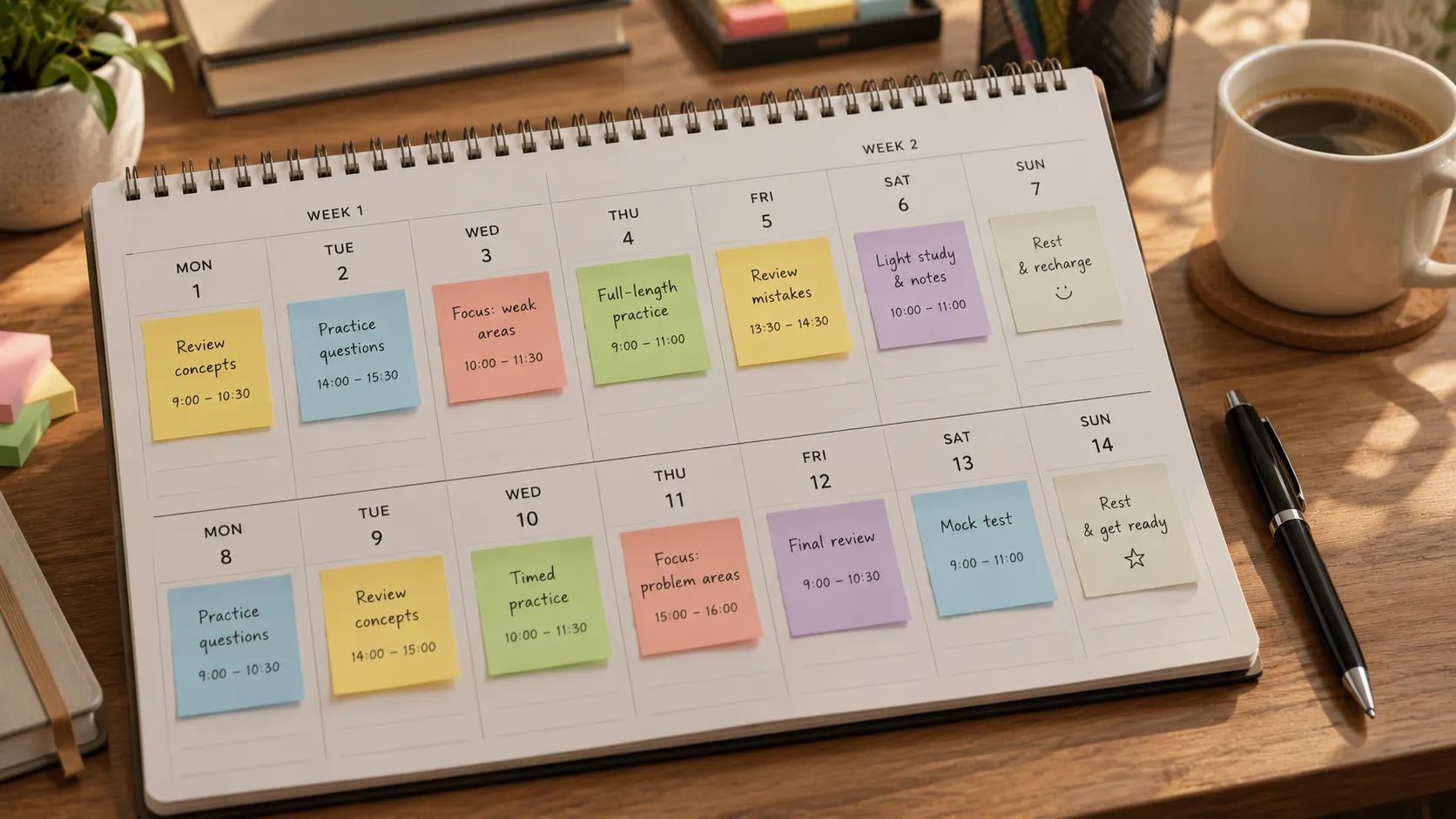
Two weeks is enough time to pass the Canadian citizenship test if you study a little every day and spend most of that time testing yourself rather than rereading. The plan below breaks the official study guide, Discover Canada, into fourteen focused sessions of 30 to 45 minutes. Week one builds your knowledge topic by topic. Week two turns that knowledge into exam-ready recall through timed mock exams, targeted review of your weak spots, and one full simulation on the final day.
How this two-week plan works
The plan follows one rule: learn first, prove it second. The real test has 20 questions, runs for 45 minutes online, and you pass with 15 correct answers out of 20, or 75 percent. You are not aiming for perfection, only for solid, steady command of the material. Spreading the work across fourteen days avoids the last-minute cramming that leaves memory gaps on test day. Here is the overall structure.
- Days 1 to 7: learn Discover Canada topic by topic, with a short quiz each day.
- Day 7: a checkpoint to spot the chapters that are still shaky.
- Days 8 to 11: one timed mock exam per day, followed by a review of your mistakes.
- Days 12 and 13: targeted review of your two or three weakest topics.
- Day 14: one full simulation under real conditions, then rest.
Your daily rhythm: 30 to 45 minutes
Consistency matters more than session length. Thirty to forty-five minutes a day, at the same time if you can, sticks far better than a single three-hour block on the weekend. Spend the first five minutes recalling yesterday's topic, give the core of the session to the day's subject, then finish with a chapter quiz to check what actually landed. That last step is non-negotiable: it is what turns reading into lasting memory.
Week 1: learn Discover Canada topic by topic
The first week covers the whole guide once, without trying to memorize everything on the first pass. History is split across several days because it carries the largest share of questions and the heaviest memory load. Follow this day-by-day order.
- Day 1: Indigenous peoples and the first contact with European explorers.
- Day 2: French and British settlement, up to the making of Canada.
- Day 3: Confederation in 1867, westward expansion and modern Canada.
- Day 4: the system of government, constitutional monarchy and how Parliament works.
- Day 5: democracy, the right to vote, elections and the justice system.
- Day 6: the rights and responsibilities of citizens, plus the national symbols.
- Day 7: geography, the five regions, the provinces, the territories and their capitals.
End each day with a quiz on that day's topic and note your score. Those numbers become your road map: they show you, without guessing, where to concentrate during the second week.
Day 7 checkpoint: see where you stand
At the end of week one, take ten minutes to look at your progress chapter by chapter. Find the two or three topics where your score stays below 70 percent, often historical dates, roles within government, or provincial capitals. These are the ones that decide whether you answer 14 or 16 questions correctly on test day. Flag them now: they become the priority for days 12 and 13.
Week 2: practise under real conditions
The second week replaces learning with timed practice. One full mock exam a day reproduces the real format, 20 questions answered within the time limit, and trains your mind to decide quickly without panic. After each exam, the step that counts is not the score but rereading every mistake to understand why the correct answer is right.
- Days 8 to 11: one timed mock exam per day, then ten minutes to analyze each mistake.
- Days 12 and 13: targeted review of the weak chapters flagged on day 7, using smart review.
- Day 14: one final full simulation under real conditions, in the morning if possible.
Use spaced review for your weak spots: revisiting a hard topic today, then again two days later, fixes it in memory far better than one long session. The review feature automatically brings missed questions back at the right moment, so you do not waste time on what you already know.
The final days: simulate the real test
Treat the day 14 simulation like the official exam. Sit somewhere quiet, keep your notes away, set a timer for 45 minutes, and answer all 20 questions without interruption. This dress rehearsal does two things: it confirms you clear the 15-out-of-20 threshold, and it lowers your stress, because the format no longer feels unfamiliar. If you score above 17 out of 20, stop studying and rest. A fresh mind performs better than an exhausted one.
Test yourself instead of rereading
Passive rereading gives a false sense of mastery: the words feel familiar, but familiarity is not recall. Quizzes and mock exams are what reveal your real gaps, because they force you to produce the answer instead of recognizing it. That is why this plan devotes the whole second week to active practice. Every missed question is good news: it is a gap caught before the test rather than during it.
If you have less than two weeks
The plan still works on a shorter timeline: compress it without changing its logic. With one week, merge the learning days (history over two days, government and geography over one or two) and keep at least three mock exams at the end. With only a few days, go straight to mock exams, review only your mistakes, and let smart review prioritize what stays weak. The order of priorities never changes: timed practice first, rereading second.
Set a task and a mini-goal for each day
Every day in the plan works better when it is tied to a concrete task and a measurable mini-goal. A vague intention like study history leads to a distracted skim, while a precise goal tells you exactly when you are done. Here is how to turn each day of the first week into clear action, so you finish the session knowing you actually learned something rather than just turning pages.
- Day 1: read the section on Indigenous peoples, then name the three main groups from memory (First Nations, Inuit, Metis). Mini-goal: 8 out of 10 on the quiz.
- Day 2: trace French and British settlement, then summarize it in five written sentences. Mini-goal: recall two key dates without looking.
- Day 3: learn what happened in 1867 and why, then explain Confederation out loud. Mini-goal: define it in a single sentence.
- Day 4: sketch a simple diagram of Parliament (Sovereign, Senate, House of Commons). Mini-goal: place each role without help.
- Day 5: list who can vote and how an election works. Mini-goal: tell the three levels of government apart.
- Day 6: write down five rights and five responsibilities, then match each national symbol to its meaning. Mini-goal: 8 out of 10 on the quiz.
- Day 7: copy out the provinces, territories and their capitals, then test yourself cold. Mini-goal: every capital from memory.
What to do if you fall behind
Missing a day or two does not break the plan, as long as you do not try to catch up all at once. Pick up where you stopped rather than skipping topics: a chapter you never opened is a guaranteed gap on test day. When time is truly tight, cut the rereading, never the practice. In concrete terms, merge two week-one learning days into one longer session, then protect at least three mock exams at the end. If you slip more than three days behind, switch to the short version of the plan described above: mock exams first, smart review to target weak spots, and rereading only where the quiz trips you up. Covering the whole guide imperfectly beats mastering half of it perfectly, because the real test can draw a question from any section.
Your final 48-hour readiness checklist
The last two days are not for learning anything new, but for confirming that everything is in place. Work through this checklist: each box you tick lowers your stress on test day and removes one more thing to worry about.
- Take one last full mock exam and confirm you clear 15 out of 20, ideally 17 or higher.
- Reread only your two or three remaining weak points, not the entire guide.
- Confirm the date, time and format of the test, along with the documents IRCC asks you to have ready.
- Test your connection and equipment if the test runs online for 45 minutes.
- The night before, stop studying early, sleep well, and trust the preparation you have done.
Knowing when you are ready
Track your progress instead of trusting a feeling. A steady score of 17 out of 20 or higher across several mock exams, under realistic conditions and without notes, is the clearest sign that you are ready, comfortably above the 15-out-of-20 pass mark. The resource is free and needs no signup, so retake as many exams as it takes to reach that consistency before you sit the real test.