
How Long After the Citizenship Test Is the Oath Ceremony?
You passed the citizenship test: when is your ceremony? Wait times seen in 2026, what happens between the two steps, and how to track your file.
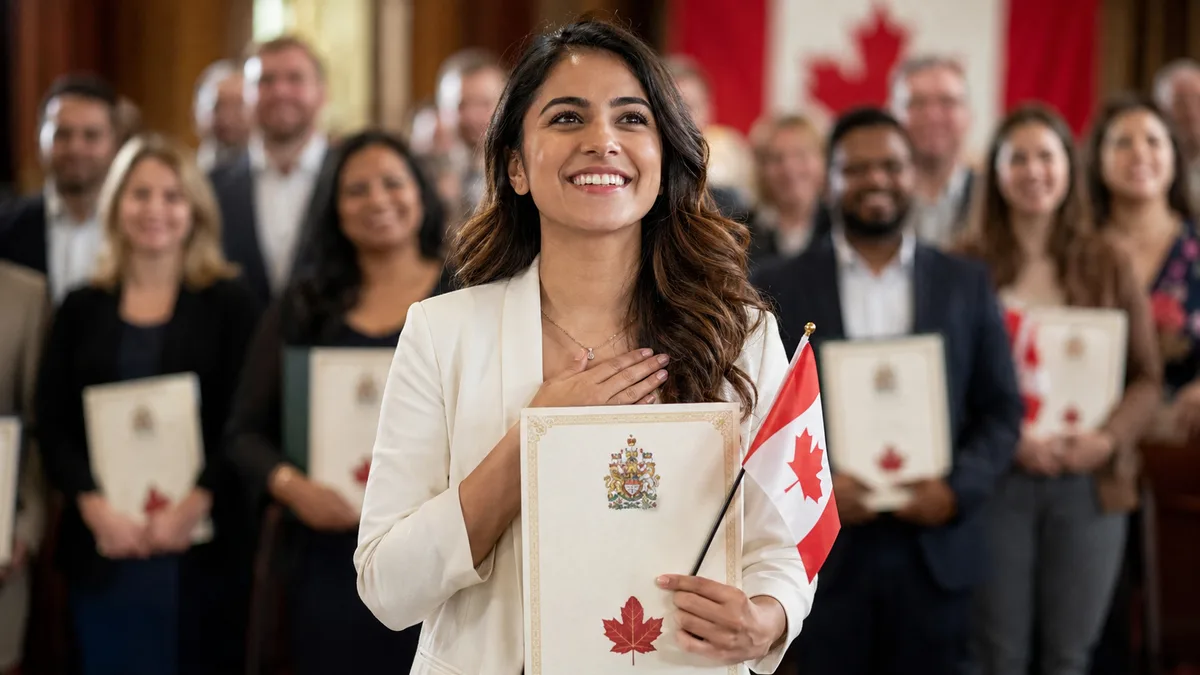
Between the citizenship test and the oath ceremony, most applicants wait somewhere from a few weeks to a few months, usually under six months. IRCC publishes no guaranteed timeline for this step: the invitation goes out once your application is approved, and it arrives at least one week before the ceremony date. Here is what actually happens between the two appointments, the wait times observed in 2026, and what you can do to avoid stretching the wait.
The short answer
Passing the test does not automatically trigger a ceremony date. A decision still has to be made on your application, then a ceremony has to be scheduled. In practice, three scenarios come up again and again: an online ceremony scheduled one to two months after the test, an in-person ceremony in a large city three to six months later, and, more rarely, a wait beyond six months because one point in the file needs to be verified. If you are in the first group, you did nothing special; if you are in the third, it does not mean your application is in trouble.
This wait comes on top of the overall processing time of your application. To place this step in the full journey, from the acknowledgement of receipt to the oath, read our guide on how to become a Canadian citizen and our article on citizenship processing times. To keep track, our application tracker lets you check off each step and follows the time elapsed since the acknowledgement of receipt.
What happens between the test and the ceremony
Four things must happen before you receive an invitation, and each one takes time. First, your result has to be made official: after an online test, an officer validates the score, which takes a few days to a few weeks; after an in-person or Teams test, you know the result immediately. Second, an officer completes the final review of your file: physical presence, tax filing, prohibitions, and whether your permanent resident status is still valid. This is when an interview may be requested if something needs clarifying.
Third, the decision: your application is approved, and the IRCC tracker reflects that change of status. Fourth, ceremony scheduling, which depends on the local office, the format (online or in person) and how many approved files are waiting in your region. That last step explains nearly every gap between applicants: with identical files, someone in Moncton and someone in Toronto will not receive their invitation at the same time.
Wait times observed in 2026
IRCC publishes no official statistic for this specific step, so what follows comes from applicants' reported experience and from what can be seen from one office to another. Online ceremonies, held by video conference, are scheduled more often and in larger groups: the invitation frequently arrives four to eight weeks after a passed test. In-person ceremonies depend on a venue, a citizenship judge or presiding official, and a local calendar, which more often pushes the wait toward three to six months.
- Online ceremony: often one to two months after the test, sometimes less.
- Large cities (Toronto, Vancouver, Montreal): longer queues, more like three to six months, and longer during peaks in demand.
- Mid-size and smaller cities: usually faster, six to twelve weeks.
- File with an additional check: the clock only restarts once the point is settled, which can exceed six months.
These ranges move with application volumes. A surge of approved files in one region mechanically lengthens the queue, without anything being wrong with your application. The right way to read a wait that drags on is to check your file status in the tracker, not to compare your case with a forum thread.
The invitation: when and how it arrives
The notice to appear for the ceremony is sent only after your application is approved, and IRCC says it goes out at least one week before the date. In practice, most applicants receive it two to three weeks ahead, by email, at the address given in the application. It states the date, the time, the format, the connection link or the venue address, the documents to bring, and what to do with your permanent resident card. If you filed a paper application without an email address, the notice comes by mail, with postal delays added on.
Two habits keep you from missing this invitation. Watch your junk folder, because IRCC's automated messages regularly land there. And if you change your email, address or phone number, report it right away through the web form or your account: an invitation sent to an old address will not be resent on its own. For what happens on the day, the oath and what to bring, our article on the citizenship ceremony and oath covers everything.
What can lengthen the wait
A few concrete situations explain most of the long waits. None of them is a refusal, but each adds a step before the decision.
- An interview or a hearing requested by an officer to clarify physical presence, an undeclared trip or an unreadable document.
- An expired permanent resident card or a doubt about your status: IRCC checks that you are still a permanent resident before granting citizenship.
- An unreported change of address, which sends the invitation back to the sender.
- A security or criminal record check still in progress, especially if you travelled extensively or lived in several countries.
- A long stay abroad after the test, which can make you miss the proposed date and send you to the back of the queue.
What to do while you wait
The wait is not dead time. First, keep your status intact: your permanent resident card must remain valid until the oath, and you remain bound by the residency obligation until that day. Avoid extended absences, and if a trip cannot be avoided, plan to be able to come back quickly for a ceremony announced with two weeks' notice. Answer any IRCC request within the stated deadline, even if it seems redundant.
Use the time to prepare what comes next, too. Learn the Oath of Citizenship, gather the identity documents the notice will ask for, and read now what to do after the ceremony: passport, voter registration, what becomes of the PR card. New citizens who start early gain several weeks on their first Canadian passport.
If you cannot attend on the proposed date
A serious obstacle, such as a health problem, a death in the family or a trip that cannot be cancelled, must be reported to IRCC before the ceremony date, with the reason, following the instructions in the notice. You do not lose your approval: you are simply invited to a later ceremony. Not showing up without notice is a different matter. After two unexplained absences, IRCC can treat your application as abandoned, and you would have to start over, fees included.
Tracking your file between the two steps
The citizenship application tracker shows the main stages of your file, including the test and the ceremony. Until the ceremony stage is scheduled, there is nothing to do but wait. Once the date is set, the tracker reflects it, usually at the same time the notice is sent. Our guide on checking your citizenship application status with IRCC explains how to link your file and what each status means.
If your wait clearly exceeds the ranges above and the tracker shows no action required on your side, you can use the IRCC web form to ask for an update, or go through your Member of Parliament, whose office can request information on the state of a file. These steps do not move the queue, but they do catch a lost invitation or an address error.
Key takeaways
- No guaranteed timeline: from a few weeks to a few months, most often under six months.
- The invitation goes out after approval, at least one week before the ceremony, usually by email.
- Online ceremonies are scheduled faster than in-person ones, and large cities wait longer.
- Keep your PR card valid, your address current and stay reachable: those are the only real levers.
Have not taken the test yet? The best way to shorten your journey is to pass it on the first try. Our timed practice exams reproduce the official 20-question format, and our article on test results and next steps tells you exactly what to expect on the day.