
How Many Questions Are on the Citizenship Test? 20 in Total
The Canadian citizenship test has 20 questions and you need 15 correct to pass, in 45 minutes. Here is how the questions break down by topic.
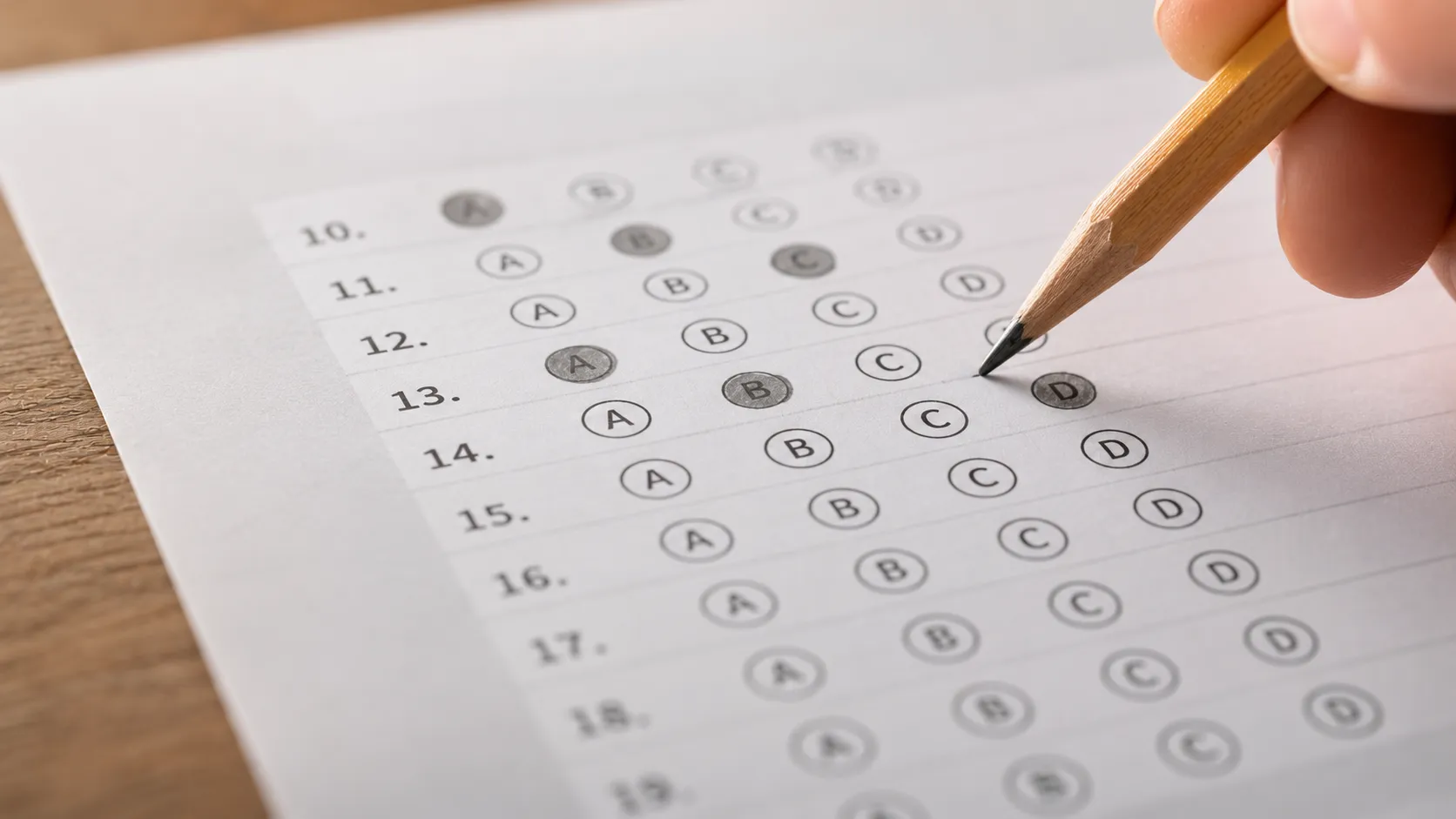
Short answer: the Canadian citizenship test has 20 questions. You need to answer at least 15 correctly, that is 75%, to pass.
That is the number everyone looks for first, and it is a good place to start. But a few details around that number matter just as much for your prep: the exact question format, the pass mark, the time you get, how many attempts are allowed, and how the topics are spread out. This article walks through each of those points, then explains why practicing hundreds of questions is still the smartest strategy even though the real exam only asks 20.
The format at a glance
The test is made up of 20 questions, all multiple-choice or true or false, drawn from the official Discover Canada study guide. There are no essays, no long-answer questions, and no hidden trick questions. Each item gives you a clear statement and a short list of possible answers, and you pick the correct one. That consistent format is good news: it is perfectly suited to practice, because you can recreate the exact same conditions at home.
Since 2020, most applicants take the exam online, from home, on a computer. You log into a secure platform, confirm your identity, and the 20 questions appear one at a time. A paper version still exists in some situations, but the content and the scoring are identical either way: 20 questions, 15 correct answers to pass.
The pass mark: how many you need
You need 15 correct answers out of 20, which is exactly 75%, to pass the citizenship test. That is the official pass mark, and it does not change by province or by test version. In practical terms, you can get up to five questions wrong and still earn your passing score.
That five-mistake cushion can feel comfortable, but it shrinks fast if you skimmed a few chapters. A single surprise question about parliamentary institutions or a historical date can eat into your margin. So the goal of good preparation is not to scrape by at exactly 15, but to land consistently around 18, 19, or 20 on mock exams, so you walk into test day with a real safety buffer.
Time allowed and number of attempts
For the online test, you get 45 minutes to answer the 20 questions, and you are allowed a maximum of three attempts. Forty-five minutes for twenty questions works out to more than two minutes each, which is plenty of time to read every statement calmly, think, and choose. Most well-prepared applicants finish well before the timer runs out.
The three attempts are a safety net, not an invitation to wing it. If you fail the first time, you can retake the test, but nothing replaces solid preparation from the start. Treating every mock exam as if it were your only shot puts you in the right frame of mind and cuts down the stress on the real day.
What the 20 questions cover
The 20 questions come from five broad topics, but history and government carry noticeably more weight than the rest. Here is the rough breakdown that most applicants plan around:
- History (the largest share): Indigenous peoples, the arrival of Europeans, Confederation in 1867, the major wars, and key historical figures.
- Government (the second-heaviest share): constitutional monarchy, Parliament, the roles of the prime minister, members of Parliament, and the governor general, and how elections work.
- Rights and responsibilities: the fundamental freedoms in the Charter, the right to vote, and citizen duties such as serving on a jury and obeying the law.
- Geography: provinces and territories, capital cities, regions, and the country's main physical landmarks.
- Symbols: the flag, the national anthem, the beaver, the maple leaf, official holidays, and national emblems.
Because history and government dominate, those are the two chapters that deserve the most of your study time. That does not mean ignoring geography or symbols: a handful of questions depend on them, and in a test where only five mistakes make the difference, every point counts. But if you have to decide where to start, start with history and institutions.
Where the questions come from
Every question on the real test is pulled from the official Discover Canada study guide, the one document you need to master. The government publishes it for free, and you can check the official citizenship test page on canada.ca for the current rules. No question comes from outside that guide, which draws a clear boundary around exactly what you have to learn.
That is a reassuring limit: the syllabus is finite and known in advance. The real work is turning passive reading of the guide into fast, automatic answers, and that is precisely where practicing lots of questions makes the difference.
Why practicing hundreds of questions helps
Even though the real test only asks 20 questions, those 20 are drawn from a large pool covering the whole guide, so no two tests are identical. You cannot guess which 20 questions will appear. The only reliable defense is to cover all the ground ahead of time, so that whatever comes up, you have already seen the topic.
Practicing hundreds of questions gives you three concrete advantages. First, exposure: you see each fact from several angles and wordings, which locks it into memory far better than rereading. Second, speed: answering becomes automatic and you stop wasting time second-guessing. Third, weak-spot detection: every mistake flags a chapter to review before it costs you a point on the real exam.
You can work through 650+ practice questions for free to cover every topic the real 20 could be drawn from. The more you vary the wording and the chapters, the less room there is for surprise.
Never leave a question blank
There is no penalty for a wrong answer, so you should answer every one of the 20 questions, even when you are unsure. A blank counts as a mistake, exactly like a wrong answer. A guess, on the other hand, gives you a chance to be right, and often more than a chance if you first rule out the options that are clearly wrong.
The right method: read the statement, eliminate the answers you know are wrong, then pick the most likely one that remains. Even an educated guess beats a blank. With 45 minutes for 20 questions, you also have time to come back to any flagged questions before you submit.
How to know if you are ready
The only real way to know if you would pass is to simulate the actual test: 20 questions, timed, scored out of 20. Take a free mock exam and see your score instantly. If you are hitting 15 or more consistently across several attempts, not just once by luck, you are ready.
One good score is not enough to conclude. Aim for consistency: three or four mock exams in a row above the pass mark, ideally around 18 out of 20, show that your knowledge holds and does not depend on a lucky draw. That cushion is what protects you from an unexpected question on the day.
If you are not there yet, study the weak areas chapter by chapter, giving priority to history and government, then come back to the mock exam until you are clearing the pass mark comfortably. Alternating between targeted review and full simulation is the most effective way to move from "I roughly know this" to "I pass every time."
The numbers to remember
To sum up, the test has 20 questions, you need 15 correct to pass, you get 45 minutes, and you have up to three attempts. Those four numbers are enough to frame your entire preparation: they tell you what score to aim for, how quickly to answer, and how much room you have if things go wrong.
Around those numbers, one simple rule guides your study: because the 20 questions can come from any part of the Discover Canada guide, practice broad rather than narrow. Cover history and government first, answer every question even by elimination, and use mock exams as a thermometer. The day you clear 15 without thinking, several times in a row, is the day you are truly ready to sit the official exam.