
Canadian Citizenship for Children: How It Works
Canadian citizenship for children: a parent applies for the minor, with no test or language proof, and usually a Canadian-citizen parent involved.
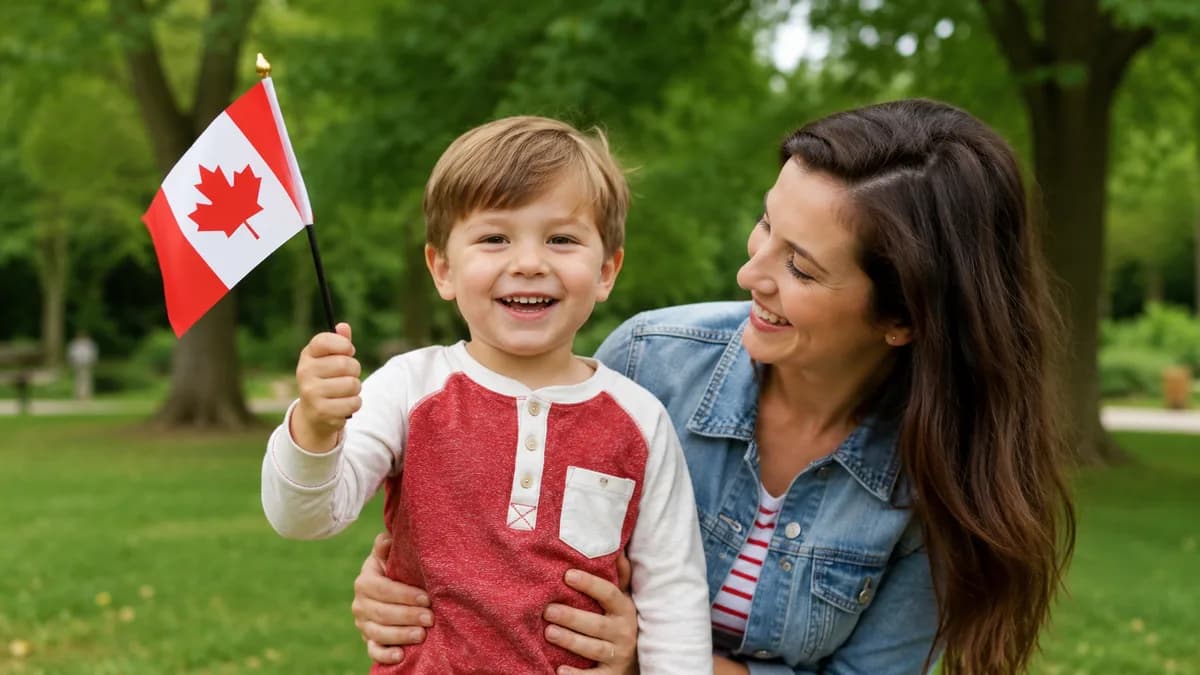
A child under 18 can become a Canadian citizen, and in almost every case a parent or legal guardian applies for them, not the child. The minor does not take the citizenship test and does not have to prove ability in English or French. These rules are part of the citizenship eligibility requirements. This stays a general guide: the official, up-to-date source is canada.ca, which you should check before you file.
Who qualifies: the child and the parent
A child's eligibility depends mainly on their immigration situation and on their parents' status. One point comes up in almost every case: the link to a parent who is a citizen or is on the way to becoming one. A minor does not build eligibility alone the way an adult does by counting days of presence in Canada. The child's application rests on a parent's application or on a status already held.
In practice, several profiles exist. A child born in Canada is already a citizen from birth, apart from rare exceptions tied to diplomatic staff. A child born outside Canada to a Canadian parent may also be a citizen already by descent, subject to the first-generation limit. Finally, a child who immigrated to Canada as a permanent resident can apply for a grant of citizenship with a parent's help. These situations use different forms, so it matters to identify yours correctly.
The two most common paths
Two routes come up most often: the child of a citizen who may already be a citizen, and the permanent-resident child who applies for citizenship with a parent. Knowing which one applies to you keeps you from filling out the wrong form.
First path, the child of a Canadian parent. If the child was born abroad and a parent was a Canadian citizen at the time of birth, the child is often already a citizen with no new grant needed. In that case the family does not apply for citizenship but for proof of citizenship, also called a citizenship certificate, which serves as the official document. If that parent was themselves born abroad, Bill C-3, in force since December 15, 2025, applies: a child born before that date is a citizen, and a child born later is one if the parent can show 1,095 days of presence in Canada before the birth. Check canada.ca to see whether your child is affected.
Second path, the permanent-resident child. If the child lives in Canada as a permanent resident, the family files a grant of citizenship application for a minor. In most cases a parent must already be a citizen or must apply for citizenship at the same time as the child. This is the typical route for families who immigrated together and then obtain citizenship a few weeks apart.
What is not required of a minor
A child's application is much lighter than an adult's: several major obligations simply do not apply. This is one of the most reassuring differences for parents.
- No knowledge test about Canada for those under 18.
- No language proof at CLB/NCLC 4 for the minor.
- A parent or guardian submits and signs the application for the child.
- Physical presence in Canada may be handled differently, or even waived, for a minor applying with a parent.
- The Oath of Citizenship is only required from age 14, at the ceremony.
The age thresholds that trigger or lift each obligation are gathered in our guide on citizenship age requirements. Keep the general logic in mind: the younger the child, the more the process rests on the parent, and the fewer personal steps the child has to complete.
The citizen-parent condition
For the grant path, the child must generally have a parent who is already a Canadian citizen, or a parent who is applying for citizenship at the same time. This rule links the child's application to a parent's and explains why so many families file together.
This condition has practical effects. If no parent is a citizen yet, it often makes sense for the eligible parent to file their own application first, or in parallel. The child's application can then attach to it. Special situations exist, including a single parent, a legal guardian, or shared custody. These are not dead ends, but they call for extra documents: always check the details on canada.ca before you file.
If you are preparing your own adult application at the same time, you can already practise for the citizenship test while the family file comes together, then shore up weak spots with the chapter quizzes.
The documents to gather
A minor's file rests mainly on identity documents and on proof of the link to a citizen or applicant parent. Gathering these papers early is often the step that takes the longest.
Depending on the path, the requested documents can vary, but the following items appear often:
- The child's birth certificate or an equivalent document establishing the parent-child link.
- Proof of the child's status: a permanent resident card or confirmation of permanent residence, as applicable.
- Proof of the parent's citizenship or a copy of the parent's application filed at the same time.
- Photos that meet the official requirements.
- Custody or guardianship documents if the parents are separated or a legal guardian is applying.
- Certified translations for any document that is not in English or French.
The exact list appears in the instruction guide for the minor application form on canada.ca. Follow that list rather than a general one, because the required documents change and depend on each family's situation.
Who signs and the fees for a minor
A parent or legal guardian signs the application on the child's behalf, and the fees for a minor are usually lower than those for an adult. These are two questions parents almost always ask.
On signing, a very young child does not sign anything: the parent or guardian completes and signs the minor form. With shared custody, it is wise to make sure the other parent is aware and, if needed, to include the custody documents. On fees, a citizenship application carries a government fee, but the amount set for a minor is usually lower than for an adult. Because fees change, check the official fee schedule on canada.ca when you pay rather than relying on an amount seen elsewhere. In every case, the fee is usually paid online when you submit the application, and you should keep the receipt with your records. If a payment is missed or made incorrectly, the authorities may return the file, which delays everything, so double-check the amount before you send it.
After filing, the family receives an acknowledgement, then a notice for the ceremony if everything is in order. That is a good time to study together: our review sessions help the adult parent lock in what they have learned before the ceremony.
Adoption and other special cases
A child adopted by a Canadian citizen may have access to a dedicated process, separate from the ordinary grant application. Canada provides a path specific to adoption, meant to recognize the parent-child link while respecting the adoption rules of the country of origin and the province.
This path does not follow exactly the same steps as a permanent-resident child's application. Adoption documents, decisions by provincial authorities, and sometimes extra checks play a central role. Other cases also call for special attention: a child under guardianship, a single parent, or a family where only one parent obtains citizenship. None of these cases bars a child from becoming a citizen in principle, but each adds documents and sometimes time. Here again, rely on the official instructions for the relevant form rather than on general rules, because the details change with each family's situation.
One last practical tip: keep copies of everything you send and note the key dates. A well-organized file makes it easier to deal with the authorities if a document is missing or a clarification is requested, and it helps you track your child's application without needless stress.
Also remember to keep your contact details current throughout processing. If your family moves or changes a phone number between filing and the ceremony, let the authorities know so you do not miss an important notice. Processing times vary with the season and the volume of applications, so avoid relying on the timeline another family reports and instead track the status of your application with the official tools listed on canada.ca.