
Canadian Citizenship Test Cheat Sheet: Key Facts to Memorize
A quick Canadian citizenship test cheat sheet of the most commonly tested facts, key dates, government basics, and symbols, plus free practice to lock them in.
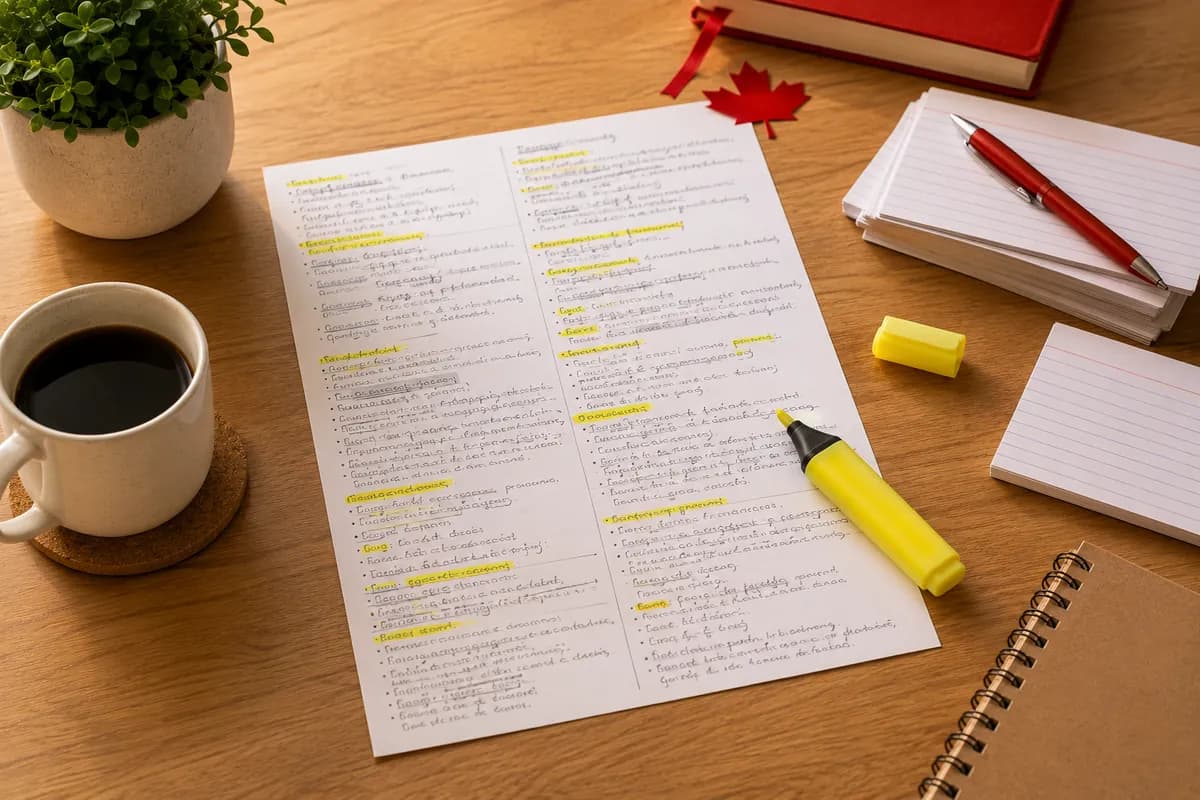
Focus your final review on a short set of high-yield facts, then drill them until recall is automatic: the Sovereign and the Governor General, how Parliament and the Prime Minister work, the three branches and three levels of government, Confederation in 1867 and the founding provinces, the provinces and territories with their capitals, the national symbols, your rights and responsibilities, and a handful of pivotal dates. Together these cover the ground that most citizenship test questions come from.
Note: cheat sheet here means a study aid for memorizing key facts before the test. You cannot use any notes during the actual test.
How to use this cheat sheet
The official Canadian citizenship test has 20 questions, gives you 45 minutes, and requires 15 correct answers out of 20 (75%) to pass. Every question is based on the official study guide, Discover Canada. This cheat sheet does not replace that guide. Think of it as a map of the facts that appear most often, so your last few study sessions stay focused instead of scattered.
Use it actively. Read one theme, cover the answers, and try to say each fact out loud before you check it. When a group of facts feels solid, switch to questions so you practice recall the way the test demands. A good rhythm is to review a theme here, then take a timed practice test that mixes topics the way the real exam does.
The Crown: Canada's head of state
Canada is a constitutional monarchy, so the country's head of state is the Sovereign, currently King Charles III. The King does not run the government day to day. Instead, he is represented in Canada by the Governor General at the federal level and by a Lieutenant Governor in each province. Knowing the difference between the head of state and the person who represents them is one of the most reliable ways to earn marks.
- King Charles III is the Sovereign and Canada's head of state
- The Governor General represents the Sovereign at the federal level
- A Lieutenant Governor represents the Sovereign in each province
- Canada is a constitutional monarchy, meaning the monarch reigns but does not rule
- The Sovereign is a symbol of Canadian sovereignty, a guardian of constitutional freedoms, and a reflection of Canada's history
The Prime Minister and how government works
The Prime Minister is the head of government, the person who actually leads the country's affairs, and this is a different role from the head of state. After a federal election, the leader of the party that wins the most seats in the House of Commons is usually asked to form the government and becomes Prime Minister. The Prime Minister chooses the Cabinet ministers, who are responsible for running government departments and answering to Parliament.
- The Prime Minister is the head of government and leads the Cabinet
- The party with the most seats in the House of Commons normally forms the government
- Cabinet ministers are usually Members of Parliament chosen by the Prime Minister
- Members of Parliament (MPs) are elected by voters to the House of Commons
- Canada is a parliamentary democracy, where citizens elect representatives to make laws
The three branches and three levels of government
Two sets of threes trip candidates up, so keep them separate in your mind. The three branches describe how power is divided (making, carrying out, and interpreting laws), while the three levels describe who governs what across the country. Expect at least one question on each.
- Executive: the Sovereign and Governor General, plus the Prime Minister and Cabinet, who carry out laws
- Legislative: Parliament, made up of the Sovereign, the Senate, and the House of Commons, which makes laws
- Judicial: the courts, which apply and interpret the law
- Federal: the national government in Ottawa, responsible for matters like defence, citizenship, and foreign policy
- Provincial or territorial: responsible for areas such as education, health care, and highways
- Municipal: local and regional governments, responsible for services like snow removal, recycling, and firefighting
Confederation and the founding provinces
Confederation took place on July 1, 1867, when the British North America Act joined the first provinces into the Dominion of Canada. This is the single most tested date, and it also explains why Canada Day is celebrated on July 1. Remember the four founding provinces and the reason the date matters.
- July 1, 1867: Confederation creates the Dominion of Canada
- The founding provinces were Ontario, Quebec, Nova Scotia, and New Brunswick
- The British North America Act (now the Constitution Act, 1867) united them
- Sir John A. Macdonald became Canada's first Prime Minister
- Canada's national holiday, Canada Day, marks this date each year
Provinces, territories, and their capitals
Capital-city questions are pure memory, which makes them some of the easiest marks to secure if you drill them. Canada has ten provinces and three territories, and the national capital is Ottawa. Group them by region so they are easier to hold in memory.
- Ontario, capital Toronto
- Quebec, capital Quebec City
- Nova Scotia, capital Halifax
- New Brunswick, capital Fredericton
- Prince Edward Island, capital Charlottetown
- Newfoundland and Labrador, capital St. John's
- Manitoba, capital Winnipeg
- Saskatchewan, capital Regina
- Alberta, capital Edmonton
- British Columbia, capital Victoria
- Northwest Territories, capital Yellowknife
- Nunavut, capital Iqaluit
- Yukon, capital Whitehorse
Discover Canada also groups the country into five regions: the Atlantic Provinces, Central Canada, the Prairie Provinces, the West Coast, and the Northern Territories. If you know which province sits in which region, questions about geography become much easier.
National symbols
National symbols are among the most recognizable topics on the test, and they come up often. The maple leaf is Canada's best-known symbol, and it sits at the centre of the national flag. Learn the anthem and the main official emblems.
- The maple leaf is Canada's most recognized symbol
- The national flag, red and white with a single red maple leaf, was first raised in 1965
- O Canada is the national anthem, proclaimed official in 1980
- The beaver is an official emblem, tied to the early fur trade
- The coat of arms and the motto A Mari Usque Ad Mare (from sea to sea) are official symbols
- Red and white are Canada's official colours
Rights, responsibilities, and official languages
Rights and responsibilities are two sides of citizenship, and the test checks that you can tell them apart. Your rights are protected by the Canadian Charter of Rights and Freedoms, part of the Constitution since 1982, while responsibilities are the duties every citizen shares. Canada also has two official languages, and that fact appears regularly.
- Fundamental freedoms: conscience and religion, thought and expression, peaceful assembly, and association
- Mobility rights: the right to live and work anywhere in Canada
- Legal rights and equality rights under the law
- Official language rights and multiculturalism
- Obeying the law
- Serving on a jury when called
- Voting in elections
- Helping others in the community and protecting the environment
Canada's two official languages are English and French. They have equal status in Parliament and throughout the federal government, and this equality is a defining feature of the country.
Pivotal dates to memorize
A few dates carry more weight than the rest. If you learn these cold, you protect yourself against some of the most common history questions.
- 1867: Confederation, Canada becomes a country
- 1812: the War of 1812 against invasion from the United States
- 1917: the Battle of Vimy Ridge in the First World War
- 1982: the Constitution is patriated and the Charter of Rights and Freedoms is added
- 1965: the current national flag is raised for the first time
- 1980: O Canada becomes the official national anthem
Do not just read it, drill it
A cheat sheet helps you recognize facts, but the test requires you to recall them under time pressure. The way to convert this list into reliable knowledge is to practice questions on each fact until the answers are automatic.
Practice real-style questions on these topics, over 650 of them, free and with no signup, so the facts above become second nature. Then study any weak area chapter by chapter to fill the gaps this cheat sheet does not cover, and take a full timed practice test to rehearse the real format. To understand the reasoning behind the answers, see worked examples with explanations.
Remember: this list is a starting point for your final review, not the whole syllabus. The real test can draw from across the entire Discover Canada guide, so treat the cheat sheet as a focus tool, not a replacement for reading it.